Active/Passive Avoidance Shuttle Box
Dual-compartment behavioral apparatus for studying active and passive avoidance learning in rodents, featuring independent shock grids, audio, and lighting controls with configurable visual contexts.
| exterior_dimensions_small | 22cm x 22cm x 25cm |
| exterior_dimensions_large | 30cm x 30cm x 30cm |
| grid_dimensions_small | 20cm x 20cm |
| grid_dimensions_large | 27cm x 27cm |
| sound_frequency_range | 100-40,000Hz |
| sound_intensity_range | 1-150dB |

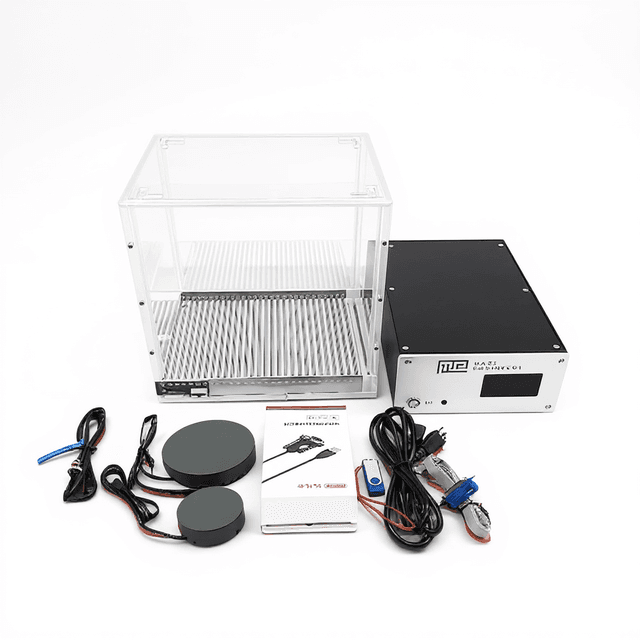
The Active/Passive Avoidance Shuttle Box is a dual-compartment behavioral apparatus designed for studying associative learning, memory formation, and avoidance behaviors in rodents. The system features two independently controlled chambers with removable acrylic plating that allows researchers to configure visual contexts for different experimental paradigms. Each compartment is equipped with independent shock grids, audio speakers, and lighting systems, enabling precise control over aversive and conditioned stimuli.
This apparatus supports both active avoidance paradigms (where animals learn to move between compartments to avoid aversive stimuli) and passive avoidance protocols (where animals learn to remain in a specific location). The modular design accommodates both mouse and rat studies, with adjustable chamber dimensions and contextual plating configurations. Independent control systems for each compartment allow for sophisticated experimental designs including discrimination learning, extinction protocols, and memory consolidation studies.
How It Works
The shuttle box operates on principles of classical and operant conditioning, where animals learn to associate environmental cues with aversive stimuli and modify their behavior accordingly. In active avoidance protocols, animals learn to shuttle between compartments in response to conditioned stimuli (typically auditory or visual cues) to avoid or escape mild electric shocks delivered through the grid floor. The temporal relationship between conditioned stimulus presentation and shock delivery determines the learning paradigm.
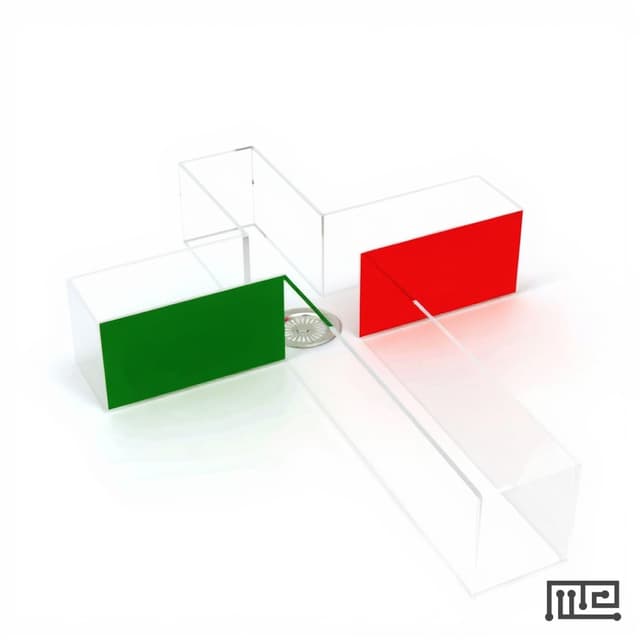
Passive avoidance protocols utilize the natural exploratory behavior of rodents, where animals initially explore both compartments but learn to avoid the compartment previously associated with aversive stimuli. The configurable acrylic plating creates distinct visual contexts that serve as discriminative cues, with black/black configurations typically used for active avoidance and white/black configurations for passive avoidance paradigms.
Independent control systems for each compartment enable sophisticated experimental designs including discrimination learning, where animals must distinguish between safe and aversive contexts, and reversal learning protocols that assess behavioral flexibility and memory updating mechanisms.
Features & Benefits
exterior_dimensions_small
- 22cm x 22cm x 25cm
exterior_dimensions_large
- 30cm x 30cm x 30cm
grid_dimensions_small
- 20cm x 20cm
grid_dimensions_large
- 27cm x 27cm
sound_frequency_range
- 100-40,000Hz
sound_intensity_range
- 1-150dB
shock_current_range
- 0.1-4.0mA
shock_current_steps
- 0.1mA increments
shock_current_type
- DC Current
audio_channels
- 2 independent channels
light_controls
- 2 independent light controls
light_types
- Visible and IR light dual bulb
grid_type
- Removable Grid
shock_grid_control
- 2 Independent
white_noise_generator
- included in default Software
Behavioral Construct
- active avoidance
- passive avoidance
- aversive learning
- fear conditioning
- associative learning
- memory consolidation
- discrimination learning
- escape learning
Automation Level
- semi-automated
Material
- Acrylic
Color
- Black
- White
Dimensions
- 18cm / 25cm x 18cm / 25cm x 20cm / 25cm
Research Domain
- Aging Research
- Anxiety and Depression
- Behavioral Pharmacology
- Learning and Memory
- Neurodegeneration
- Neuroscience
Species
- Mouse
- Rat
Weight
- 21.0 kg
Dimensions
- L: 43.2 mm
- W: 38.0 mm
- H: 27.9 mm
Comparison Guide
| Feature | This Product | Typical Alternative | Advantage |
|---|---|---|---|
| Audio Frequency Range | 100-40,000Hz with dual independent channels | Basic models often limited to audible frequencies with single channel output | Enables ultrasonic conditioning protocols specific to rodent hearing ranges while supporting complex auditory discrimination tasks. |
| Shock Current Control | 0.1-4.0mA in 0.1mA increments with DC delivery | Fewer intensity steps with AC current systems common in entry-level models | Provides precise stimulus titration for individual animal sensitivity and eliminates AC artifacts in physiological recordings. |
| Visual Context Configuration | Removable acrylic plating with black/black, white/black, and clear options | Fixed chamber configurations requiring separate apparatus for different protocols | Enables rapid protocol switching between active and passive avoidance paradigms using the same apparatus. |
| Lighting System | Independent visible and IR dual bulb controls for each compartment | Single lighting mode with limited compartment-specific control | Supports simultaneous behavioral observation under IR while delivering visible light as conditioned stimuli. |
| Software Integration | Conductor Science Software with Neuralynx and Ethovision integration | Basic data logging software with limited analysis capabilities | Eliminates separate I/O boxes while providing comprehensive data analysis and third-party system integration. |
| Species Adaptability | Configurable dimensions for both mouse and rat studies | Species-specific models requiring separate apparatus for different rodent types | Provides cost-effective solution for multi-species research programs with optimized scaling for each species. |
This system offers comprehensive stimulus control capabilities with precise parameter adjustment, configurable visual contexts, and software integration that supports complex behavioral paradigms. The dual-species compatibility and modular design provide experimental flexibility beyond fixed-configuration alternatives.
Practical Tips
Verify shock grid conductivity before each experimental session by measuring current delivery at multiple intensity settings with a digital multimeter.
Why: Ensures consistent aversive stimulus delivery and prevents learning deficits due to inadequate shock intensities.
Clean shock grids with alcohol-based disinfectants and allow complete drying before reassembly to prevent current leakage.
Why: Maintains electrical safety and prevents cross-contamination between animal subjects.
Randomize chamber assignment across subjects and counterbalance which compartment serves as the aversive zone to control for spatial biases.
Why: Eliminates apparatus-related confounds that could influence learning performance independent of experimental manipulations.
If animals show reluctance to cross between compartments, reduce shock intensity and verify that grid spacing provides adequate foot contact.
Why: Ensures aversive stimuli are perceived consistently while preventing tissue damage or excessive stress responses.
Record baseline activity patterns in both compartments before conditioning to establish individual exploration preferences.
Why: Provides reference data for normalizing learning scores and identifying animals with pre-existing spatial biases.
Use infrared lighting during behavioral sessions to minimize stress responses while maintaining adequate observational conditions.
Why: Reduces anxiety-inducing visual stimuli that could confound learning measurements while preserving data collection quality.
Allow 5-10 minutes of habituation in the apparatus before beginning conditioning trials to reduce novelty-induced behaviors.
Why: Establishes consistent baseline activity levels and improves signal-to-noise ratio in learning measurements.
Monitor trial-by-trial latencies to identify plateau phases and determine when learning criteria have been achieved.
Why: Enables objective determination of acquisition endpoints and prevents overtraining that could obscure treatment effects.
Setup Guide
What’s in the Box
- Dual-compartment shuttle box apparatus
- Two removable shock grid assemblies
- Black/black acrylic plating set
- White/black acrylic plating set
- Dual control speaker systems
- Dual control lighting assemblies
- Top lid assembly
- Power and control cables
- User manual and protocol guide (typical)
- Conductor Science Software license (typical)
Warranty
ConductScience provides a standard one-year manufacturer warranty covering defects in materials and workmanship, with technical support for setup and protocol optimization.
Compliance
References
Background reading relevant to this product:
What shock intensities are appropriate for mouse versus rat studies?
The system provides 0.1-4.0mA range in 0.1mA increments. Mice typically require 0.2-0.8mA while rats generally use 0.5-2.0mA, depending on strain sensitivity and experimental requirements. Pilot studies should establish minimum effective intensities for each cohort.
Can the apparatus support simultaneous physiological recordings?
Yes, the DC current shock delivery system minimizes electrical artifacts that could interfere with concurrent electrophysiological recordings. The infrared lighting option enables behavioral monitoring without visible light artifacts.
How do I configure chambers for discrimination learning protocols?
Use the white/black acrylic plating configuration to create distinct visual contexts. Independent control of audio, lighting, and shock systems in each compartment enables complex discrimination paradigms with compartment-specific stimulus associations.
What data outputs are available for learning curve analysis?
Integration with Conductor Science Software provides trial-by-trial latency measurements, crossing frequencies, and time spent in each compartment. Custom analysis protocols can track acquisition curves and extinction patterns.
How should I clean the apparatus between subjects?
Remove shock grids for thorough cleaning with appropriate disinfectants. Acrylic plating can be removed and sanitized separately. Allow complete drying before reassembly to prevent electrical complications.
What environmental controls are necessary for consistent results?
A sound attenuation chamber (sold separately) is recommended to control ambient noise. Maintain consistent temperature and lighting conditions, as these factors can influence baseline activity levels and learning rates.
Can I modify stimulus timing parameters for different learning protocols?
Yes, the system supports programmable stimulus timing sequences through the software interface. Configure conditioned stimulus-unconditioned stimulus intervals from milliseconds to minutes depending on experimental design.
How does this compare to single-compartment passive avoidance systems?
The dual-compartment design enables both active and passive avoidance protocols within the same apparatus. This provides greater experimental flexibility and allows for more complex behavioral paradigms than single-compartment systems.
Have a question about this product?
Accessories
Enhance your setup with compatible accessories

Upgrade Options