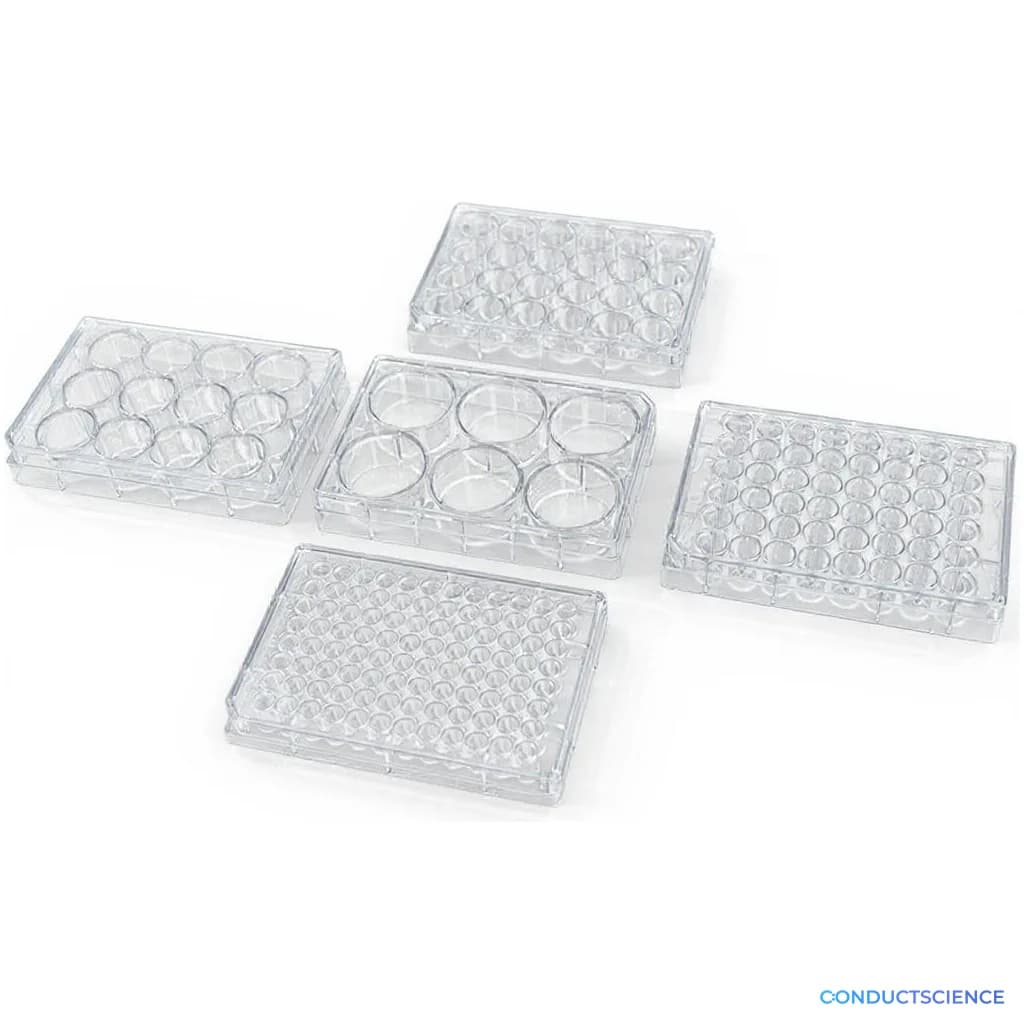
ConductScience Cell Culture Plates, 6-Well, TC-Treated (Case of 10)
$89.00 per unit | 10 units per pack Bulk pricing: Case of 10 at $890.00 ($89.00 per unit)
6-well cell culture plates designed for routine cell biology applications requiring controlled growth conditions. Features tissue culture-treated polystyrene surface to promote cell attachment and proliferation. Flat-bottom well design provides uniform growth surface and optical clarity for microscopic observation and imaging applications.
Sterile, non-pyrogenic construction eliminates contamination risk during cell culture workflows. Low-evaporation lid design minimizes media volume loss during extended incubation periods. Compatible with standard laboratory incubators, microscopes, and automated liquid handling systems commonly used in cell biology research.
How It Works
Tissue culture-treated polystyrene surface undergoes plasma oxidation to introduce polar functional groups that enhance hydrophilicity and promote protein adsorption. This surface modification creates favorable conditions for cell attachment through integrin-mediated adhesion mechanisms. The negatively charged surface attracts serum proteins from culture media, forming a conditioning layer that facilitates cell spreading and proliferation.
Flat-bottom well geometry provides uniform surface area for consistent cell density and growth patterns. The 9.6 cm² growth area per well accommodates typical seeding densities for most adherent cell types. Low-evaporation lid design incorporates condensation rings that minimize media volume loss through vapor exchange while maintaining gas permeability for CO₂ equilibration during incubation.
Sterile gamma irradiation eliminates microbial contamination without affecting surface chemistry or optical properties. Non-pyrogenic certification ensures absence of endotoxins that could activate immune responses in sensitive cell cultures, particularly important for primary cell work and immunological studies.
Features & Benefits
Research Domain
- Cancer Research
- Cell Biology
- Developmental Biology
- Immunology
- Microbiology
- Pharmaceutical QC
- Toxicology
Weight
- 632.15 lbs
Dimensions
- L: 30.0 in
- W: 25.0 in
- H: 20.0 in
Comparison Guide
| Feature | This Product | Typical Alternative | Advantage |
|---|---|---|---|
| Well Volume Capacity | 2-3 mL working volume per well | Entry-level plates often offer smaller volumes with limited scalability | Larger volumes accommodate higher cell densities and allow for media sampling without compromising culture conditions |
| Surface Treatment | Tissue culture-treated polystyrene surface | Basic models may lack surface modification | Enhanced cell attachment and proliferation across diverse cell types without additional coating steps |
| Lid Design | Low-evaporation lid with condensation management | Standard lids offer basic coverage without evaporation control | Maintains media stability during extended incubation periods, reducing variability in experimental conditions |
| Sterility Assurance | Gamma-irradiated, non-pyrogenic certified | Basic sterilization methods vary by manufacturer | Eliminates contamination risk and endotoxin interference, critical for sensitive cell culture applications |
| Well Geometry | Flat-bottom design for uniform cell distribution | Round-bottom options available for specific applications | Optimal for microscopic observation and adherent cell culture with consistent growth patterns |
This 6-well plate combines TC-treated surface chemistry with low-evaporation lid design and sterile packaging to provide reliable cell culture performance. The flat-bottom geometry and standard footprint ensure compatibility with automated systems while accommodating applications requiring larger well volumes and cell densities.
Practical Tips
Allow refrigerated plates to equilibrate to room temperature before adding warm media to prevent thermal shock and condensation formation.
Why: Temperature gradients can affect cell attachment and create optical interference during microscopy.
Store unused plates in original packaging at room temperature away from direct light and heat sources.
Why: Exposure to UV light or elevated temperatures can degrade surface treatment and plastic properties.
Use consistent seeding patterns across wells and document well positions for reproducible results in multi-condition experiments.
Why: Positional effects from incubator gradients or handling variations can introduce systematic bias in results.
Always work within biological safety cabinet when handling cell cultures and dispose of used plates according to biohazard waste protocols.
Why: Prevents contamination of cultures and protects laboratory personnel from potential biological hazards.
If cells show poor attachment, verify media pH and osmolarity, and check for endotoxin contamination in reagents.
Why: Media chemistry changes can overcome surface treatment benefits and inhibit normal cell adhesion mechanisms.
Pre-equilibrate culture media CO₂ levels before seeding to minimize pH shifts that affect cell behavior immediately post-seeding.
Why: pH fluctuations during initial attachment period can reduce cell viability and alter experimental outcomes.
Document incubation conditions and media lot numbers for each experiment to enable troubleshooting of culture variability.
Why: Batch-to-batch variation in media components or incubator performance can significantly impact cell culture results.
Setup Guide
What’s in the Box
- 6-well cell culture plates (50 per pack)
- Individual sterile packaging
- Product documentation (typical)
Warranty
ConductScience provides standard warranty coverage against manufacturing defects. Technical support available for application guidance and troubleshooting.
Compliance
What seeding density should I use for different cell types in these 6-well plates?
Seeding density varies by cell type and experimental goals. For adherent cell lines, typical range is 2×10⁵ to 5×10⁵ cells per well for routine culture, or 1×10⁴ to 5×10⁴ for growth curve analysis. Primary cells may require higher initial densities for optimal attachment.
Can these plates be used for both adherent and suspension cell cultures?
While designed primarily for adherent cells with TC-treated surface, they can accommodate suspension cultures. However, flat-bottom geometry may not provide optimal mixing compared to round-bottom plates specifically designed for suspension culture applications.
What is the maximum incubation time before media evaporation becomes significant?
Low-evaporation lid design typically maintains stable volumes for 7-10 days under standard incubation conditions (37°C, 5% CO₂, 95% humidity). Monitor volume loss and osmolarity for longer experiments requiring media replacement.
Are these plates compatible with high-content imaging systems?
Flat, optically clear bottom provides excellent compatibility with automated microscopy systems. Standard footprint fits most high-content screening platforms, though verify specific dimensional requirements with your imaging system manufacturer.
Can I freeze cells directly in these plates for long-term storage?
Not recommended for cryopreservation. Polystyrene construction may crack during freeze-thaw cycles. Use specialized cryogenic vials or plates designed for ultra-low temperature storage instead.
What cleaning protocol should I use if plates need to be reused?
These are single-use, disposable plates designed for sterile applications. Reuse is not recommended as cleaning may compromise surface treatment and introduce contamination risk. Use fresh sterile plates for each experiment.
How do these compare to 96-well plates for drug screening applications?
6-well format provides larger culture volume and surface area, suitable for applications requiring more cells or media changes. 96-well plates offer higher throughput but smaller volumes. Choose based on assay requirements and cell number needs.
Have a question about this product?
Replacement Parts & Consumables
Upgrade Options
Related Products