ConductScience Cell Culture Plates, 12-Well, TC-Treated (Case of 10)
$85.00 per unit | 10 units per pack Bulk pricing: Case of 10 at $850.00 ($85.00 per unit)

Louise Corscadden, PhD
Director of Science · ConductScience
Ask Louise about ConductScience Cell Culture Plates, 12-Well, TC-Treated (Case of 10) fit, setup, configuration, or quote prep.
Already working with us? Sign in to connect this with My Scientist.
Key Specifications
Full details →- Model fit
- Configured during quote
- SKU family
- CS-CCP-12W-50
- Shipping box
- 30.0 x 25.0 x 20.0 cm
- Ordering
- Online checkout and quote request available
- Category
- Cell Culture
- Build notes
- Confirm accessories, station layout, and support needs before purchase
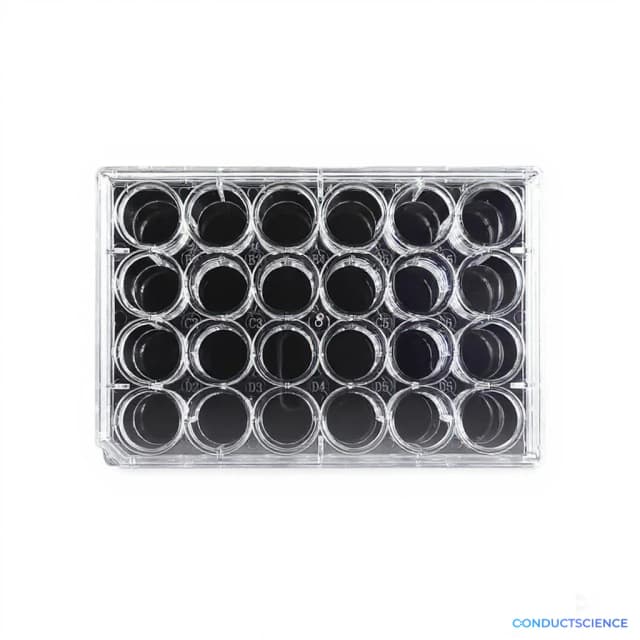
TC-treated 12-well cell culture plates provide a standardized platform for mammalian cell cultivation, offering consistent surface chemistry for reliable cell attachment and growth. The tissue culture treatment involves plasma oxidation of the polystyrene surface to increase hydrophilicity and introduce charged groups that promote protein adsorption and cell adhesion. Each well features a flat bottom geometry that facilitates uniform cell distribution and enables consistent microscopic observation across the culture surface.
The low-evaporation lid design minimizes medium loss during extended incubation periods, maintaining osmolarity and preventing concentration effects that can alter experimental conditions. Sterile packaging ensures aseptic handling and reduces contamination risk in cell culture workflows. The 12-well format provides an optimal balance between sample throughput and individual culture volume, accommodating experiments requiring multiple treatment conditions or time points while maintaining sufficient culture volume for downstream analyses.
How It Works
The tissue culture treatment process involves exposing polystyrene surfaces to oxygen plasma, creating hydroxyl and carboxyl functional groups that increase surface hydrophilicity. This chemical modification reduces the contact angle of aqueous solutions, allowing culture medium to spread evenly across the well bottom and facilitating uniform cell seeding density. The negatively charged surface groups attract positively charged regions of serum proteins, forming a conditioning layer that presents integrin-binding sites for cell attachment.
The flat-bottom well geometry ensures consistent optical path length for spectrophotometric measurements and provides uniform focal plane for microscopic observation. Medium depth remains consistent across the well surface, eliminating edge effects that can occur with meniscus formation in untreated surfaces. The low-evaporation lid incorporates design features that minimize air exchange while preventing condensation dropback, maintaining stable culture conditions during incubation periods.
Features & Benefits
Automation Level
- manual
Research Domain
- Cancer Research
- Cell Biology
- Developmental Biology
- Immunology
- Pharmaceutical QC
- Toxicology
Shipping weight
- 632.15 lb
Shipping box
- L: 30.0 cm
- W: 25.0 cm
- H: 20.0 cm
| Feature | This Product | Typical Alternative | Advantage |
|---|---|---|---|
| Well Configuration | 12 wells per plate | Entry-level formats often provide 6 or 24 wells | Balances sample throughput with adequate culture volume for downstream analyses |
| Surface Treatment | TC-treated polystyrene | Untreated surfaces require additional coating steps | Provides immediate cell attachment capability without additional preparation |
| Lid Design | Low-evaporation lid | Standard lids offer basic coverage | Maintains culture conditions during extended incubation periods |
| Sterilization | Pre-sterilized packaging | Some alternatives require user sterilization | Eliminates additional sterilization steps and reduces contamination risk |
These plates provide TC-treated surfaces for reliable cell attachment, low-evaporation lids for stable culture conditions, and sterile packaging for immediate use. The 12-well format offers optimal sample throughput while maintaining adequate culture volumes for experimental flexibility.
Practical Tips
Pre-warm plates to 37°C before cell seeding to prevent thermal shock and promote uniform cell attachment.
Why: Temperature equilibration prevents condensation and thermal gradients that can affect cell viability.
Store unopened plates in original packaging at room temperature away from direct sunlight.
Why: UV exposure can degrade the polystyrene surface and compromise sterility integrity.
Use consistent pipetting techniques and seeding patterns to ensure uniform cell distribution across wells.
Why: Uneven cell distribution creates experimental variability and affects quantitative measurements.
Handle all plates within appropriate biosafety containment levels based on cell line risk assessment.
Why: Cell culture work requires proper containment to prevent exposure to potentially hazardous biological materials.
If cells fail to attach properly, verify medium pH and serum concentration before suspecting surface treatment issues.
Why: Poor attachment is more commonly caused by medium conditions than surface chemistry problems.
Avoid stacking more than 10 plates to prevent weight-induced stress on lower plates during incubation.
Why: Excessive stacking can cause plate deformation and affect medium distribution.
Setup Guide
What’s in the Box
- 50 sterile 12-well cell culture plates
- Individual protective packaging
- Product documentation and certificates (typical)
Warranty
ConductScience provides standard warranty coverage against manufacturing defects, with technical support available for cell culture application guidance and troubleshooting.
Compliance
What is the optimal seeding density for primary cells in these wells?
Seeding density varies by cell type, but typically ranges from 50,000-200,000 cells per well for adherent cell lines. Primary cells may require lower densities to prevent overcrowding.
Can these plates be used for suspension cell cultures?
While designed for adherent cells, suspension cultures can be maintained in TC-treated plates, though untreated plates are preferred to prevent unwanted cell attachment.
What is the recommended medium volume per well?
Working volume typically ranges from 1-3 mL per well, with 2 mL being optimal for most applications to balance evaporation concerns with medium depth requirements.
Are these plates compatible with automated liquid handling systems?
Yes, the standard 12-well format follows SBS specifications and is compatible with most multichannel pipettes and robotic liquid handlers.
How long can cultures be maintained in these plates?
Culture duration depends on cell type and growth rate, but most adherent cell lines can be maintained for 5-7 days before requiring passage or medium changes.
Can the plates withstand centrifugation for cell harvesting?
The plates can tolerate low-speed centrifugation (typically up to 1000 x g) for cell pelleting, though individual well caps or sealing films should be used to prevent spillage.
Have a question about this product?
Have a question? Just ask.
Send it over and we'll email you a personalized answer — no call, no scheduling.
Prefer to talk it through?
Replacement Parts & Consumables
Upgrade Options
Related Products