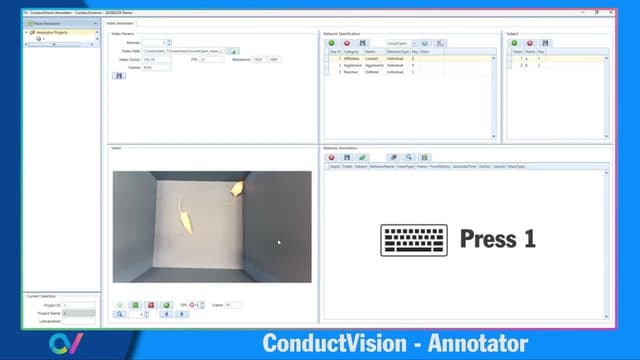
ConductVision: AI Driven Video Tracking
AI-powered video tracking for 18 rodent behavioral paradigms at 30+ fps. Includes Barnes Maze, Elevated Plus Maze, Morris Water Maze, Open Field, Y-Maze, T-Maze, Radial Arm Maze, and 11 more pre-configured tests. One license, multiple paradigms, m...
| operating_system_requirement | Windows 10+ |
| ram_requirement | 16 GB RAM |
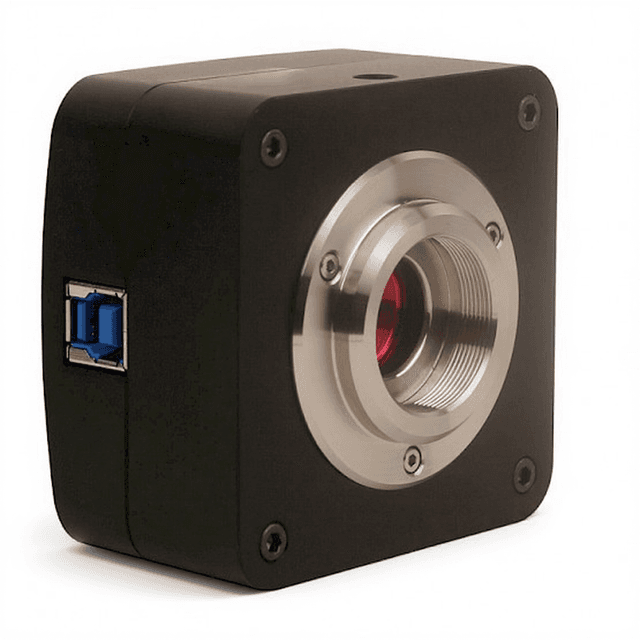
| camera_sensor | 1/3" CMOS |
| camera_type | Monochrome |
| frame_rate | Up to 76 images per second |
| supported_protocols | ['Novel object recognition', 'Alternation mazes', 'Fear conditioning', 'Y maze', 'T maze', 'Radial maze', 'Open field'] |
ConductVision — Rodent Maze Package
ConductVision’s Rodent Maze Package provides AI-driven video tracking across 18 pre-configured behavioral paradigms for mice, rats, and ferrets. Built on advanced machine learning that detects multiple key body points per subject — not just contour outlines — delivering tracking at 30+ frames per second compared to the 6–8 fps of traditional software.
Included Paradigms
| Paradigm | Key Metrics |
|---|---|
| Barnes Maze | Latency to target, quadrant counts, search strategy classification |
| Balance Beam | Foot slips, falls, traverse time |
| Conditioned Place Preference (CPP) | Time in compartments, preference score, entries |
| Elevated Plus Maze | Open/closed arm time, entries, head dip count |
| Elevated Zero Maze | Open/closed quadrant time, head dip count |
| Horizontal Ladder | Foot slips, falls, crossing time |
| Morris Water Maze | Escape latency, path length, swim speed, quadrant time |
| Light Dark Box | Time in light/dark, transitions, latency to enter |
| Open Field | Distance, velocity, center time, thigmotaxis, grooming, rearing |
| Open Field Set of 4 | Simultaneous 4-arena tracking with individual metrics |
| Novel Object Recognition | Exploration time, discrimination index, preference ratio |
| Novel Object Recognition Set of 4 | Simultaneous 4-arena NOR with individual discrimination indices |
| Puzzle Box | Latency to solve, attempts, strategy progression |
| Radial Arm Maze | User-defined arm entry, working/reference memory errors, re-entries |
| Sociability Chamber | Time with stranger vs. empty, social preference index |
| T-Maze | User-defined arm entry, alternation rate, latency |
| Tail Suspension | Immobility time, latency to first immobility, struggle bouts |
| Y-Maze | User-defined arm entry, spontaneous alternation %, entries |
Key Advantages
- 30+ fps tracking — 4–5× faster than traditional contour-based systems
- Multi-point body tracking — automatically detects key body points, not just outlines
- Batch processing — upload multiple videos simultaneously for overnight analysis
- Adapts to conditions — works across different lighting and camera setups
- Live or recorded — real-time video stream or .mp4/.avi file analysis
- Infrared compatible — track in dark cycle experiments
- CSV data export — ready for statistical analysis, custom output on request
- Seamless hardware integration — optimized for Conduct Science mazes
What’s Included
- ConductVision software license (1 computer)
- All 18 rodent maze paradigms listed above
- Free software updates
- 24/7 online support (phone, video call, on-site setup on request)
Need specialty paradigms? Add the Advanced Rodent Module for gait analysis, fear conditioning, social interaction (markerless), operant conditioning, and more. Zebrafish and Drosophila packages also available.
How It Works
ConductVision employs computer vision algorithms and machine learning models to automatically detect, track, and analyze rodent movement patterns from video recordings. The system uses a monochrome CMOS camera sensor to capture high-contrast images, which are processed through AI-driven tracking algorithms that identify the animal's position, orientation, and movement trajectories in real-time.
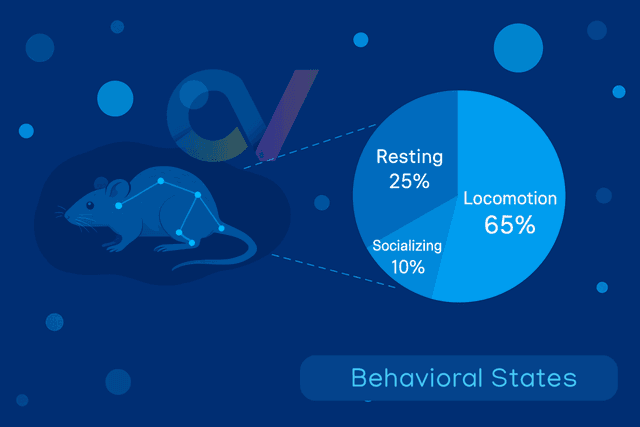
The software applies pre-trained behavioral recognition models to classify specific behaviors such as freezing, rearing, grooming, and exploration patterns based on movement characteristics and positional data. Automated zone detection algorithms define experimental areas (center, periphery, arms of mazes) and calculate time spent, entries, and path efficiency metrics without manual intervention.
Data processing occurs through frame-by-frame analysis where the AI system maintains continuous tracking of the subject's centroid position and body orientation, generating comprehensive behavioral datasets including distance traveled, velocity profiles, zone preferences, and protocol-specific measurements for immediate analysis and export.
Features & Benefits
operating_system_requirement
- Windows 10+
ram_requirement
- 16 GB RAM
camera_sensor
- 1/3" CMOS
camera_type
- Monochrome
frame_rate
- Up to 76 images per second
supported_protocols
- ['Novel object recognition', 'Alternation mazes', 'Fear conditioning', 'Y maze', 'T maze', 'Radial maze', 'Open field']
software_type
- Plug-and-play
support_included
- Unlimited virtual support
Plan
- 5 Years
- Annual
Behavioral Construct
- Locomotor Activity
- Spatial Navigation
- Exploratory Behavior
- Anxiety-like Behavior
- Recognition Memory
- Fear Learning
- Motor Coordination
- Stereotypy
Automation Level
- fully-automated
Accuracy
- 744x480 (0.4 MP)
Species
- Mouse
- Rat
Research Domain
- Addiction Research
- Aging Research
- Anxiety and Depression
- Behavioral Pharmacology
- Learning and Memory
- Motor Function
- Neurodegeneration
- Neuroscience
Weight
- 6.06 kg
Quick Specification Notes
- Core ConductVision software package for multi-paradigm rodent behavioral video tracking.
- Includes the protocol families and system requirements described in the product description and attribute table.
- Acts as the base software environment for ConductVision add-on modules where noted on related product pages.
Comparison Guide
| Feature | This Product | Typical Alternative | Advantage |
|---|---|---|---|
| Frame Rate Capability | Up to 76 frames per second | Entry-level systems often provide 30 fps or lower | Higher frame rates enable detection of rapid movements and fine motor behaviors critical for detailed kinematic analysis. |
| Protocol Support Range | Seven core behavioral protocols including mazes, fear conditioning, and open field | Basic systems often focus on single protocol types | Comprehensive protocol support reduces need for multiple software packages and maintains consistency across experimental designs. |
| Analysis Automation Level | AI-driven automated behavioral classification and data collection | Manual scoring systems require extensive human input | Automated analysis eliminates observer bias and reduces time investment for behavioral scoring. |
| Camera Sensor Type | 1/3" CMOS monochrome sensor | Color sensors are common in consumer-grade systems | Monochrome sensors provide superior contrast for tracking applications and consistent performance under laboratory lighting conditions. |
| Support Structure | Unlimited virtual technical support included | Limited support periods or per-incident charges | Comprehensive support coverage ensures ongoing assistance for protocol optimization and troubleshooting throughout research projects. |
ConductVision combines high-frequency video capture with AI-driven behavioral analysis in a plug-and-play software platform. The system provides automated data collection across multiple behavioral protocols with comprehensive technical support, designed for researchers requiring standardized behavioral measurements without extensive manual scoring requirements.
Practical Tips
Establish arena dimensions and zone boundaries during initial setup using physical measurement tools to ensure accurate distance and area calculations.
Why: Proper calibration ensures behavioral metrics reflect true spatial measurements rather than pixel coordinates.
Clean camera lens and check mounting stability weekly, especially in high-use laboratory environments.
Why: Lens contamination or camera movement can introduce tracking artifacts and reduce measurement accuracy.
Maintain consistent lighting conditions and minimize shadows across the behavioral arena throughout recording sessions.
Why: Uniform illumination optimizes subject detection algorithms and prevents tracking interruptions due to contrast variations.
Monitor real-time tracking display during initial minutes of each session to verify proper subject detection before extended recordings.
Why: Early detection of tracking issues prevents loss of valuable behavioral data during critical experimental periods.
Adjust detection sensitivity parameters if tracking is lost during periods of minimal movement or when animals remain in corners.
Why: Fine-tuning detection thresholds optimizes tracking performance for different animal behaviors and experimental conditions.
Export data immediately after each session and maintain backup copies of raw video files for potential reanalysis.
Why: Data backup procedures protect against system failures and enable retrospective analysis with updated algorithms or parameters.
Validate automated behavioral classifications by comparing AI results with manual scoring for a subset of recordings initially.
Why: Validation ensures AI algorithms perform accurately for specific experimental conditions and animal models used in the laboratory.
Setup Guide
What’s in the Box
- ConductVision software license and installation files
- 1/3" CMOS monochrome camera unit (typical)
- USB camera cable and power adapter (typical)
- User manual and protocol guides
- Technical support contact information
- Arena calibration templates (typical)
Warranty
ConductScience provides standard software licensing terms with technical support included per the selected service tier. Annual plans include ongoing software updates and unlimited virtual technical assistance.
Compliance
References
Background reading relevant to this product:
What spatial resolution can the system achieve for position tracking in a standard open field arena?
The 744x480 resolution sensor provides positional accuracy appropriate for standard behavioral arenas. Consult product datasheet for specific pixel-to-millimeter conversion factors based on camera mounting height.
Can the software distinguish between different behavioral states automatically?
Yes, AI-driven algorithms classify behaviors such as freezing, rearing, and grooming based on movement patterns, though classification accuracy should be validated for specific experimental conditions and animal models.
How does the system handle lighting variations during long recording sessions?
The monochrome sensor design provides consistent performance under stable lighting conditions. Uniform illumination setup is recommended to maintain tracking accuracy throughout extended recording periods.
What data export formats are supported for statistical analysis?
The software provides data export capabilities compatible with common research analysis platforms, though specific formats should be verified during trial evaluation.
Can multiple arenas be tracked simultaneously with one software license?
Multi-arena capability depends on the selected service tier. The customized plan includes expanded tracking options, while annual plans focus on single-arena applications.
How does tracking performance compare between different rodent strains and ages?
Tracking algorithms are optimized for standard laboratory rodent models, though detection sensitivity may require adjustment for very small (juvenile) or highly pigmented animals to maintain accuracy.
What minimum computer specifications are needed for real-time analysis?
Windows 10+ operating system with 16 GB RAM minimum is required, though processor specifications and storage requirements should be confirmed based on recording duration and frame rate settings.
Have a question about this product?
Accessories
Enhance your setup with compatible accessories
Frequently Bought Together


Upgrade Options