ConductVision Grooming Analysis Module
Advanced grooming behavior analysis add-on for ConductVision.
Automated detection of grooming bouts, microstructure sequencing, body region targeting, and stress-related grooming patterns. 1-year license.

Louise Corscadden, PhD
Director of Science · ConductScience
Ask Louise about ConductVision Grooming Analysis Module fit, setup, configuration, or quote prep.
Already working with us? Sign in to connect this with My Scientist.
Key Specifications
Full details →- Model fit
- 2 selectable configurations
- SKU family
- CS-SW-00007
- Shipping box
- 25.0 x 20.0 x 5.0 cm
- Ordering
- Online checkout and quote request available
- Category
- ConductVision Software
- Build notes
- Confirm accessories, station layout, and support needs before purchase
ConductVision — Grooming Analysis Module
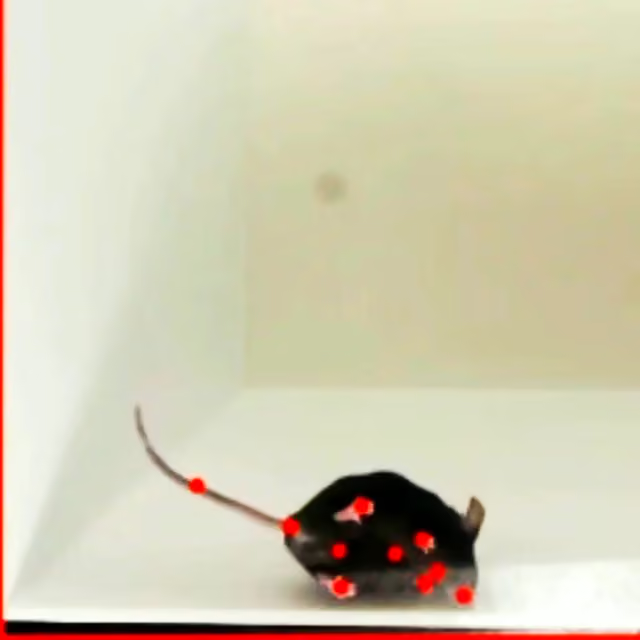
Automated, frame-by-frame grooming behavior analysis. The Grooming Module uses body-point tracking to detect and classify grooming sequences with the precision needed for stress, OCD, dermatological, and neurological research — replacing hours of manual video scoring.
Capabilities
| Feature | Key Metrics |
|---|---|
| Grooming Bout Detection | Total grooming time, bout count, bout duration, inter-bout intervals |
| Grooming Microstructure | Syntactic chain analysis (Phases I–IV), chain completions, interrupted chains, transition probabilities |
| Body Region Targeting | Paw licking, face washing, head grooming, body grooming, tail/genital grooming — time per region |
| Stress-Induced Grooming | Rostral-to-caudal progression score, cephalocaudal index, incorrect transitions |
| Barbering Detection | Over-grooming zones, hair loss area estimation, barbering frequency |
| Splash Test | Latency to groom, grooming frequency, total grooming duration post-stimulus |
Highlights
- Microstructure analysis — automatically classifies Berridge syntactic grooming chains (Phases I–IV)
- Body region mapping — multi-point tracking identifies which body part is being groomed
- Stress biomarker — cephalocaudal disruption index as an automated stress indicator
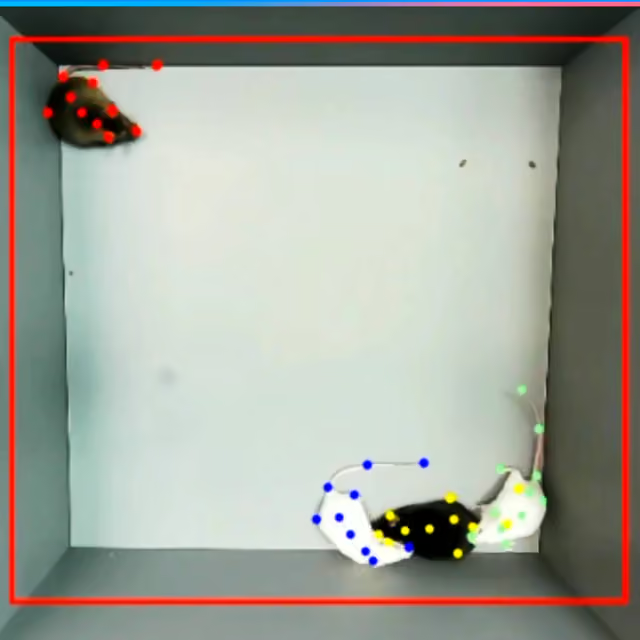
- Batch processing — score entire cohorts without manual frame-by-frame review
- 30+ fps — captures rapid grooming transitions between body regions
What’s Included
- All grooming analysis paradigms listed above
- 1-year software license
- Free updates during license period
- 24/7 online support
How It Works
Features & Benefits
Shipping weight
- 0.22 lb
Shipping box
- L: 25.0 cm
- W: 20.0 cm
- H: 5.0 cm
Quick Specification Notes
- ConductVision add-on module for structured grooming analysis workflows.
- Intended for bout-level, sequence-level, and body-region-oriented grooming review where video quality supports it.
- Available with the license terms shown on the product page.
| Feature | This Product | Typical Alternative | Advantage |
|---|---|---|---|
| Grooming Detail | Supports bout, sequence, and body-region-oriented grooming review | Basic workflows often stop at broad duration estimates | |
| Shared ConductVision Platform | Fits labs already using ConductVision | Separate grooming tools can fragment training and exports | |
| Cohort Processing | Useful for larger studies where manual grooming review would be slow | Frame-by-frame manual review becomes a major bottleneck |
The Grooming Analysis Module is positioned for labs that need a more structured grooming workflow than simple total-time scoring alone can provide.
| Model | SKU | Listed price | Status | Shipping box |
|---|---|---|---|---|
| 5 Year | CS-SW-00007 | $2,000.00 | Available | 25.0 x 20.0 x 5.0 cm |
| 1 Year | CS-SW-00007 | $500.00 | Available | 25.0 x 20.0 x 5.0 cm |
Practical Tips
Record with stable lighting and clear visibility of the full animal body.
Why: Grooming interpretation becomes unreliable when the target body region is obscured.
Keep bedding, debris, and other visual clutter to a minimum during the analyzed epoch.
Why: Clutter can hide paws or body regions during short grooming events.
Review a pilot session manually before batch-processing the cohort.
Why: That helps confirm the workflow matches the grooming features you care about most.
Use separate presets when switching between splash-test, spontaneous grooming, and other assay families.
Why: Different grooming contexts emphasize different timing and interpretation rules.
Setup Guide
What’s in the Box
- ConductVision Grooming Analysis Module license
- Grooming-focused analysis workflow inside ConductVision
- Active-term software updates
- ConductScience remote support
Warranty
Support and updates follow the selected ConductVision license term. ConductScience remote assistance remains available during the active covered period.
Compliance
References
Background reading relevant to this product:
Why use a dedicated grooming module instead of broad locomotor tracking?
Because grooming studies often care about bout structure, sequence organization, and body-region targeting, not just overall activity.
What is the biggest imaging requirement?
Clear visibility of the full animal body is the main requirement, since short grooming events are easy to miss when regions are obscured.
Can this help with stress-linked grooming studies?
Yes. The module is positioned for workflows where grooming organization and disruption patterns matter.
How should I validate the setup before the main cohort?
Run a pilot recording, review whether the relevant grooming features are visible, and then lock the workflow before scaling up.
Have a question about this product?
Have a question? Just ask.
Send it over and we'll email you a personalized answer — no call, no scheduling.
Prefer to talk it through?