Ductless Fume Hood FH (C)
Ductless recirculating fume hood with activated carbon and HEPA filtration for chemical vapor containment, featuring transparent acrylic construction and adjustable air velocity control.
| control_panel | LCD Touch screen |
| front_window_angle | 8° slope |
| window_design | Three side transparent acrylic windows with front window reversal design |
| base_cabinet_feature | Middle partition |
| sensors | Temperature and humidity sensors |
| detection_system | Inside and outside probe for air pollution and filter conditions |
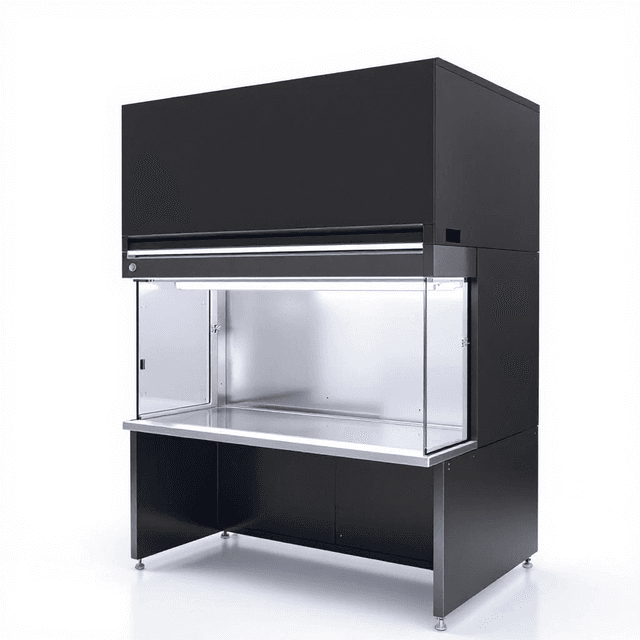
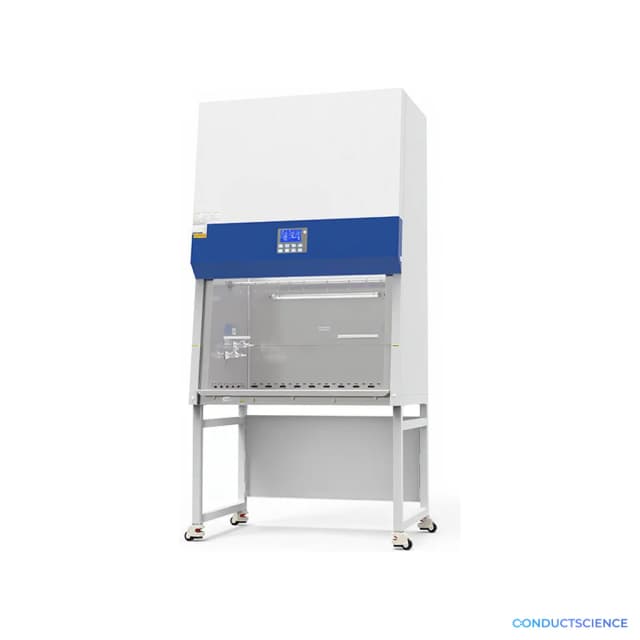
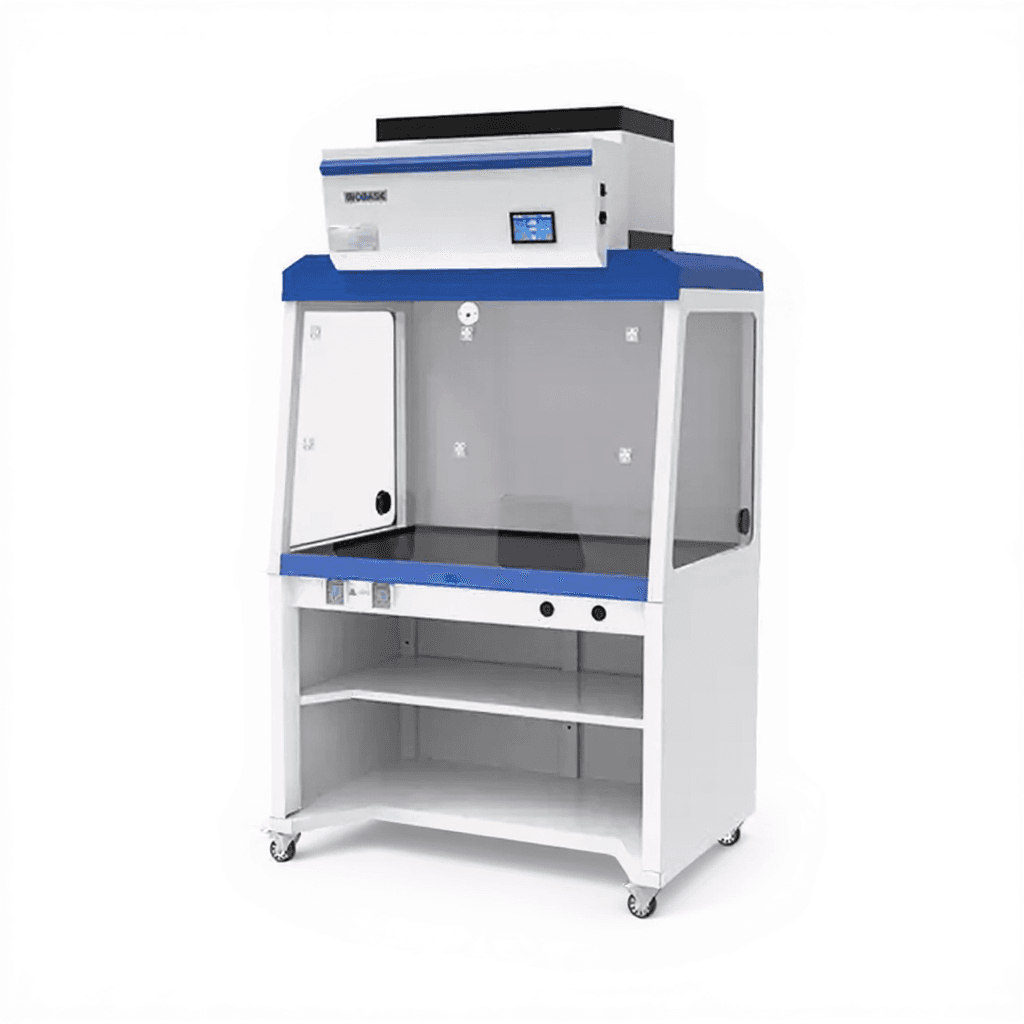
The Ductless Fume Hood FH (C) provides localized containment and filtration for chemical vapors, particulates, and aerosols in laboratory environments without requiring external ductwork connection. This recirculating system employs a multi-stage filtration approach using activated carbon and HEPA filters to remove contaminants from the work area atmosphere before returning cleaned air to the laboratory. The unit features transparent acrylic construction with three-sided viewing and an 8° sloped front window for optimal visibility and accessibility during manipulations.
Available in multiple configurations accommodating different workspace requirements, with internal work areas ranging from 680×606×688mm to 980×606×688mm in benchtop models, and extended cabinet configurations with integrated storage. The system incorporates centrifugal blowers with adjustable air velocity (0.3-0.8 m/s), LCD touch screen control panel, and environmental monitoring capabilities including temperature and humidity sensors with audible and visual alarms for filter condition monitoring.
How It Works
The ductless fume hood operates on a recirculating air filtration principle, drawing contaminated air from the work area through a centrifugal blower system and processing it through sequential filtration stages before returning cleaned air to the laboratory. The airflow pattern creates a protective barrier at the hood opening, with adjustable air velocity (0.3-0.8 m/s) that captures chemical vapors and particulates at their source point.
The multi-stage filtration system employs activated carbon for organic vapor adsorption and HEPA filters for particulate removal. Activated carbon provides high surface area for physical adsorption of volatile organic compounds through van der Waals forces, while HEPA filtration captures particles ≥0.3 micrometers with high efficiency. The system continuously monitors filter saturation through internal and external air quality probes, triggering audible and visual alarms when filter replacement is required.
Environmental sensors continuously monitor temperature and humidity within the work area, with data displayed on the LCD touch screen control panel. The 8° sloped front window design optimizes airflow dynamics while maintaining visibility, and the three-sided transparent acrylic construction allows observation from multiple angles during manipulations.
Features & Benefits
Model
- BB-FH700(PD)
- BB-FH1000(PD)
- BB-FH1000(C)
- BB-FH1800(C)
control_panel
- LCD Touch screen
front_window_angle
- 8° slope
window_design
- Three side transparent acrylic windows with front window reversal design
base_cabinet_feature
- Middle partition
sensors
- Temperature and humidity sensors
detection_system
- Inside and outside probe for air pollution and filter conditions
alarm_system
- Audible and visual alarm
filtration_technology
- ['activated carbon', 'HEPA filters']
operation_type
- Recirculating/ductless
memory_function
- Power-failure memory function
safety_features
- Anti-overload, anti-electric shock protection
Automation Level
- semi-automated
Integral External Size (W×D×H)
- 1100×800×2060mm
Internal Size (W×D×H)
- 980×660×847mm
Exhaust Volume
- 1850m³/h
Air Velocity
- 0.3~0.8m/s
Noise
- ≤65dB(A)
Max Opening
- 490mm
Integral Net Weight
- 126kg
Material
- transparent acrylic
Display Type
- LCD
Research Domain
- Analytical Chemistry
- Environmental Monitoring
- Materials Science
- Microbiology
- Pharmaceutical QC
- Toxicology
Power/Voltage
- 220V±10%, 50Hz; 110±10%V, 60Hz
Weight
- 277.78 lbs
Dimensions
- L: 27.09 in
- W: 26.77 in
- H: 23.86 in
Comparison Guide
| Feature | This Product | Typical Alternative | Advantage |
|---|---|---|---|
| Filtration Technology | Multi-stage activated carbon and HEPA filtration system | Single-stage filtration or basic carbon filtering | Comprehensive removal of both organic vapors and particulates in a single system reduces exposure risk across diverse chemical applications. |
| Air Velocity Control | Adjustable 0.3-0.8 m/s with digital control | Fixed air velocity or limited adjustment range | Allows optimization of containment performance based on specific chemical volatility and handling requirements. |
| Environmental Monitoring | Integrated temperature and humidity sensors with LCD display | Basic airflow monitoring only | Enables documentation of work area conditions for quality assurance and regulatory compliance requirements. |
| Control Interface | LCD touch screen with power-failure memory | Basic switch controls or analog displays | Provides intuitive operation with automatic parameter restoration after power interruption for consistent performance. |
| Window Design | 8° sloped front window with three-sided viewing | Vertical sash windows or limited viewing angles | Optimized airflow dynamics combined with multi-angle visibility improves both containment effectiveness and operational convenience. |
| Noise Level | ≤65 dB(A) operational noise | Higher noise levels from centrifugal blowers | Reduced acoustic disruption enables extended use in laboratory environments without impacting concentration or communication. |
This ductless fume hood combines multi-stage filtration with environmental monitoring and intuitive touch screen control in a transparent acrylic construction designed for chemical vapor containment. The adjustable air velocity system and comprehensive alarm monitoring provide operational flexibility while maintaining safety performance.
Practical Tips
Verify air velocity uniformity across the work area opening using a calibrated anemometer at multiple measurement points during commissioning.
Why: Ensures consistent containment performance across the entire work surface.
Monitor filter replacement alarms closely and replace both activated carbon and HEPA filters simultaneously to maintain system balance.
Why: Unbalanced filtration stages can compromise overall containment effectiveness and create pressure imbalances.
Position equipment and materials at least 6 inches inside the hood opening to ensure adequate capture velocity.
Why: Work positioned too close to the opening may escape the protective airflow pattern.
Never disable or ignore audible and visual alarms, and immediately cease work if alarm conditions persist after initial troubleshooting.
Why: Alarm conditions indicate compromised containment that could result in personnel exposure to chemical vapors.
Document temperature and humidity readings from the environmental sensors for each work session involving sensitive procedures.
Why: Environmental conditions can affect chemical behavior and analytical results in quality-controlled applications.
If containment appears reduced, check for objects blocking airflow paths and verify that the front window is positioned correctly.
Why: Airflow obstructions or improper sash positioning can significantly reduce containment effectiveness.
Clean transparent acrylic surfaces with appropriate solvents to maintain visibility while avoiding chemical compatibility issues.
Why: Chemical residues on viewing surfaces can interfere with observation and may react with subsequent chemicals used in the hood.
Allow the system to run for several minutes before beginning work to establish stable airflow patterns.
Why: Stable airflow is essential for reliable containment performance and consistent environmental conditions.
Setup Guide
What’s in the Box
- Ductless fume hood main unit
- Activated carbon filter cartridge
- HEPA filter module
- Power cord
- Installation hardware
- User manual and safety documentation
- Filter replacement indicators (typical)
- Calibration certificate (typical)
Warranty
ConductScience provides standard one-year manufacturer warranty covering defects in materials and workmanship, with technical support for installation guidance and operational troubleshooting.
Compliance
References
Background reading relevant to this product:
What types of chemicals can be safely handled in this ductless fume hood?
The activated carbon and HEPA filtration system is designed for organic vapors, particulates, and aerosols. Consult product datasheet for specific chemical compatibility and breakthrough volumes. Not suitable for highly toxic gases, acids requiring specialized scrubbing, or radioactive materials.
How do I know when filters need replacement?
The system includes internal and external air quality probes that monitor filter saturation, triggering audible and visual alarms when replacement is needed. Environmental monitoring also tracks temperature and humidity changes that may indicate filter performance degradation.
What is the effective containment performance of this unit?
The adjustable air velocity range of 0.3-0.8 m/s provides containment optimization based on chemical properties. Actual containment effectiveness depends on proper installation, maintenance, and operational procedures. Conduct smoke testing during commissioning to verify performance.
Can this unit be integrated with laboratory management systems?
The LCD touch screen control panel provides local monitoring and control. Consult product datasheet for external communication capabilities and potential integration with building management or laboratory information systems.
What maintenance procedures are required?
Regular maintenance includes filter replacement based on alarm indicators, periodic cleaning of acrylic surfaces, and verification of sensor calibration. The power-failure memory function maintains settings during service interruptions.
How does this compare to ducted fume hood systems?
Ductless design eliminates external ductwork requirements and associated HVAC integration, making installation more flexible. However, filtration capacity is limited to chemical types compatible with activated carbon adsorption, unlike ducted systems that can handle broader chemical ranges.
What are the electrical requirements for installation?
Unit operates on either 220V±10%, 50Hz or 110V±10%, 60Hz power supply systems. Installation requires grounded electrical connection with appropriate circuit protection. Net weight of 126kg requires adequate structural support.
Have a question about this product?
Accessories
Enhance your setup with compatible accessories