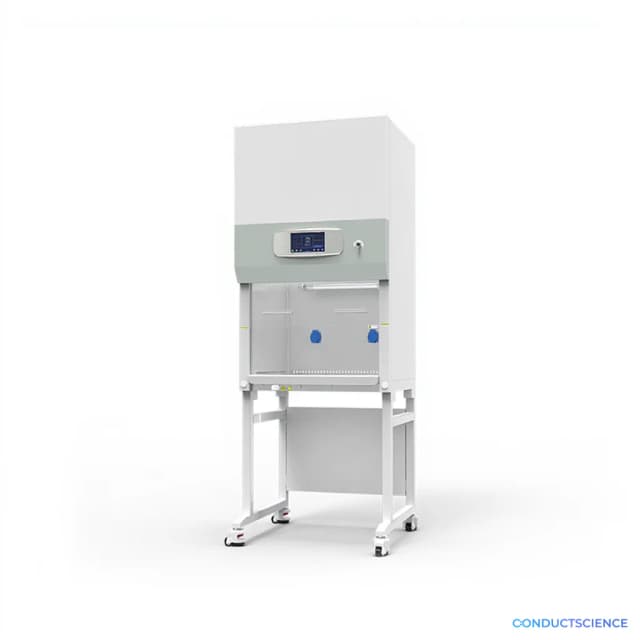
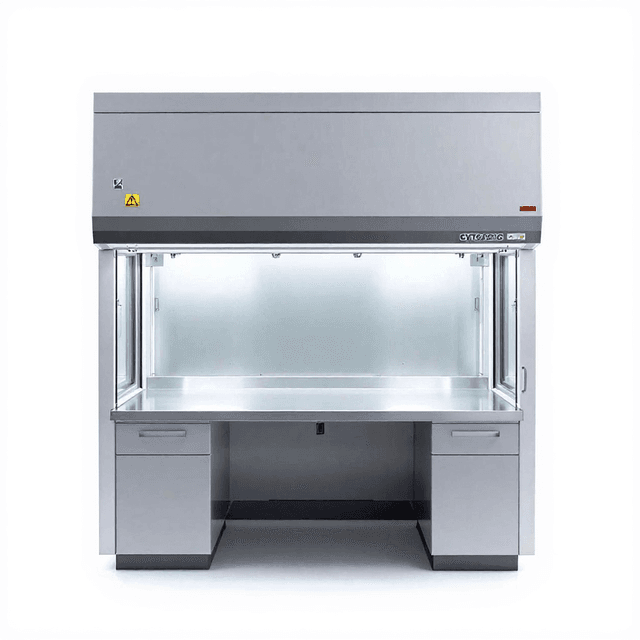
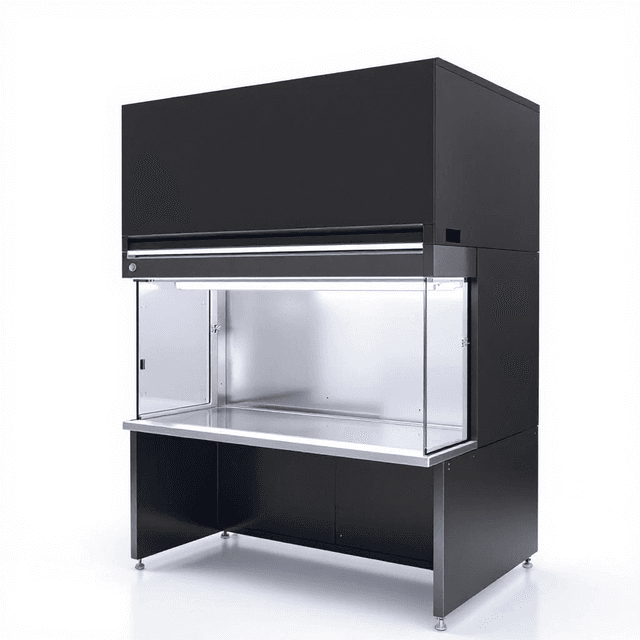
AC Series Class II B2 Biological Safety Cabinet
Class II B2 biological safety cabinet with total exhaust design and dual ULPA filtration for high-containment biological and chemical work.

Louise Corscadden, PhD
Director of Science · ConductScience
Ask Louise about AC Series Class II B2 Biological Safety Cabinet fit, setup, configuration, or quote prep.
Already working with us? Sign in to connect this with My Scientist.
Key Specifications
Full details →- Model fit
- Configured during quote
- SKU family
- BIO-0002
- Shipping box
- 225.0 x 110.0 x 77.5 cm
- Ordering
- Online checkout and quote request available
- Category
- Clean Benches & Fume Hoods
- Build notes
- Confirm accessories, station layout, and support needs before purchase
The AC Series Class II B2 Biological Safety Cabinet provides total exhaust containment for high-risk biological applications requiring maximum operator, product, and environmental protection. This cabinet exhausts 100% of contaminated air through ULPA filtration, eliminating any recirculation to the laboratory environment. The motorized front window with safety height controls ensures proper containment while maintaining operator accessibility.
Designed for biosafety level applications involving volatile toxic chemicals, chemotherapy drugs, and hazardous biological agents, this cabinet features dual ULPA filtration with 99.9995% efficiency at 0.12 micrometers. The laminated toughened glass front window provides anti-UV protection while the integrated UV lamp enables surface decontamination protocols. Available in three sizes to accommodate various laboratory workspaces and experimental requirements.
How It Works
The Class II B2 biological safety cabinet operates on a total exhaust principle, drawing room air through the front opening and work area while exhausting 100% of contaminated air through dual ULPA filters. The cabinet maintains negative pressure containment by pulling air inward at 0.53±0.025 m/s through the front opening, preventing escape of hazardous materials. Downward laminar airflow at 0.33±0.025 m/s provides product protection by creating a sterile work environment.
Two ULPA filters achieve 99.9995% particle removal efficiency at 0.12 micrometers, ensuring complete containment of biological aerosols and chemical vapors. The motorized front window system automatically positions to the designated safety height of 200mm, optimizing airflow patterns while maintaining operator safety. Filter life indicators monitor ULPA filter performance to ensure continued containment effectiveness.
The integrated 30-40W UV lamp provides surface decontamination capability, with anti-UV glass protection for the operator. The two-layer laminated toughened glass construction (≥6mm) provides chemical resistance and impact protection while maintaining optical clarity for work visualization.
Features & Benefits
Automation Level
- semi-automated
BSC-1300IIB2-X
- BSC-1500IIB2-X
External Size(W*D*H)
- 1100*775*2250mm
1300*775*2250mm
- 1500*775*2250mm
Internal Size(W*D*H)
- 940*600*660mm
1150*600*660mm
- 1350*600*660mm
Tested Opening
- Safety height 200mm(8)
Max Opening
- 480mm
Inflow Velocity
- 0.53±0.025m/s
Downflow Velocity
- 0.33±0.025m/s
ULPA Filter
- Two, 99.9995% efficiency at 0.12μm, filter life indicator
Front Window
- Motorized. Two-layer laminated toughened glass≥6mm. Anti UV
Noise
- ≤65dB
UV Lamp
- 30W*1
30W*1
- 40W*1
Brand
- ConductScience
Research Domain
- Cancer Research
- Cell Biology
- Clinical Diagnostics
- Immunology
- Microbiology
- Pharmaceutical QC
Shipping weight
- 275.0 lb
Shipping box
- L: 225.0 cm
- W: 110.0 cm
- H: 77.5 cm
| Feature | This Product | Typical Alternative | Advantage |
|---|---|---|---|
| Exhaust Design | Total exhaust (100% air exhausted) | Many Class II A cabinets recirculate 70% of filtered air back to laboratory | Eliminates risk of laboratory contamination when working with volatile chemicals or high-risk biologics |
| ULPA Filter Efficiency | 99.9995% at 0.12μm with dual filters | Entry-level models often use single HEPA filters with 99.97% efficiency at 0.3μm | Provides superior submicron particle containment for enhanced safety margins |
| Window Operation | Motorized with automatic safety height positioning | Manual windows require operator positioning and monitoring | Ensures consistent airflow patterns and reduces risk of containment breaches from improper positioning |
| Size Options | Three configurations: 940mm, 1150mm, and 1350mm work widths | Limited size options in specialized total exhaust models | Allows selection based on specific workspace requirements and experimental protocols |
| Filter Monitoring | Integrated filter life indicator system | Basic models rely on manual pressure monitoring or scheduled replacement | Provides real-time performance data to optimize filter replacement timing and ensure continued protection |
This cabinet combines total exhaust containment with dual ULPA filtration and motorized window controls for applications requiring maximum safety. The multiple size configurations and integrated monitoring systems provide flexibility for diverse laboratory requirements while maintaining consistent containment performance.
Practical Tips
Verify airflow velocities quarterly using a calibrated digital anemometer at multiple points across the work opening.
Why: Ensures containment performance remains within specified parameters throughout the service life.
Clean interior surfaces with appropriate disinfectant before and after each use, allowing complete drying before UV decontamination.
Why: Prevents contamination carryover between experiments and maximizes UV lamp effectiveness.
Allow cabinet to operate for 5-10 minutes before beginning work to establish stable airflow patterns.
Why: Ensures optimal containment conditions and prevents disruption during critical procedures.
Never place equipment or materials within 6 inches of the front or rear grilles to maintain proper airflow.
Why: Prevents airflow disruption that could compromise containment or product protection.
If filter life indicator shows early replacement needs, check for excessive loading from particulate work or chemical exposure.
Why: Helps identify process modifications that could extend filter life and reduce operating costs.
Document airflow measurements and filter performance data in a logbook for trend analysis and regulatory compliance.
Why: Provides evidence of proper maintenance and helps predict when preventive service is needed.
Use the motorized window positioning system consistently rather than manually adjusting to maintain reproducible containment conditions.
Why: Ensures consistent airflow patterns across different operators and experimental sessions.
Setup Guide
What’s in the Box
- AC Series Class II B2 Biological Safety Cabinet (main unit)
- Dual ULPA filters (pre-installed)
- UV lamp assembly
- Filter life indicator system
- Installation hardware and brackets (typical)
- User manual and safety guidelines (typical)
- Certification documentation (typical)
Warranty
ConductScience provides a comprehensive 1-year manufacturer warranty covering cabinet performance and component functionality. Technical support includes installation guidance, airflow certification assistance, and maintenance protocols.
Compliance
What type of exhaust system is required for installation?
The cabinet requires connection to a building exhaust system capable of handling 100% air volume since this is a total exhaust design with no recirculation.
How frequently should ULPA filters be replaced?
Filter replacement depends on usage and contamination levels. The integrated filter life indicator system monitors performance and alerts when replacement is needed, typically every 1-3 years.
Can this cabinet be used for volatile chemical work?
Yes, the Class II B2 total exhaust design specifically accommodates work with volatile toxic chemicals, chemotherapy drugs, and other hazardous compounds requiring complete containment.
What certification testing is required after installation?
Post-installation certification should include airflow velocity measurements, ULPA filter integrity testing, and containment verification per applicable standards.
How does the motorized window system work?
The motorized front window automatically positions to the safety height of 200mm for optimal containment while allowing manual adjustment up to 480mm maximum opening when needed.
What maintenance procedures are required?
Routine maintenance includes surface decontamination, UV lamp replacement, filter monitoring, and annual airflow certification to ensure continued performance.
Are there size limitations for equipment placement inside?
Equipment placement should not obstruct airflow patterns. The work area dimensions range from 940×600×660mm to 1350×600×660mm depending on cabinet size selected.
Have a question about this product?
Have a question? Just ask.
Send it over and we'll email you a personalized answer — no call, no scheduling.
Prefer to talk it through?
Replacement Parts & Consumables