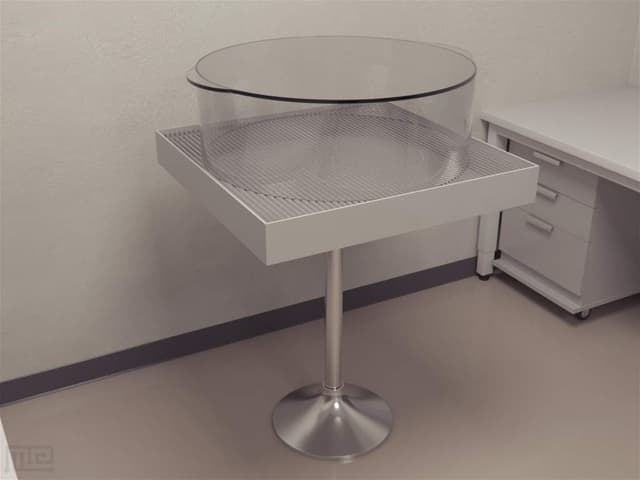
Heat Maze
Thermotaxis-based spatial learning apparatus for Drosophila featuring temperature-controlled zones and visual cues to assess place learning and memory.
| arena_shape | circular |
| arena_diameter | 18 cm |
| peltier_grid_configuration | 5×5 grid |
| peltier_element_size | 4x4 cm |
| safe_zone_size | 4x4 cm |
| safe_zone_temperature | 20°C |

The Heat Maze is a specialized behavioral apparatus designed for spatial learning and memory assessment in Drosophila melanogaster. This circular acrylic arena employs thermotaxis-based learning, where fruit flies learn to navigate away from heated zones toward cooler safe areas using visual cues. The system features a 5×5 Peltier grid that creates spatially discrete temperature zones, enabling precise control over thermal gradients within the 18 cm diameter arena.
Based on principles similar to the Morris water maze, the Heat Maze leverages Drosophila's innate thermal avoidance behavior to study spatial cognition. The apparatus incorporates both proximal and distal visual cues to support place learning paradigms. Temperature control ranges from 20°C (safe zone) to 37°C (aversive zone), with manual or computer-controlled regulation through dedicated software. This system enables researchers to investigate genetic, pharmacological, and environmental influences on spatial navigation and memory formation in fruit flies.
How It Works
The Heat Maze operates on thermotaxis-driven spatial learning principles. Drosophila melanogaster naturally avoid elevated temperatures, creating an intrinsic motivation to escape heated zones. The apparatus contains a 5×5 grid of individually controlled Peltier elements (4×4 cm each), allowing precise spatial control of temperature gradients. One element maintains 20°C as the safe zone while others heat to 37°C, creating discrete thermal zones that flies must learn to differentiate.
During spatial learning trials, flies use visual cues positioned around the arena to navigate toward the cooler safe zone. The temperature differential provides immediate negative feedback when flies enter heated areas, reinforcing spatial memory formation. Computer-controlled temperature regulation ensures consistent thermal gradients throughout testing sessions. The system records fly position and movement patterns, enabling quantitative analysis of spatial learning acquisition, memory retention, and navigation strategies.
Place learning occurs through repeated exposure trials where flies associate visual landmarks with the fixed location of the safe zone. Memory consolidation is assessed through probe trials where temperature zones are equalized, testing whether flies preferentially search the previous safe zone location based solely on visual cues.
Features & Benefits
arena_shape
- circular
arena_diameter
- 18 cm
peltier_grid_configuration
- 5×5 grid
peltier_element_size
- 4x4 cm
safe_zone_size
- 4x4 cm
safe_zone_temperature
- 20°C
unsafe_zone_temperature
- 37°C
control_method
- Conduct Heat Maze software
required_accessories_not_included
- talc-coated metal ring (height 5 cm), blank white paper sheet (height 20 cm)
spatial_learning_trials
- 7 trials, 5 minutes each
non_spatial_learning_trials
- 3 trials, 10 minutes each
inter_trial_interval
- 10 seconds
Behavioral Construct
- spatial learning
- spatial memory
- place learning
- thermal avoidance
- navigation
- thermotaxis
Automation Level
- semi-automated
Material
- Acrylic
Temperature Range
- 20°C to 37°C
Species
- Drosophila melanogaster
Dimensions
- 18 cm diameter
Research Domain
- Addiction Research
- Behavioral Pharmacology
- Developmental Biology
- Learning and Memory
- Neurodegeneration
- Neuroscience
Weight
- 14.3 kg
Dimensions
- L: 110.5 mm
- W: 78.7 mm
- H: 10.1 mm
Comparison Guide
| Feature | This Product | Typical Alternative | Advantage |
|---|---|---|---|
| Temperature Control Range | 20°C to 37°C with precise Peltier regulation | Limited temperature control or broader, less precise ranges | Optimal thermal differential for Drosophila thermotaxis without tissue damage |
| Spatial Resolution | 25 discrete zones (5×5 grid) with 4×4 cm elements | Fewer temperature zones or continuous gradients | Creates clearly differentiated spatial locations for precise place learning assessment |
| Arena Size | 18 cm diameter circular arena | Varies by model, often smaller or less optimal dimensions | Provides adequate space for natural movement while maintaining visual cue effectiveness |
| Software Integration | Dedicated Conduct Heat Maze software with automated protocols | Manual control or generic temperature control software | Standardized protocols ensure experimental consistency and reduce operator variability |
| Trial Standardization | Established 7+3 trial protocol with defined durations and intervals | Variable or undefined behavioral protocols | Validated paradigm enables direct comparison with published literature |
The Heat Maze offers precise temperature control across 25 discrete zones with dedicated software and validated protocols. The system provides standardized spatial learning assessment for Drosophila with optimal thermal parameters and arena dimensions based on published research.
Practical Tips
Verify temperature accuracy across all Peltier elements using an independent thermometer before each experimental session.
Why: Temperature calibration ensures consistent thermal gradients and reliable behavioral responses.
Replace paper floor surface between animals to prevent chemical cues from affecting subsequent trials.
Why: Fresh surfaces eliminate potential pheromone or chemical trail influences on navigation behavior.
Maintain consistent ambient room temperature and lighting conditions throughout experimental sessions.
Why: Environmental stability prevents confounding variables that could affect thermal perception and visual cue visibility.
Record fly position data at minimum 10 Hz sampling rate to capture detailed movement trajectories.
Why: High-resolution tracking enables analysis of navigation strategies and path optimization over trials.
If flies show reduced activity, verify that thermal zones have reached equilibrium and check for air currents near the arena.
Why: Temperature gradients and air movement can affect fly behavior and thermal perception.
Monitor fly behavior for signs of thermal stress and reduce trial duration if excessive immobility occurs.
Why: Preventing thermal damage ensures animal welfare and maintains valid behavioral responses.
Use age-matched flies (3-7 days post-eclosion) and test during peak activity periods for consistent performance.
Why: Standardized age and circadian timing reduce behavioral variability and improve data reliability.
Setup Guide
What’s in the Box
- Heat Maze main unit with 5×5 Peltier grid
- Circular acrylic arena (18 cm diameter)
- Temperature controller unit
- Conduct Heat Maze software
- Power cables and connections
- User manual and protocol guide
- Talc-coated metal ring (5 cm height) - required accessory
- Blank white paper sheets (20 cm height) - required accessory
Warranty
ConductScience provides a standard 1-year manufacturer warranty covering defects in materials and workmanship, with technical support for software and temperature control systems.
Compliance
References
Background reading relevant to this product:
What is the optimal acclimation time before starting behavioral trials?
Allow 10 minutes for thermal equilibration after setting temperature zones, and 2-3 minutes for individual fly acclimation to arena conditions before trial initiation.
How does trial duration affect spatial learning measurement?
Standard 5-minute spatial learning trials provide sufficient time for navigation without thermal stress, while 10-minute non-spatial trials control for non-specific temperature avoidance.
Can the safe zone location be randomized between animals?
Yes, any of the 25 Peltier elements can serve as the safe zone, allowing counterbalancing of safe zone positions across subjects to control for arena bias.
What visual cue configurations are most effective?
Combination of high-contrast proximal cues within the arena and distinct distal landmarks outside the arena provides optimal spatial reference points for place learning.
How is spatial memory retention assessed?
Probe trials with all zones at neutral temperature test whether flies preferentially search the former safe zone location based on visual cues alone.
What data parameters indicate successful spatial learning?
Decreased latency to safe zone, increased time in target quadrant, and reduced path length over successive trials indicate spatial learning acquisition.
How does this compare to other Drosophila learning assays?
Heat Maze provides spatial learning assessment similar to Morris water maze in rodents, while other Drosophila assays typically focus on associative conditioning rather than place learning.
Have a question about this product?
Accessories
Enhance your setup with compatible accessories