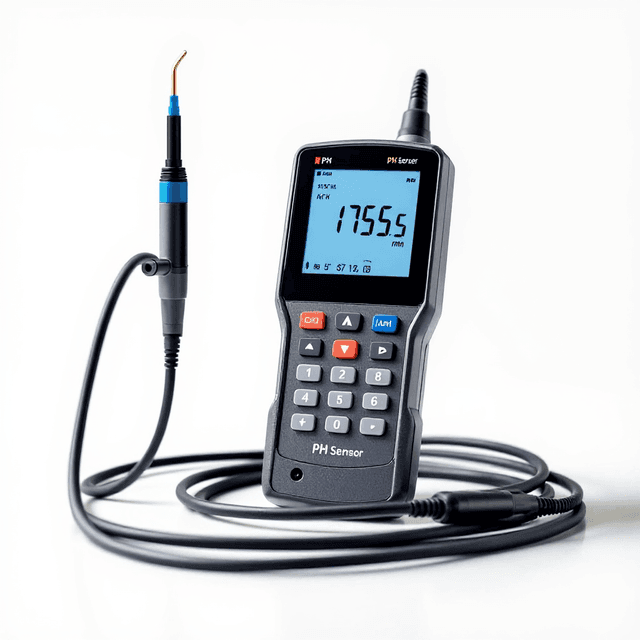
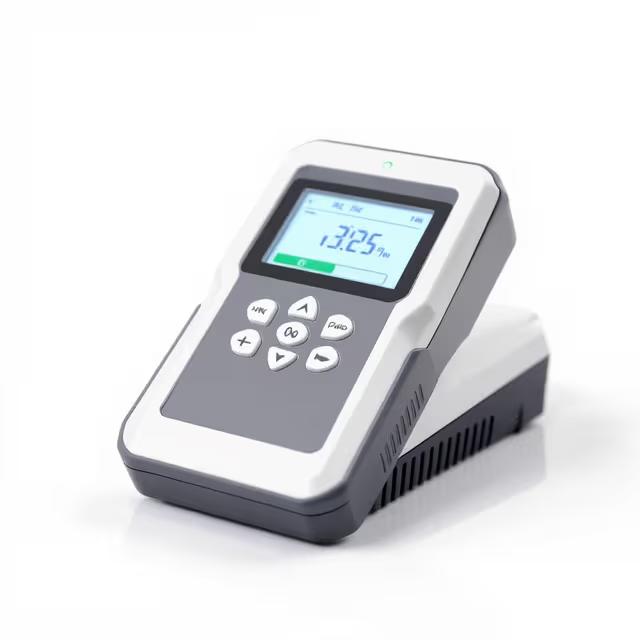
Industrial pH Probe
General-purpose potentiometric pH electrode with plastic body construction for routine measurements from 0-14 pH across 5-60°C temperature range.
| PH range | Temp. Range(â) |
| 0-14 | 5-60 |
| Automation Level | manual |
| Brand | ConductScience |

The Industrial pH Probe CS-LH-ELC005 is a general-purpose potentiometric electrode designed for routine pH measurements across field, laboratory, and educational environments. This plastic-bodied electrode employs standard glass membrane technology to provide reliable pH determination from 0-14 across a temperature range of 5-60°C. The electrode features a robust construction suitable for industrial and research applications requiring consistent pH monitoring.
The probe utilizes a conventional glass membrane sensing element that generates a potential difference proportional to hydrogen ion activity in solution. Standard BNC connectivity ensures compatibility with most pH meters and data acquisition systems, while optional Y-blade and pin connector configurations provide flexibility for specialized instrumentation setups. The plastic construction offers enhanced durability compared to traditional glass electrodes while maintaining measurement accuracy for routine analytical work.
How It Works
The Industrial pH Probe operates on potentiometric principles, measuring the electrical potential difference between a pH-sensitive glass membrane and a stable reference electrode. When immersed in solution, the glass membrane selectively responds to hydrogen ion activity, generating a voltage that follows the Nernst equation: E = E° + (RT/F)ln(aH+). At 25°C, this relationship produces approximately 59.2 mV change per pH unit.
The glass membrane contains a thin hydrated gel layer that allows selective ion exchange with hydrogen ions in the sample solution. This creates a potential difference across the membrane that is logarithmically proportional to the pH of the solution. The internal reference element maintains a stable potential, while the external reference completes the electrochemical cell. Temperature compensation may be required as the Nernstian slope varies with temperature according to RT/F.
Signal conditioning through a high-impedance pH meter converts the millivolt output to pH units using calibration data from standard buffer solutions. The BNC connector provides low-noise signal transmission to prevent interference from electrical noise that could affect the high-impedance measurement.
Features & Benefits
PH range
- Temp. Range(â)
0-14
- 5-60
Automation Level
- manual
Brand
- ConductScience
Research Domain
- Analytical Chemistry
- Food Science
- Industrial Hygiene
- Materials Science
- Microbiology
- Pharmaceutical QC
- Water Quality & Environmental Monitoring
Weight
- 0.26 kg
Dimensions
- L: 20.0 mm
- W: 10.0 mm
- H: 5.0 mm
Comparison Guide
| Feature | This Product | Typical Alternative | Advantage |
|---|---|---|---|
| pH Measurement Range | 0-14 pH | Most standard electrodes offer 0-14 range | Full pH spectrum coverage eliminates range limitations for diverse sample analysis. |
| Temperature Range | 5-60°C operational range | Entry-level electrodes often limited to 0-50°C | Extended temperature capability accommodates industrial processes and heated sample analysis. |
| Body Construction | Durable plastic body construction | Traditional glass body electrodes more fragile | Enhanced mechanical durability reduces breakage risk in field and industrial environments. |
| Connector Options | BNC standard with Y-blade and pin options available | Many electrodes offer only single connector type | Flexible connectivity accommodates diverse instrumentation without adapter requirements. |
| Application Focus | General-purpose routine measurements | Specialized electrodes target specific applications | Versatile design suitable for multiple sample types and measurement scenarios without specialized requirements. |
The Industrial pH Probe offers practical combination of measurement range (0-14 pH), temperature capability (5-60°C), and mechanical durability through plastic construction. Multiple connector options and general-purpose design provide operational flexibility for diverse analytical applications.
Practical Tips
Perform two-point calibration using buffers that bracket your expected sample pH range.
Why: Provides optimal accuracy within the measurement range of interest rather than across the entire pH spectrum.
Store electrode in pH 4 buffer solution rather than distilled water between uses.
Why: Maintains proper hydration of the glass membrane and prevents ion depletion that degrades response.
Allow electrode potential to stabilize for 30-60 seconds before recording measurements.
Why: Ensures complete equilibration between sample and electrode membrane for accurate and reproducible results.
Check for air bubbles in electrode fill solution if response becomes slow or erratic.
Why: Air bubbles disrupt electrical continuity and cause unstable readings that cannot be corrected by recalibration.
Record sample temperature during measurement and apply temperature compensation when necessary.
Why: Both electrode response and sample pH change with temperature, affecting measurement accuracy outside 20-25°C range.
Rinse electrode thoroughly when switching between samples of dramatically different pH.
Why: Prevents cross-contamination and carryover effects that could bias subsequent measurements.
Replace calibration buffers regularly and check expiration dates before use.
Why: Buffer degradation from contamination or aging leads to calibration errors that propagate through all sample measurements.
Inspect BNC connector for corrosion or contamination and clean contacts if necessary.
Why: Poor electrical connections introduce noise and drift that compromise measurement precision and accuracy.
Setup Guide
What’s in the Box
- Industrial pH Probe electrode (typical)
- BNC connector cable (typical)
- User manual (typical)
- Electrode care instructions (typical)
Warranty
ConductScience provides standard 1-year manufacturer warranty covering defects in materials and workmanship, with technical support for calibration and maintenance guidance.
Compliance
References
Background reading relevant to this product:
What is the expected electrode slope and how often should calibration be performed?
Typical glass electrodes exhibit near-Nernstian response (58-60 mV/pH at 25°C). Calibration frequency depends on sample matrix and accuracy requirements, typically daily for critical measurements or weekly for routine monitoring.
How does temperature affect measurement accuracy and what compensation is needed?
Temperature affects both electrode slope and sample pH. The 5-60°C range accommodates most applications, but automatic temperature compensation (ATC) is recommended for measurements outside 20-25°C.
What sample volume and immersion depth are required for accurate measurements?
Minimum 25-50 mL sample volume with electrode immersed to cover the glass membrane completely. Junction and reference areas must also be submerged for proper electrical contact.
How does the plastic body affect chemical compatibility compared to glass electrodes?
Plastic body provides enhanced resistance to breakage and some aggressive chemicals. Glass membrane remains the pH-sensitive element, maintaining measurement characteristics while improving mechanical durability.
What connector options are available and how do they affect measurement performance?
Standard BNC provides low-noise connection for most applications. Y-blade and pin connectors accommodate specific meter requirements - all maintain equivalent electrical performance when properly connected.
What is the typical electrode lifespan and what factors affect longevity?
Electrode lifespan typically ranges 6-18 months depending on sample matrix, temperature exposure, and maintenance. Proper storage in appropriate solutions and avoiding extreme pH or temperature extends operational life.
How should the electrode be maintained between measurements and during storage?
Store in pH 4 buffer or manufacturer's storage solution to maintain membrane hydration. Clean with distilled water between samples and avoid prolonged exposure to distilled water or dry conditions.
Have a question about this product?
Upgrade Options