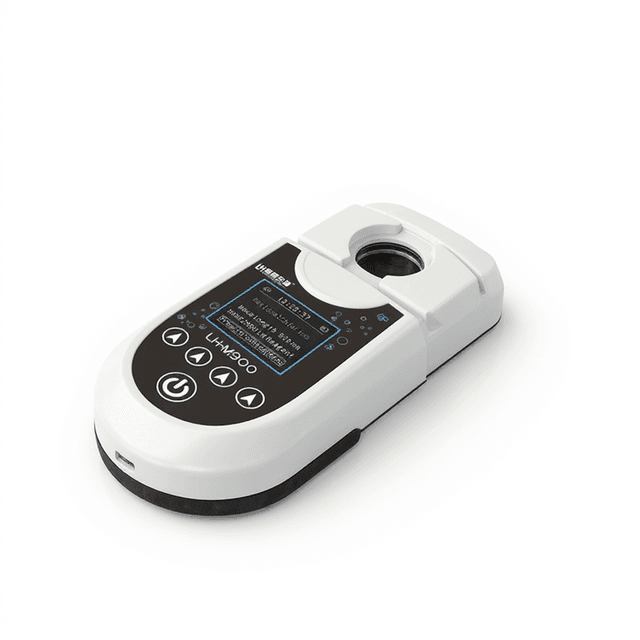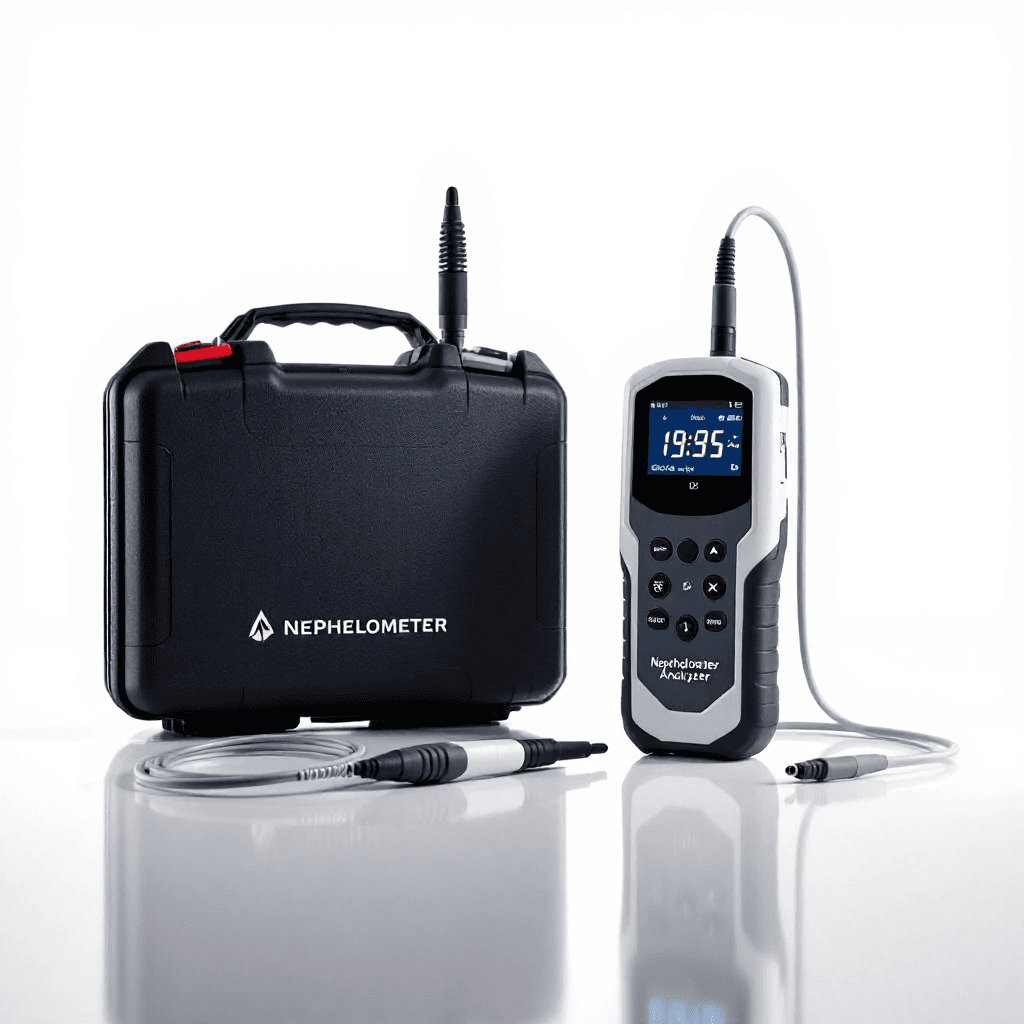
Nephelometer
Benchtop dispersive optical nephelometer for precise turbidity measurement in water and transparent liquids, with 0-200 NTU range and 0.1 NTU resolution.
| Model | WGZ-20 |
| Product name | turbidity measurement device |
| Minimum Readout ( NTU) | 0.1 |
| Measuring Range(NTU) | 0--200 |
| Basic Error(F.S) | ±2.5% |
| Repeatability | â¤1.5% |
The WGZ-20 Nephelometer is a benchtop dispersive optical turbidity measurement instrument designed for quantitative analysis of light scattering from suspended particulate matter in water and transparent liquids. This laboratory-grade instrument measures turbidity levels from 0 to 200 NTU with a minimum readout resolution of 0.1 NTU, providing researchers with precise characterization of suspended particle concentrations in aqueous samples.
The instrument operates on dispersive optical principles to detect and quantify light scattering caused by insoluble particles suspended in liquid media. With a basic error of ±2.5% F.S. and repeatability of ≤1.5%, the WGZ-20 delivers reliable turbidity measurements for water quality assessment, environmental monitoring, and industrial process control applications across research and quality control laboratories.
How It Works
The WGZ-20 Nephelometer operates on the principle of dispersive optical turbidimetry, where light from an internal light source is directed through a liquid sample contained in a glass sample bottle. When light encounters suspended particles in the sample, it undergoes scattering according to Rayleigh and Mie scattering theories, depending on particle size relative to the incident wavelength.
The instrument's optical system detects scattered light at specific angles, with the intensity of scattered light being proportional to the concentration and size distribution of suspended particles. A photodetector converts the scattered light signal into an electrical signal, which is processed and displayed as turbidity in Nephelometric Turbidity Units (NTU). The measurement principle relies on the fact that higher particle concentrations produce increased light scattering, resulting in higher turbidity readings.
Sample bottles are positioned in a dedicated sample holder with precise alignment to ensure consistent optical path geometry. The instrument includes zero drift compensation and calibration capabilities using standard turbidity solutions to maintain measurement accuracy across the 0-200 NTU range.
Features & Benefits
Model
- WGZ-20
Product name
- turbidity measurement device
Minimum Readout ( NTU)
- 0.1
Measuring Range(NTU)
- 0--200
Basic Error(F.S)
- ±2.5%
Repeatability
- â¤1.5%
Zero Draft(F.S)
- ±0.2%
Characters
- Bench top type
Failure phenomenon
- Possible causes
1,after starting up, display
- Aãpower line and socket connection is bad or loose
2,measuring reaction
- A, light damageB, internal connector looseC, electrical system fault
3,measurement instability or drift
- A, solution with bubbles or particles in does not stop movingB, circuitry within the apparatus of dampC, the outer surface of the bottle water sampleD, external interferenceE, the supply voltage instability of
4.zero, less than zero
- A, adjustable zero without the use of zero turbidity waterB, zero potentiometer damageC, zero range migrationD, light path offset
5,not to the correction value
- A, standard solution standard value is not accurateB, correction potentiometer is damagedC, range migration correctionD, light path offset
Automation Level
- manual
Brand
- ConductScience
Power/Voltage
- AC220V/50Hz
Research Domain
- Environmental Monitoring
- Food Science
- Industrial Hygiene
- Microbiology
- Pharmaceutical QC
Weight
- 0.35 lbs
Dimensions
- L: 20.0 in
- W: 10.0 in
- H: 5.0 in
Comparison Guide
| Feature | This Product | Typical Alternative | Advantage |
|---|---|---|---|
| Measurement Range | 0-200 NTU with 0.1 NTU resolution | Entry-level models often provide narrower ranges or lower resolution | Wide range accommodates both clean water assessment and moderately turbid industrial samples in a single instrument |
| Measurement Accuracy | ±2.5% F.S. basic error with ≤1.5% repeatability | Portable units typically offer lower precision specifications | Laboratory-grade accuracy ensures reliable quantitative data for research and regulatory compliance |
| Zero Drift Stability | ±0.2% F.S. zero drift specification | Many instruments lack specified drift characteristics | Documented stability reduces need for frequent recalibration during measurement sessions |
| Power Requirements | AC220V/50Hz mains power | Battery-powered portable units require charging | Continuous mains power eliminates concerns about battery depletion during extended measurement campaigns |
| Sample Handling | Bottle-based sample measurement with alignment system | Some units use cuvettes or flow-through cells | Sample bottles allow larger sample volume and easier cleaning between different sample types |
| Configuration Type | Benchtop design with stable sample holder | Handheld units offer portability but less stable measurement geometry | Fixed optical geometry provides consistent measurement conditions and reduces operator-induced variability |
The WGZ-20 provides laboratory-grade turbidity measurement capabilities with documented accuracy specifications and drift characteristics. The benchtop configuration offers stable measurement geometry with sample bottle handling suitable for batch processing in research and quality control laboratories.
Practical Tips
Always perform zero adjustment with zero turbidity water at the beginning of each measurement session and verify with secondary standards.
Why: Optical systems can drift with temperature and aging, affecting baseline accuracy.
Handle sample bottles by the upper portions only and clean all surfaces with lint-free cloths to prevent fingerprints on optical surfaces.
Why: Fingerprints and scratches on bottle surfaces will scatter light and create false readings.
Allow samples to equilibrate to room temperature and gently swirl to ensure homogeneous particle distribution before measurement.
Why: Temperature differences and particle settling can affect light transmission and scattering characteristics.
Keep the instrument covered when not in use and clean the sample compartment weekly with appropriate cleaning solutions.
Why: Dust accumulation in the optical path will increase background scatter and degrade measurement accuracy.
If readings become unstable, check for bubbles in samples, verify bottle cleanliness, and ensure proper seating in the sample holder.
Why: Air bubbles and contaminated surfaces are common sources of measurement variability and false readings.
Measure samples promptly after collection and avoid prolonged storage that allows particle settling or aggregation.
Why: Time-dependent changes in particle size distribution will alter scattering properties and turbidity readings.
Ensure the light-blocking cover is in place during measurements to prevent ambient light interference and protect eyes from the internal light source.
Why: External light sources will interfere with measurements and direct exposure to optical sources can cause eye strain.
Use fresh calibration standards and replace them according to manufacturer expiration dates or when values drift outside specifications.
Why: Degraded standards will introduce systematic errors in all subsequent measurements.
Setup Guide
What’s in the Box
- WGZ-20 Nephelometer main unit
- Sample bottles (typical)
- Sample bottle caps (typical)
- AC220V power cord
- Sample holder with alignment system
- Light-blocking cover
- User manual and operation guide (typical)
- Calibration standards (typical)
Warranty
ConductScience provides a standard one-year manufacturer warranty covering defects in materials and workmanship, with technical support for instrument operation and troubleshooting.
Compliance
References
Background reading relevant to this product:
What is the measurement principle and how does particle size affect readings?
The WGZ-20 uses dispersive optical turbidimetry, measuring light scattering from suspended particles. Larger particles generally produce higher scattering signals per unit mass, while very small particles may scatter less efficiently. The instrument measures total light scattering regardless of particle size distribution.
How frequently should the instrument be calibrated and with what standards?
Perform zero and span calibration before each measurement session using zero turbidity water and certified turbidity standards. For critical measurements, verify calibration every 2-4 hours during extended operation. Use NIST-traceable formazin or polymer-based turbidity standards.
What sample preparation is required and what interferes with measurements?
Samples should be at room temperature, free of air bubbles, and measured promptly to prevent settling. Interferences include colored samples that absorb light, samples with high dissolved solids, and temperature variations that affect light transmission properties.
What is the minimum sample volume and can the instrument measure flowing samples?
The sample bottle must be filled to the scale line for proper optical geometry. This is a batch measurement instrument requiring discrete samples; it cannot measure continuously flowing streams. Sample bottles must be cleaned thoroughly between measurements.
How does this compare to other turbidity measurement methods?
Nephelometric methods like the WGZ-20 measure light scattering and are most sensitive to particle concentration. This differs from turbidimetric methods that measure light transmission, which are better for higher turbidity samples but less sensitive at low levels.
What maintenance is required for optimal performance?
Clean the sample compartment and bottle holder regularly with lint-free cloths. Verify optical alignment if readings become unstable. Replace the light source when intensity decreases. Store in a dust-free environment and protect from vibration during measurements.
Can the instrument be used for colored samples or non-aqueous liquids?
The instrument is optimized for water and transparent liquids. Colored samples may interfere with optical measurements depending on absorption characteristics. For non-aqueous solvents, verify compatibility with sample bottles and consider refractive index effects on readings.
What is the measurement time and how many samples can be processed per hour?
Individual measurements are essentially instantaneous once samples are positioned. Sample throughput depends primarily on sample preparation and bottle cleaning time between measurements. Typically 15-20 samples per hour with proper sample handling procedures.
Have a question about this product?