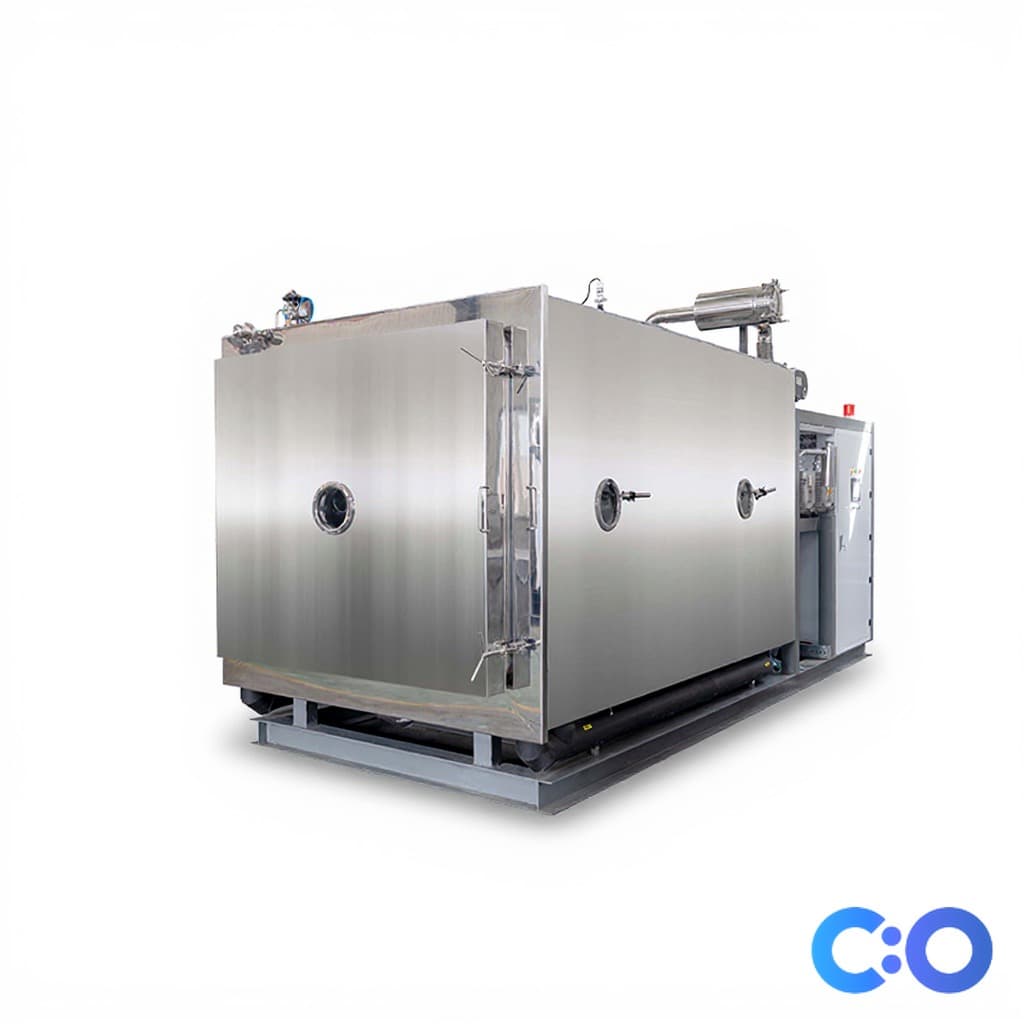
Pharmaceutical Freeze Dryer
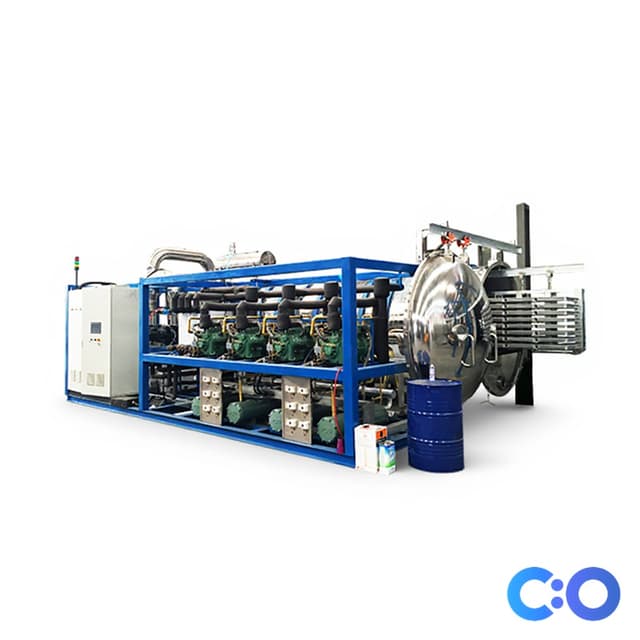
Large-scale pharmaceutical freeze dryer with 20.2 m² drying area, accommodating over 84,000 vials with automatic stoppering and temperature control from -50°C to +70°C.
| Automation Level | semi-automated |
| Freeze Drying Area(m2) | 20.2 |
| 10.5 | 20.2 |
| Vacuum Level(Pa) | ≤1 |
| Cold Trap Temperature(℃) | -75 |
| Maximum ice capacity(kg/B) | >400 |
The Pharmaceutical Freeze Dryer (BIO-0119) is a large-scale lyophilization system designed for pharmaceutical manufacturing and research applications. With a 20.2 m² freeze-drying area and capacity for over 84,000 vials (16mm diameter, 2ml), this system provides high-throughput processing for drug formulation development and production-scale freeze-drying operations.
The system features seven temperature-controlled shelves with automatic stoppering capability, operating across a wide temperature range from -50°C to +70°C. The -75°C cold trap temperature and vacuum capability below 1 Pa enable efficient sublimation and secondary drying phases. This equipment supports pharmaceutical research workflows requiring preservation of heat-sensitive compounds, protein formulations, and other biologics through controlled lyophilization processes.
How It Works
Freeze-drying operates through sublimation, where frozen water transitions directly from solid to vapor phase under vacuum conditions. The process begins with freezing the product to solidify free water, followed by primary drying where ice sublimes under reduced pressure. The cold trap at -75°C condenses water vapor, maintaining the vacuum environment necessary for efficient sublimation.
The seven temperature-controlled shelves provide heat input during sublimation, with precise temperature regulation from -50°C to +70°C enabling optimization of drying rates without damaging heat-sensitive compounds. Secondary drying removes bound water through desorption at slightly elevated temperatures under continued vacuum conditions.
Automatic stoppering functionality allows vials to be sealed under vacuum or controlled atmosphere conditions while still in the freeze dryer, preventing rehydration and maintaining product integrity throughout the process.
Features & Benefits
Automation Level
- semi-automated
Freeze Drying Area(m2)
- 20.2
10.5
- 20.2
Vacuum Level(Pa)
- ≤1
Cold Trap Temperature(℃)
- -75
Maximum ice capacity(kg/B)
- >400
>200
- >400
Shelf Temperature Range(℃)
- -50~+70
Shelf Size(W*D*H) (mm)
- 1220*1520*20
990*1520*20
- 1220*1520*20
Number of Shelf Layers(pcs)
- 7+1
7-1
- 7+1
Stoppering Mode
- automatic
automatic
- /
Total Qty. Of Vial (φ16mm(2ml))
- 84942
Brand
- ConductScience
Research Domain
- Analytical Chemistry
- Clinical Diagnostics
- Food Science
- Microbiology
- Pharmaceutical QC
Weight
- 881.85 lbs
Dimensions
- L: 59.84 in
- W: 48.03 in
- H: 0.63 in
Comparison Guide
| Feature | This Product | Typical Alternative | Advantage |
|---|---|---|---|
| Freeze-Drying Area | 20.2 m² across seven shelves | Laboratory models typically offer 0.1-2 m² drying area | Enables production-scale throughput for pharmaceutical manufacturing rather than research-only applications |
| Vial Capacity | 84,942 vials (16mm diameter, 2ml) | Small-scale systems handle hundreds to low thousands of vials | Supports commercial batch sizes reducing processing time and labor costs per unit |
| Cold Trap Capacity | >400 kg ice capacity at -75°C | Smaller systems typically offer 10-50 kg ice capacity | Maintains consistent vacuum conditions throughout extended production cycles without trap regeneration |
| Temperature Range | -50°C to +70°C shelf temperature control | Entry-level models may offer limited temperature ranges | Accommodates diverse pharmaceutical formulations from heat-sensitive biologics to robust compounds |
| Stoppering Capability | Automatic stoppering system | Manual stoppering or no stoppering capability | Maintains sterile conditions and prevents rehydration without operator intervention |
| Vacuum Performance | ≤1 Pa vacuum capability | Research systems may achieve 5-50 Pa depending on pump configuration | Enables faster sublimation rates and more complete moisture removal for improved product stability |
This pharmaceutical freeze dryer offers production-scale capacity with 20.2 m² drying area and automatic processing capabilities that distinguish it from laboratory research systems. The high vial capacity, deep vacuum performance, and automated stoppering provide the throughput and process control required for pharmaceutical manufacturing environments.
Practical Tips
Perform temperature mapping across all shelf positions using calibrated thermocouples to verify uniform heat distribution before processing critical batches.
Why: Temperature uniformity affects sublimation rates and final moisture content consistency across the batch.
Monitor vacuum pump oil condition and change according to manufacturer schedule to maintain optimal vacuum performance.
Why: Degraded pump oil reduces vacuum capability and increases cycle times while potentially contaminating products.
Load vials in consistent patterns with adequate spacing to ensure uniform vapor flow and heat transfer across shelf surfaces.
Why: Proper loading maximizes drying efficiency and prevents product temperature variations that could affect quality.
If vacuum levels exceed 1 Pa during operation, check door seal integrity and valve positions before investigating pump performance.
Why: Minor leaks are more common than pump failure and can be quickly identified and resolved.
Record shelf temperatures, chamber pressure, and product temperatures continuously throughout the cycle for process validation.
Why: Complete process documentation is essential for pharmaceutical manufacturing compliance and batch release decisions.
Ensure proper ventilation around the vacuum pump and cold trap to prevent accumulation of potentially hazardous vapors from products.
Why: Some pharmaceutical solvents or degradation products may present inhalation hazards during sublimation.
Pre-cool the chamber and shelves to freezing temperatures before loading to minimize product thaw during setup.
Why: Maintaining frozen state throughout loading prevents ice crystal growth that could affect product structure.
Inspect and clean the cold trap regularly to remove any product residues that could affect heat transfer efficiency.
Why: Fouled cold trap surfaces reduce condensation efficiency and may lead to vacuum performance degradation.
Setup Guide
What’s in the Box
- Main freeze dryer unit with control system
- Seven temperature-controlled shelves (1220×1520×20 mm each)
- Automatic stoppering mechanism
- Cold trap assembly
- Vacuum pump system
- Temperature monitoring sensors (typical)
- Process control software (typical)
- Installation and operation manual
- Calibration certificates (typical)
Warranty
ConductScience provides a comprehensive one-year manufacturer warranty covering parts and technical support, with extended service contracts available for production environments requiring maximum uptime.
Compliance
References
Background reading relevant to this product:
What is the maximum product load capacity for different vial sizes?
The system accommodates 84,942 vials of 16mm diameter (2ml volume). For larger vial sizes, capacity decreases proportionally based on footprint - consult product datasheet for specific configurations with different vial dimensions.
How uniform is temperature distribution across the 20.2 m² shelf area?
With seven individual shelves each measuring 1220×1520 mm, temperature uniformity depends on proper loading patterns and shelf calibration. Temperature mapping should be performed during qualification to verify ±2°C uniformity typical for pharmaceutical applications.
What cycle development capabilities does the control system provide?
The system supports programmable temperature profiles from -50°C to +70°C with vacuum control below 1 Pa. Cycle optimization requires process development work to determine appropriate primary and secondary drying parameters for specific formulations.
How does the automatic stoppering function integrate with sterile processing?
Automatic stoppering seals vials under controlled atmosphere conditions while maintaining chamber sterility. The mechanism must be qualified for sterile operations and integrated with facility environmental controls.
What utilities and facility requirements are needed for installation?
Installation requires appropriate electrical supply, chilled water circulation for condenser cooling, compressed air for pneumatics, and adequate floor loading capacity. Consult installation specifications for specific utility requirements.
How is process monitoring and data logging accomplished?
The control system monitors shelf temperatures, chamber pressure, and product temperatures throughout the cycle. Data logging capabilities and regulatory compliance features should be confirmed based on specific facility requirements.
What maintenance schedule is recommended for continuous operation?
Regular maintenance includes vacuum pump service, temperature calibration verification, and seal inspection. Preventive maintenance schedules depend on usage intensity and should follow manufacturer guidelines for production environments.
Have a question about this product?
Upgrade Options