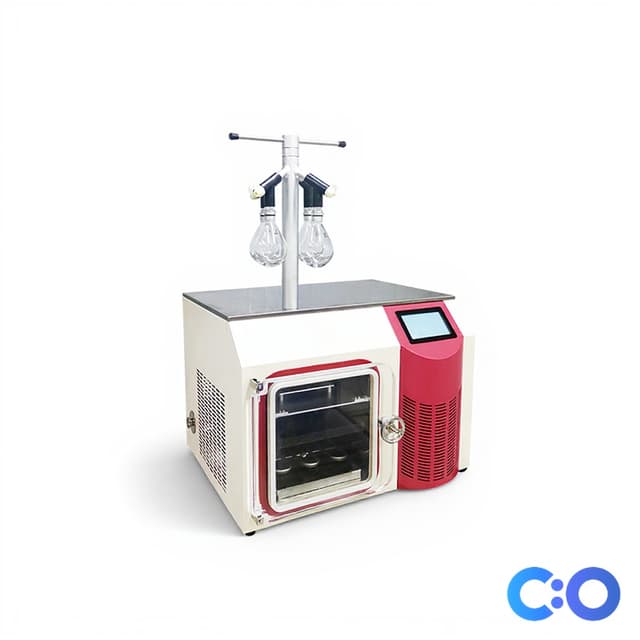
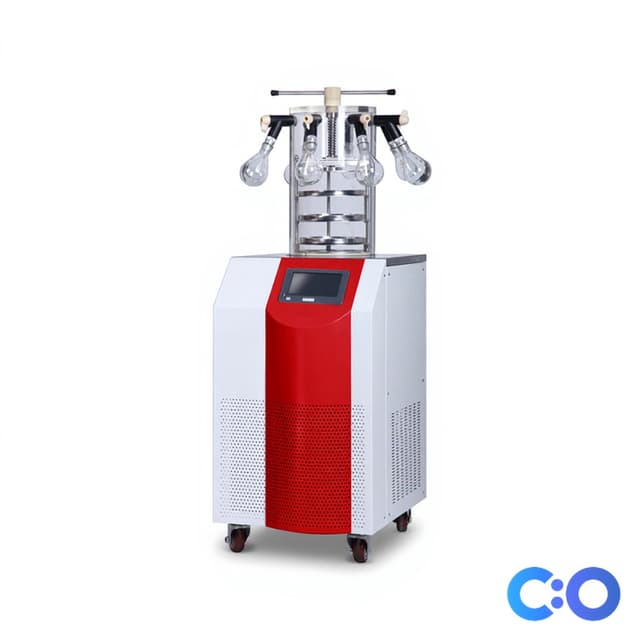
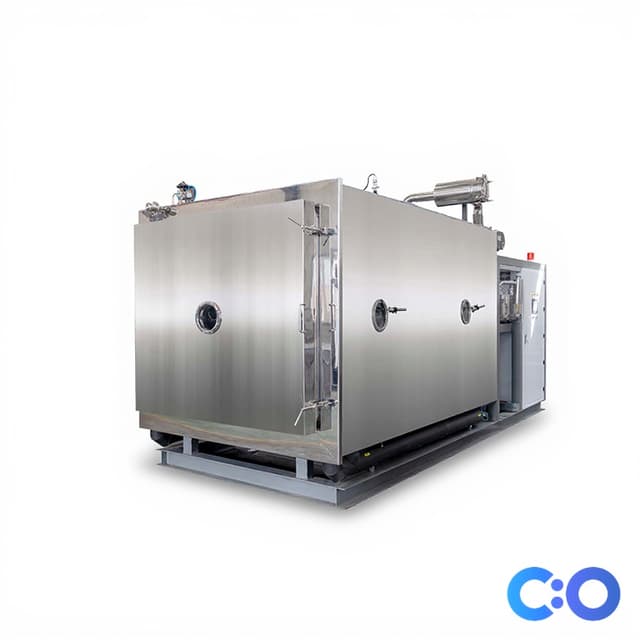
Vertical Freeze Dryer
Laboratory-scale vertical freeze dryer for preserving biological samples and pharmaceuticals through controlled lyophilization, featuring compact benchtop design with optimized vapor flow patterns.

Louise Corscadden, PhD
Director of Science · ConductScience
Ask Louise about Vertical Freeze Dryer fit, setup, configuration, or quote prep.
Already working with us? Sign in to connect this with My Scientist.
Key Specifications
Full details →- Model fit
- Configured during quote
- SKU family
- BIO-0122
- Shipping box
- 38.19 x 24.8 x 22.83 cm
- Ordering
- Online checkout and quote request available
- Category
- Freeze Dryers
- Build notes
- Confirm accessories, station layout, and support needs before purchase
The Vertical Freeze Dryer provides laboratory-scale lyophilization capabilities for preserving biological samples, pharmaceuticals, and other moisture-sensitive materials. This benchtop unit utilizes controlled sublimation to remove water directly from frozen samples while maintaining structural integrity and bioactivity. The vertical chamber design optimizes heat transfer and vapor flow patterns for consistent drying performance across multiple sample types.
With external dimensions of 97 cm length, 63 cm width, and 58 cm height, this freeze dryer accommodates standard laboratory workspace requirements while providing sufficient chamber volume for research-scale sample processing. The system is designed for applications requiring precise moisture removal without thermal degradation, making it suitable for protein preservation, vaccine formulation, tissue sample preparation, and pharmaceutical stability studies.
How It Works
Freeze drying operates through sublimation, the direct transition of ice to vapor without passing through the liquid phase. The process begins by freezing samples to approximately -40°C to -80°C, ensuring all water is converted to ice crystals. The chamber is then evacuated to create a vacuum environment where the vapor pressure of ice exceeds the partial pressure of water vapor in the system.
Under these conditions, ice sublimes directly into water vapor, which is captured by a cold trap maintained at temperatures below -40°C. The vertical chamber configuration promotes uniform heat distribution and efficient vapor removal by creating natural convection patterns that prevent vapor stagnation. Temperature and pressure are carefully controlled throughout the process to maintain sublimation conditions while preventing sample melting.
The drying process typically occurs in three phases: primary drying removes bulk ice through sublimation, secondary drying eliminates bound water molecules at slightly elevated temperatures, and final conditioning ensures complete moisture removal while maintaining sample integrity.
Features & Benefits
Automation Level
- semi-automated
Research Domain
- Cell Biology
- Food Science
- Immunology
- Materials Science
- Microbiology
- Pharmaceutical QC
Shipping weight
- 165.96 lb
Shipping box
- L: 38.19 cm
- W: 24.8 cm
- H: 22.83 cm
| Feature | This Product | Typical Alternative | Advantage |
|---|---|---|---|
| Chamber Orientation | Vertical chamber design with optimized vapor flow | Many entry-level models use horizontal tray configurations | Vertical orientation promotes uniform heat distribution and prevents vapor stagnation for consistent drying |
| Footprint Efficiency | Compact benchtop design at 97 x 63 x 58 cm | Larger units often require dedicated floor space | Benchtop compatibility maximizes laboratory space utilization while maintaining processing capacity |
| Sample Format Flexibility | Multiple sample holder configurations supported | Some models are limited to specific vial sizes or tray formats | Versatile sample handling accommodates diverse research applications and changing protocol requirements |
| Control System | Programmable cycle control with automated parameters | Basic models may offer limited programming options | Automated control ensures reproducible results and reduces operator intervention during long drying cycles |
This vertical freeze dryer combines compact benchtop design with research-grade performance capabilities. The vertical chamber orientation and programmable control system provide reliable lyophilization for diverse sample types while fitting standard laboratory workspace requirements.
Practical Tips
Pre-freeze samples to -40°C or below before loading to ensure complete ice crystal formation.
Why: Incomplete freezing can lead to sample melting during vacuum application and poor drying results.
Verify temperature sensor accuracy quarterly using NIST-traceable reference thermometers.
Why: Temperature accuracy is critical for maintaining proper sublimation conditions and sample integrity.
Clean the cold trap after each use cycle to prevent ice buildup and maintain vacuum efficiency.
Why: Ice accumulation in the cold trap reduces capacity and can compromise vacuum levels in subsequent runs.
Record chamber pressure and temperature continuously throughout the drying cycle.
Why: Process monitoring data enables cycle optimization and provides documentation for quality control purposes.
Check vacuum pump oil level and condition if ultimate vacuum is not achieved.
Why: Contaminated or insufficient pump oil is the most common cause of poor vacuum performance.
Allow chamber to return to atmospheric pressure slowly to prevent sample disturbance.
Why: Rapid pressure changes can create turbulence that redistributes dried samples or damages fragile structures.
Load samples in similar-sized containers to ensure uniform drying across the chamber.
Why: Different container sizes create varying heat transfer rates and can lead to inconsistent drying times.
Setup Guide
What’s in the Box
- Vertical freeze dryer main unit
- Sample holder assembly (typical)
- Vacuum pump system (typical)
- Temperature monitoring sensors (typical)
- Power cables and connections (typical)
- User manual and operating procedures (typical)
- Performance qualification documentation (typical)
Warranty
ConductScience provides a standard one-year manufacturer warranty covering parts and labor for defects in materials and workmanship. Technical support includes application guidance, troubleshooting assistance, and access to operating protocols for optimal performance.
Compliance
What sample volumes can this freeze dryer accommodate?
Consult product datasheet for specific chamber volume and sample capacity specifications. The vertical design typically accommodates multiple sample formats including vials, flasks, and bulk materials.
What vacuum level does the system achieve?
Consult product datasheet for ultimate vacuum specifications. Effective freeze drying typically requires pressures below 100 mTorr for efficient sublimation.
How long does a typical drying cycle take?
Cycle time varies with sample type, volume, and moisture content. Primary drying can range from hours to days depending on sample characteristics and desired final moisture level.
Can the system handle organic solvents?
Consult product datasheet for solvent compatibility. Many freeze dryers are designed primarily for aqueous samples and may require special considerations for organic solvents.
What maintenance is required?
Regular maintenance includes cold trap cleaning, vacuum pump oil changes, seal inspection, and temperature sensor calibration. Maintenance frequency depends on usage intensity and sample types.
Is the system suitable for pharmaceutical applications?
The system can be used in pharmaceutical research and development environments. Validation and qualification requirements depend on specific regulatory compliance needs.
How does performance compare to larger production freeze dryers?
Laboratory-scale units prioritize versatility and ease of use over throughput. Processing capacity is lower than production systems but offers greater flexibility for research applications.
Have a question about this product?
Have a question? Just ask.
Send it over and we'll email you a personalized answer — no call, no scheduling.
Prefer to talk it through?
Upgrade Options