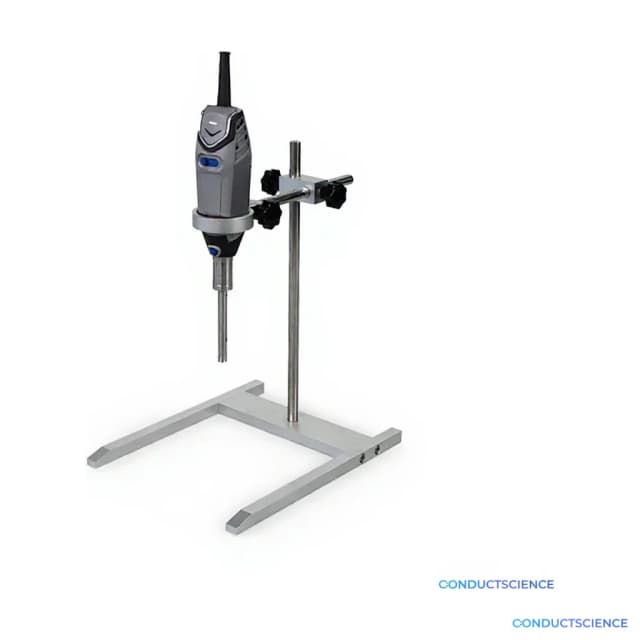
Portable Ultrasonic Cell Disruptor
Portable ultrasonic cell disruptor with 20-30 kHz frequency and adjustable 2.5-250W power for mechanical disruption of cellular structures in sample volumes from 0.1 to 150 ml.
| Automation Level | manual |
| Frequency(KHz) | 20~30, frequency automatic tracking |
| Crushing Capacity(ml) | 0.1~150ml(need to choose the corresponding horn) |
| Standard Amplitude Pole Φ(mm) | 3 or 5 |
| Optional Amplitude Pole Φ(mm) | 2, 3, 5, 6 |
| Standard Accessories | Bracket |

The Portable Ultrasonic Cell Disruptor is a laboratory instrument designed for mechanical disruption of cellular and subcellular structures through high-frequency ultrasonic waves. Operating at 20-30 kHz with automatic frequency tracking, this device generates controlled cavitation effects that break cell membranes and homogenize biological samples. The system delivers adjustable ultrasonic power from 2.5 to 250 watts, enabling processing of sample volumes from 0.1 to 150 ml depending on the selected amplitude pole configuration.
The portable design incorporates interchangeable amplitude poles (2, 3, 5, or 6 mm diameter) to accommodate different sample types and processing requirements. Standard equipment includes a 3 or 5 mm amplitude pole and mounting bracket, with optional accessories including a foot switch for hands-free operation and sound proof box for noise reduction. The unit operates on standard laboratory power (AC220V or AC110V) and provides consistent performance across diverse sample preparation protocols.
How It Works
The ultrasonic cell disruptor operates through the principle of acoustic cavitation, where high-frequency sound waves create alternating pressure cycles in liquid media. At frequencies of 20-30 kHz, the ultrasonic transducer generates compression and rarefaction waves that propagate through the sample. During rarefaction phases, negative pressure creates microscopic cavitation bubbles in the liquid, which rapidly collapse during compression phases, generating intense localized forces.
The collapsing cavitation bubbles produce extreme conditions including high temperatures (>5000K), pressures (>1000 atm), and shear forces that mechanically disrupt cell walls and membranes. The amplitude pole, available in diameters of 2-6 mm, focuses these ultrasonic waves into the sample volume, with smaller poles providing higher intensity for concentrated samples and larger poles distributing energy across greater volumes. The automatic frequency tracking system maintains optimal resonance conditions throughout the processing cycle.
Power adjustment from 2.5 to 250 watts allows precise control over disruption intensity, enabling gentle homogenization of delicate samples or aggressive disruption of resistant cell types. The pulsed operation capability prevents excessive heating while maintaining effective cellular breakdown, preserving thermally sensitive biomolecules during extraction procedures.
Features & Benefits
Automation Level
- manual
Frequency(KHz)
- 20~30, frequency automatic tracking
Crushing Capacity(ml)
- 0.1~150ml(need to choose the corresponding horn)
Standard Amplitude Pole Φ(mm)
- 3 or 5
Optional Amplitude Pole Φ(mm)
- 2, 3, 5, 6
Standard Accessories
- Bracket
Optional Accessories
- Foot switch, sound proof box
Ultrasonic Power(W)
- 2.5~250W, adjustable
Package Size(W*D*H)
- 470*305*450mm
Brand
- ConductScience
Research Domain
- Analytical Chemistry
- Cell Biology
- Food Science
- Materials Science
- Microbiology
- Pharmaceutical QC
Power/Voltage
- AC220V, 50/60Hz(Standard); AC110V, 50/60Hz(Optional)
Weight
- 14kg
Weight
- 14.0 kg
Dimensions
- L: 45.0 mm
- W: 47.0 mm
- H: 30.5 mm
Comparison Guide
| Feature | This Product | Typical Alternative | Advantage |
|---|---|---|---|
| Power Range | 2.5-250W adjustable | Fixed power models often limited to single output level | Enables optimization for different cell types and sample volumes within a single instrument. |
| Sample Volume Range | 0.1-150 ml capacity | Entry-level models typically handle narrower volume ranges | Accommodates both analytical and preparative scale work without requiring separate equipment. |
| Frequency Control | 20-30 kHz with automatic tracking | Basic models use fixed frequency operation | Maintains optimal energy transfer efficiency as sample properties change during processing. |
| Amplitude Pole Options | 2, 3, 5, 6 mm diameter options | Standard models often include only one or two probe sizes | Optimizes energy density for different sample volumes and applications without compromising performance. |
| Portability | 14 kg portable design with bracket | Benchtop units may require permanent installation | Provides installation flexibility for shared laboratory spaces and hood-based work. |
This ultrasonic disruptor offers broad power adjustment range (2.5-250W), wide sample volume compatibility (0.1-150 ml), and multiple amplitude pole options in a portable configuration. The automatic frequency tracking system maintains consistent performance across diverse sample types.
Practical Tips
Verify ultrasonic power output periodically using calorimetric methods to ensure consistent energy delivery.
Why: Power output can drift over time, affecting reproducibility of cell disruption protocols.
Inspect amplitude poles regularly for surface erosion and replace when pitting becomes visible.
Why: Damaged probe surfaces reduce energy transmission efficiency and can introduce contaminants.
Use pulsed operation (30-60 second intervals) rather than continuous treatment for temperature-sensitive samples.
Why: Prevents thermal degradation of proteins and other biomolecules while maintaining effective disruption.
If disruption efficiency decreases, check probe immersion depth and ensure it does not contact container walls.
Why: Improper probe positioning reduces cavitation effectiveness and can damage both probe and container.
Record total energy input (power × time) for each sample to enable protocol standardization and reproducibility.
Why: Energy dose is a critical parameter for consistent results across different operators and time points.
Always wear appropriate PPE including eye protection and use sound dampening when possible.
Why: Ultrasonic operation generates noise levels that can cause hearing damage with prolonged exposure.
Pre-cool samples and maintain on ice during processing to prevent thermal denaturation.
Why: Ultrasonic energy generates heat that can damage thermally sensitive cellular components.
If foaming occurs, reduce power settings or add antifoam agents compatible with downstream analysis.
Why: Excessive foaming reduces disruption efficiency and can lead to sample loss during processing.
Setup Guide
What’s in the Box
- Ultrasonic cell disruptor main unit
- Standard amplitude pole (3 or 5 mm)
- Mounting bracket
- Power cord
- User manual
- Calibration certificate (typical)
Warranty
ConductScience provides a one-year manufacturer warranty covering defects in materials and workmanship, with technical support for operation and maintenance guidance.
Compliance
What sample volumes can be effectively processed with different amplitude pole sizes?
The 0.1-150 ml capacity range requires appropriate amplitude pole selection: 2-3 mm poles for small volumes (0.1-10 ml), 5 mm pole for medium volumes (10-50 ml), and 6 mm pole for larger volumes (50-150 ml). Consult product datasheet for specific volume recommendations per pole diameter.
How do I prevent sample heating during extended ultrasonic treatment?
Use pulsed operation cycles (e.g., 30 seconds on, 30 seconds off) and maintain samples on ice during processing. Lower power settings with longer treatment times often achieve better results than high power continuous operation for heat-sensitive samples.
What maintenance is required for the amplitude poles?
Clean amplitude poles immediately after use with appropriate solvents, inspect for erosion or pitting that could affect performance, and replace when surface irregularities develop. Proper cleaning prevents cross-contamination and maintains consistent energy transmission.
Can this disruptor handle both aqueous and organic solvent-based samples?
Yes, the amplitude poles are compatible with most laboratory solvents. Ensure adequate ventilation when processing organic solvents and verify chemical compatibility for specialized solvents that might affect the titanium probe material.
How does the automatic frequency tracking feature work?
The system continuously monitors resonance conditions and adjusts frequency within the 20-30 kHz range to maintain optimal energy transfer efficiency, compensating for changes in sample properties during processing.
What factors determine the optimal power setting for cell disruption?
Cell type, sample volume, desired disruption level, and temperature sensitivity are key factors. Start with 10-20% power for delicate cells, 30-50% for standard applications, and higher settings for resistant organisms like spores or plant cells.
Have a question about this product?
Upgrade Options