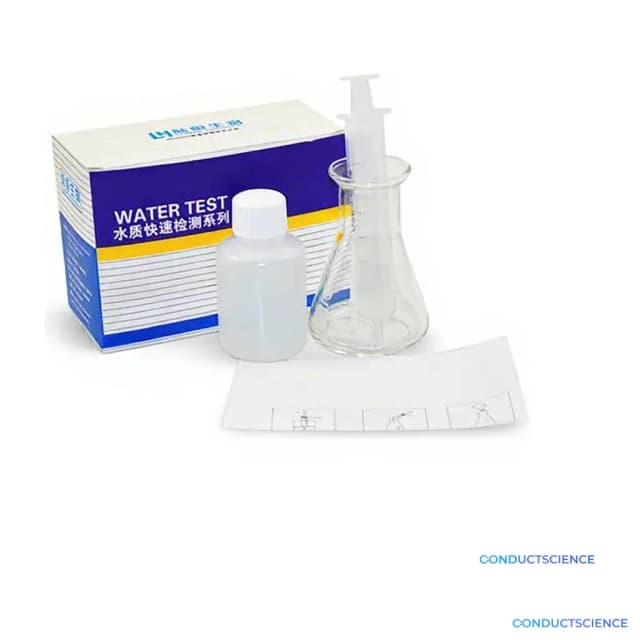
Purified Water Nitrite Test Kit
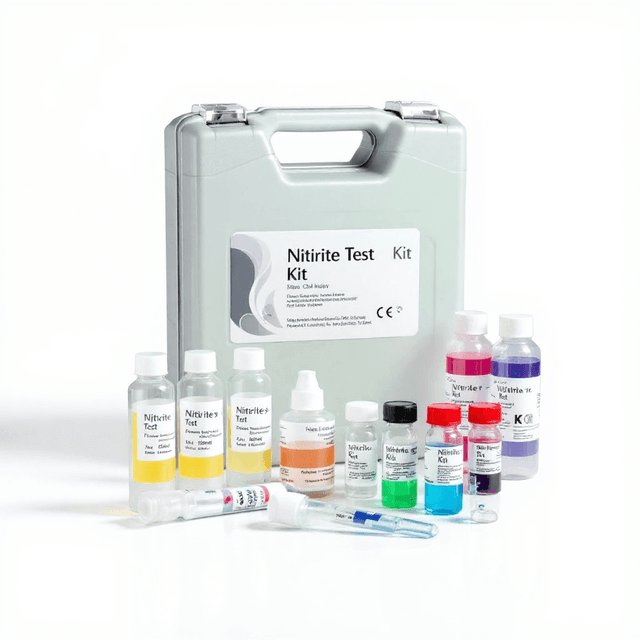
Colorimetric test kit for quantitative nitrite analysis in purified water systems, designed for pharmaceutical and research water quality monitoring.
| Product name | Model No. |
| purified water nitrite test kit | LH2014 |
| Automation Level | manual |
| Brand | ConductScience |

The Purified Water Nitrite Test Kit (Model LH2014) provides quantitative analysis of nitrite contamination in purified water systems used in pharmaceutical, biotechnology, and research applications. This colorimetric assay kit enables routine monitoring of water quality parameters critical for maintaining system integrity and product safety in regulated environments.
The test kit employs diazotization chemistry to detect nitrite concentrations through spectrophotometric measurement. Each kit contains pre-measured reagents and standardized protocols for consistent, reproducible results across multiple testing sessions. The methodology is suitable for both routine quality control monitoring and investigative troubleshooting of water purification systems.
How It Works
The test kit utilizes the Griess diazotization reaction, where nitrite ions react with sulfanilamide under acidic conditions to form a diazonium compound. This intermediate then couples with N-(1-naphthyl)ethylenediamine dihydrochloride to produce an azo dye with characteristic pink-purple coloration. The intensity of color development is directly proportional to nitrite concentration and can be measured spectrophotometrically at 540 nm.
The reaction proceeds through two sequential steps: first, nitrite reacts with sulfanilamide in the presence of phosphoric acid to form the diazonium salt. Second, the diazonium compound couples with the naphthylethylenediamine reagent to form the colored azo dye. This two-step mechanism ensures specificity for nitrite while minimizing interference from other nitrogen-containing compounds.
Quantification is achieved by comparing sample absorbance to a standard curve prepared using known nitrite concentrations. The linear response range and detection limits are optimized for typical nitrite levels encountered in purified water systems, providing reliable quantitation for regulatory compliance monitoring.
Features & Benefits
Product name
- Model No.
purified water nitrite test kit
- LH2014
Automation Level
- manual
Brand
- ConductScience
Research Domain
- Analytical Chemistry
- Clinical Diagnostics
- Environmental Monitoring
- Industrial Hygiene
- Microbiology
- Pharmaceutical QC
Weight
- 0.26 kg
Dimensions
- L: 30.0 mm
- W: 20.0 mm
- H: 10.0 mm
Comparison Guide
| Feature | This Product | Typical Alternative | Advantage |
|---|---|---|---|
| Detection Method | Colorimetric assay using Griess reaction chemistry | Ion chromatography or electrode-based methods | Requires only standard spectrophotometric equipment available in most laboratories. |
| Reagent Preparation | Pre-measured reagent system with standardized protocols | Manual reagent preparation from stock solutions | Eliminates preparation errors and ensures consistent test conditions between operators. |
| Sample Matrix | Optimized for purified water applications | General-purpose methods require matrix-specific validation | Provides validated performance for pharmaceutical and research water systems. |
| Equipment Requirements | Standard laboratory spectrophotometer at 540 nm | Specialized ion chromatography or electrode systems | Utilizes existing laboratory instrumentation without additional capital investment. |
The Purified Water Nitrite Test Kit provides a practical balance of analytical performance and operational simplicity for routine water quality monitoring. The standardized reagent system and established colorimetric methodology offer reliable results using standard laboratory equipment.
Practical Tips
Prepare fresh standards for each testing session and verify linearity across the full concentration range.
Why: Nitrite standards can degrade over time, affecting quantitation accuracy.
Store reagents according to specified temperature conditions and monitor for color changes or precipitation.
Why: Reagent degradation directly impacts color development and measurement precision.
Maintain consistent timing for color development and measurement across all samples and standards.
Why: Color intensity continues to change over time, requiring standardized timing for reproducible results.
Use reagent blanks to identify background interferences and verify spectrophotometer baseline stability.
Why: Systematic errors from contaminated reagents or instrument drift can compromise accuracy.
Include quality control samples at known concentrations with each analytical batch.
Why: QC samples provide real-time verification of method performance and detection of systematic errors.
Handle reagents in well-ventilated areas and avoid skin contact with diazotization reagents.
Why: Some reagents may cause skin sensitization or respiratory irritation with prolonged exposure.
Document environmental conditions including temperature and humidity during testing.
Why: Reaction kinetics can be influenced by environmental factors affecting reproducibility.
Setup Guide
What’s in the Box
- Nitrite test reagent vials (typical)
- Nitrite standard solution (typical)
- Reaction vessels or cuvettes (typical)
- Detailed protocol instructions
- Quality control materials (typical)
- Safety data sheets (typical)
Warranty
ConductScience provides standard warranty coverage for reagent kits, including replacement of defective components and technical support for methodology questions. Warranty terms apply to properly stored kits within the specified shelf life period.
Compliance
What is the detection limit and linear range for nitrite measurement?
Consult the product datasheet for specific detection limits and calibration ranges, which are optimized for typical nitrite levels in purified water systems.
How long are the reagents stable after opening?
Reagent stability varies by component; follow storage instructions provided with the kit and monitor for signs of degradation such as color changes or precipitation.
Can this kit be used for other water types besides purified water?
The kit is optimized for purified water matrices; other water types may require dilution or method modification to account for matrix interferences.
What spectrophotometer specifications are required?
A standard laboratory spectrophotometer capable of measurement at 540 nm with appropriate cuvette path length is required for quantitative analysis.
How does sample storage affect nitrite stability?
Nitrite is susceptible to bacterial conversion and oxidation; analyze samples immediately or store at 4°C for maximum 24 hours to maintain accuracy.
What interferences should be considered?
Common interferences include high chloride levels, turbidity, and certain organic compounds; consult methodology notes for specific interference thresholds.
How many tests can be performed per kit?
The number of determinations depends on reagent volumes and sample size requirements; refer to kit specifications for testing capacity.
Have a question about this product?
Accessories
Enhance your setup with compatible accessories
Frequently Bought Together