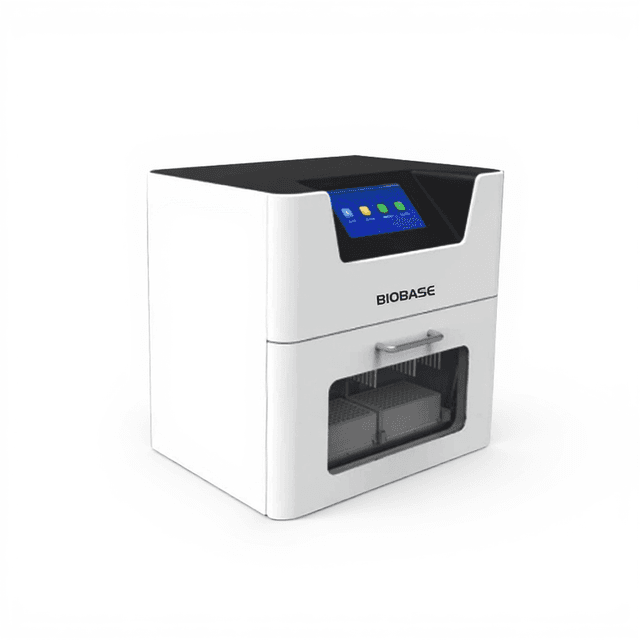
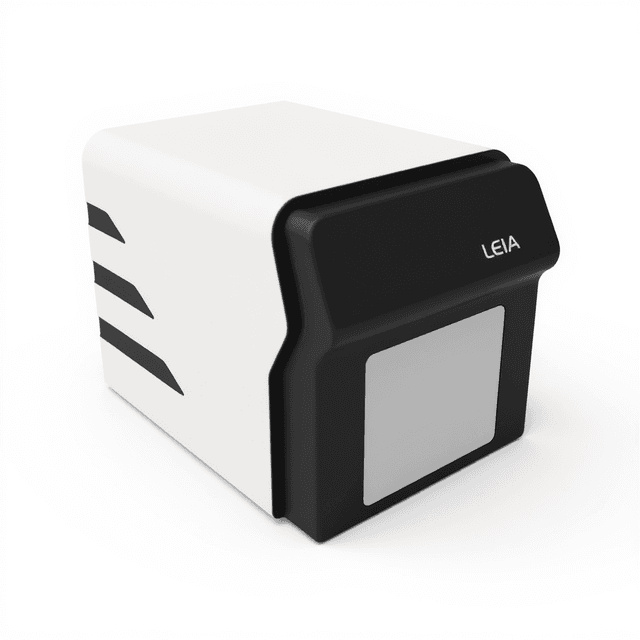
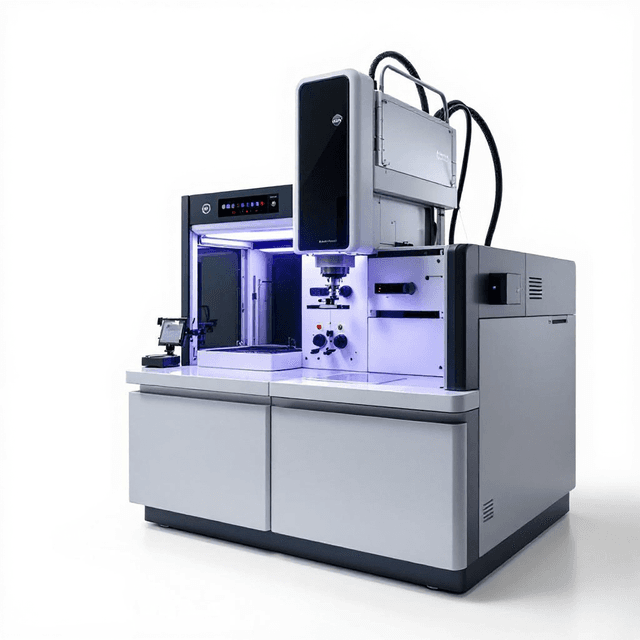
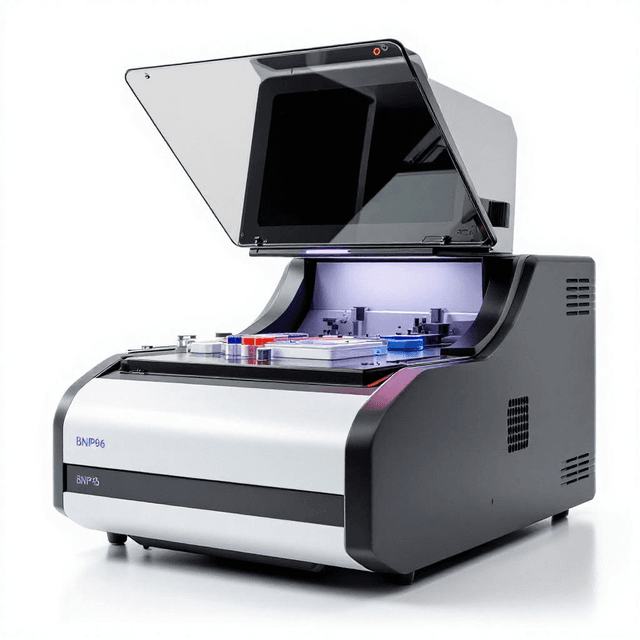
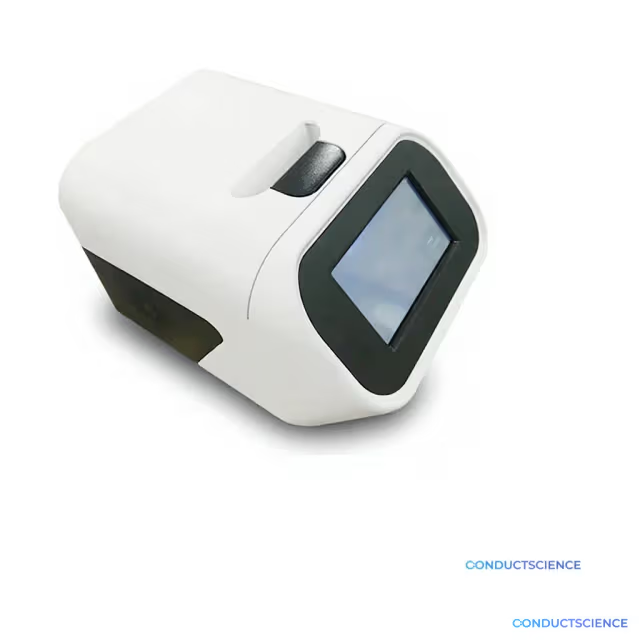
Real Time PCR Detection System
96-well real-time PCR system with 4-channel fluorescence detection, providing quantitative nucleic acid analysis with 1×10^10 copy dynamic range and 5.5-second plate scanning capability.
| Instrument Type | PCR & Molecular |
| Application Area | Molecular Biology |
| Automation Level | fully-automated |
| max_heating_rate | 7.0℃/s |
| fluorescence_channels | 4/6-channel |
| detection_method | Top excitation/detection, non-contact measurement |
The Real Time PCR Detection System is a 96-well quantitative PCR platform designed for molecular biology research applications requiring precise nucleic acid quantification. The system features 4-channel fluorescence detection with LED excitation and photodiode sensors, enabling simultaneous monitoring of multiple targets across a 1×10^10 copy dynamic range with reaction volumes from 5-100 μL.
The instrument employs top excitation and non-contact detection methodology with motor-controlled X-Y axis positioning for precise fluorescence measurement. Temperature control operates from 4-105°C with uniformity maintained within ±0.3°C across the thermal block and accuracy of ±0.1°C. Complete plate scanning is accomplished in 5.5 seconds with maximum ramp rates of 4.0°C/s, supporting high-throughput analysis workflows in research laboratories requiring rapid thermal cycling and real-time fluorescence monitoring.
How It Works
The Real Time PCR Detection System operates on the principle of thermal cycling combined with real-time fluorescence detection. During each PCR cycle, template DNA is denatured at high temperature, primers anneal at intermediate temperature, and DNA polymerase extends the primers at optimal temperature. As target sequences amplify exponentially, fluorescent reporters (dyes or probes) generate proportional signal increases that are monitored in real-time.
The system uses LED excitation sources and photodiode sensors arranged in a 4-channel configuration to simultaneously detect multiple fluorophores. Top excitation and non-contact detection methodology eliminates optical interference while motor-controlled X-Y positioning ensures precise measurement across all 96 wells. The thermal block maintains uniform temperature distribution (±0.3°C) through engineered heat transfer, while rapid ramp rates up to 4.0°C/s minimize cycle times.
Quantification is achieved by determining the cycle number (Ct) at which fluorescence exceeds background threshold. Earlier Ct values indicate higher initial target concentrations, enabling precise quantification across the 10-fold dynamic range from 1 to 10^10 copies through comparison with standard curves or reference genes.
Features & Benefits
Instrument Type
- PCR & Molecular
Application Area
- Molecular Biology
Automation Level
- fully-automated
max_heating_rate
- 7.0℃/s
fluorescence_channels
- 4/6-channel
detection_method
- Top excitation/detection, non-contact measurement
sensor_type
- PD sensor with high sensitivity
light_source
- Long-life LED
sample_format
- 96-hole
movement_control
- Motor control x and Y axis
Sample Capacity
- 96×0.2ml PCR plate
Reaction System
- 5~100μl
Dynamics Range
- 1~10^10
Channel Count
- 4
Module Temp Range
- 4~105°C (±0.1°C)
Ramp Rate
- 4.0°C/s (max)
Temp Control Accuracy
- ±0.1°C
Temp Uniformity
- ≤±0.3°C
Gradient Temp Range
- 1~36°C
Scanning Time
- 5.5 seconds
Dimensions (L×W×H)
- 410×386×352mm
Research Domain
- Cancer Research
- Clinical Diagnostics
- Developmental Biology
- Environmental Monitoring
- Immunology
- Microbiology
- Molecular Biology
- Pharmaceutical QC
Power/Voltage
- 100~240V, 50/60Hz, 600W
Weight
- 55kg
Weight
- 121.25 lbs
Dimensions
- L: 16.14 in
- W: 15.2 in
- H: 13.86 in
Comparison Guide
| Feature | This Product | Typical Alternative | Advantage |
|---|---|---|---|
| Detection Channels | 4-channel fluorescence detection | Entry-level models often offer 2-channel detection | Enables multiplexed assays and simultaneous internal controls, reducing reagent costs and analysis time. |
| Plate Scanning Speed | 5.5-second complete plate scan | Basic systems typically require 10-30 seconds per scan | Minimizes fluorescence acquisition time during cycling, reducing total protocol duration. |
| Dynamic Range | 1×10^10 copy quantification range | Standard systems often provide 10^6-10^8 copy range | Accommodates both trace-level detection and high-abundance targets without dilution requirements. |
| Temperature Ramp Rate | 4.0°C/s maximum heating rate | Conventional systems typically achieve 2-3°C/s | Reduces cycling time while maintaining temperature precision for faster protocol completion. |
| Sample Capacity | 96-well format with 5-100 μL reactions | Smaller systems may offer 48-well or fixed volume formats | Provides high-throughput capability with flexible reaction volume optimization for different applications. |
| Temperature Uniformity | ±0.3°C uniformity across thermal block | Basic models may have ±0.5°C or greater variation | Ensures consistent amplification efficiency across all wells for reliable quantitative comparisons. |
This system combines research-grade thermal precision and 4-channel detection with high-throughput 96-well capacity, offering faster scanning and broader dynamic range than entry-level platforms. The motor-controlled positioning and LED-photodiode detection provide stable performance for demanding quantitative applications.
Practical Tips
Verify thermal calibration quarterly using certified temperature standards, particularly after any maintenance or if temperature-sensitive assays show unexpected results.
Why: Maintains temperature accuracy critical for reproducible amplification kinetics and quantitative precision.
Clean the thermal block weekly with appropriate solvents and inspect optical windows for contamination that could affect fluorescence detection.
Why: Prevents thermal transfer issues and optical interference that can compromise data quality.
Include no-template controls and reference standards on every plate to monitor for contamination and verify quantification accuracy.
Why: Enables real-time quality control and ensures data reliability across experimental runs.
Optimize reaction volumes between 10-25 μL for most applications to balance cost efficiency with signal-to-noise ratio performance.
Why: Smaller volumes may show increased variability while larger volumes increase reagent costs without proportional benefit.
If amplification curves appear irregular, check plate sealing integrity and verify that ramp rates are appropriate for your polymerase system.
Why: Evaporation and thermal stress can cause amplification artifacts that affect quantitative accuracy.
Allow the thermal block to cool completely before handling and always use appropriate personal protective equipment when working with heated surfaces.
Why: The thermal block reaches 105°C and retains heat after cycling, presenting burn hazards during plate handling.
Position the instrument away from vibration sources and maintain consistent ambient temperature to minimize baseline drift in fluorescence measurements.
Why: Environmental stability is crucial for sensitive fluorescence detection and quantitative reproducibility.
Replace desiccants in the instrument compartment annually and monitor for condensation that could affect electronic components.
Why: Humidity control protects sensitive optical and electronic systems from corrosion and performance degradation.
Setup Guide
What’s in the Box
- Real Time PCR Detection System main unit
- Power cable and adapter
- USB communication cable (typical)
- 96-well PCR plate adapters
- Calibration standards and verification materials (typical)
- Analysis software installation media
- User manual and protocol guides
- Quick start guide and safety instructions
Warranty
ConductScience provides a standard one-year manufacturer warranty covering parts and labor, with comprehensive technical support for installation, training, and ongoing operation. Extended warranty options are available for mission-critical applications.
Compliance
References
Background reading relevant to this product:
What fluorophores are compatible with the 4-channel detection system?
The system supports standard qPCR fluorophores including FAM, HEX, ROX, and Cy5, though specific excitation and emission wavelengths should be verified against the instrument specifications for optimal performance.
Can the system perform both absolute and relative quantification?
Yes, the 1×10^10 copy dynamic range supports both absolute quantification using standard curves and relative quantification using reference gene normalization methods such as the ΔΔCt approach.
What is the minimum detectable change in gene expression?
Fold-change detection depends on experimental design and controls, but the system's temperature precision (±0.1°C) and dynamic range typically enable reliable detection of 2-fold or greater expression differences with appropriate replication.
How does thermal uniformity affect quantitative accuracy?
The ±0.3°C uniformity across the 96-well block ensures consistent amplification efficiency between wells, critical for comparative quantification and maintaining CV values below 5% for technical replicates.
Can custom PCR protocols be programmed for specialized applications?
The system allows full protocol customization including temperature profiles, hold times, ramp rates, and fluorescence acquisition settings to accommodate diverse PCR applications and optimization requirements.
What data formats are supported for downstream analysis?
Consult product datasheet for specific file export formats, though most real-time PCR systems support standard formats compatible with statistical analysis software and laboratory information management systems.
How frequently does the system require calibration?
Thermal calibration should be verified quarterly or after any maintenance, while fluorescence calibration frequency depends on usage intensity and performance monitoring through quality control standards.
What maintenance procedures are required for optimal performance?
Regular maintenance includes thermal block cleaning, optical window inspection, and performance verification using calibration standards, with annual professional servicing recommended for high-usage laboratories.
Have a question about this product?
Accessories
Enhance your setup with compatible accessories
Frequently Bought Together