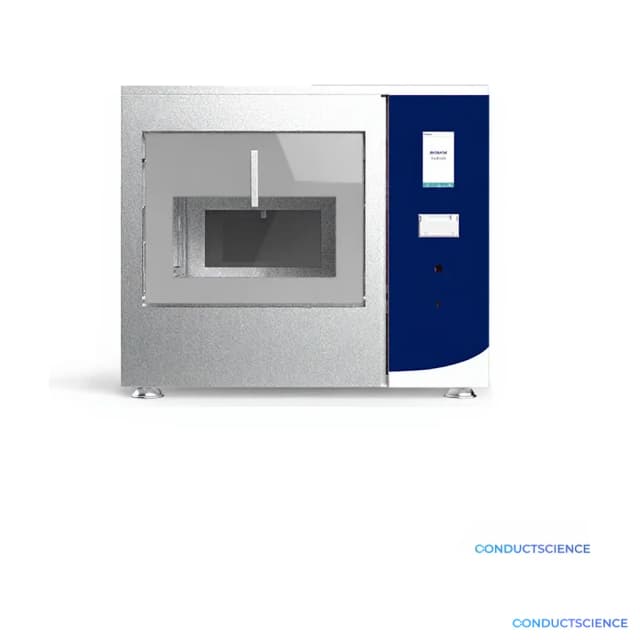
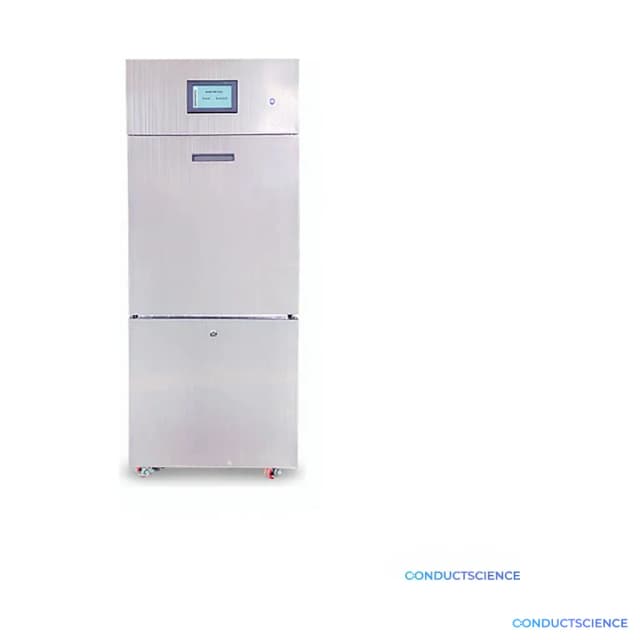
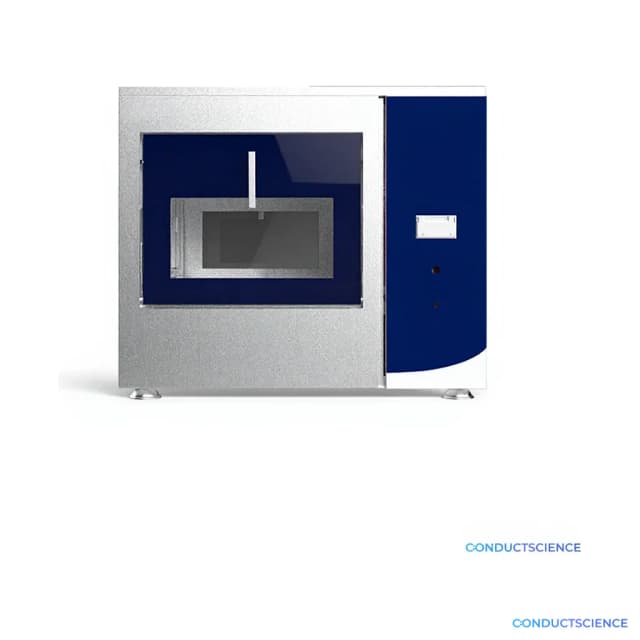
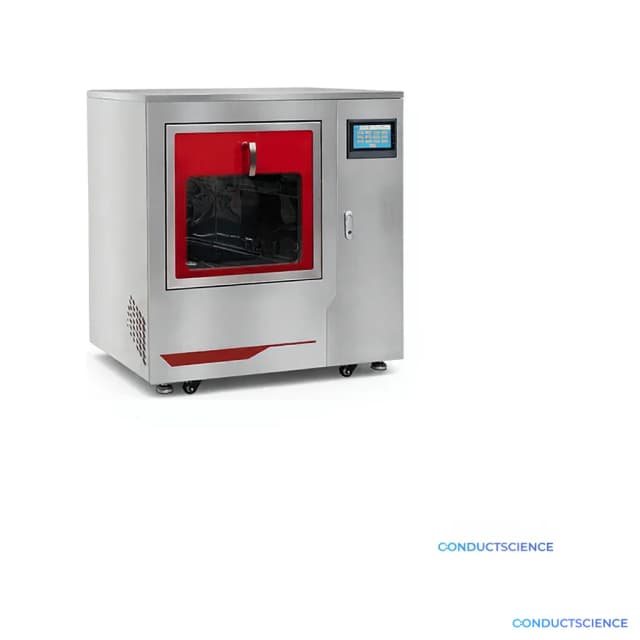
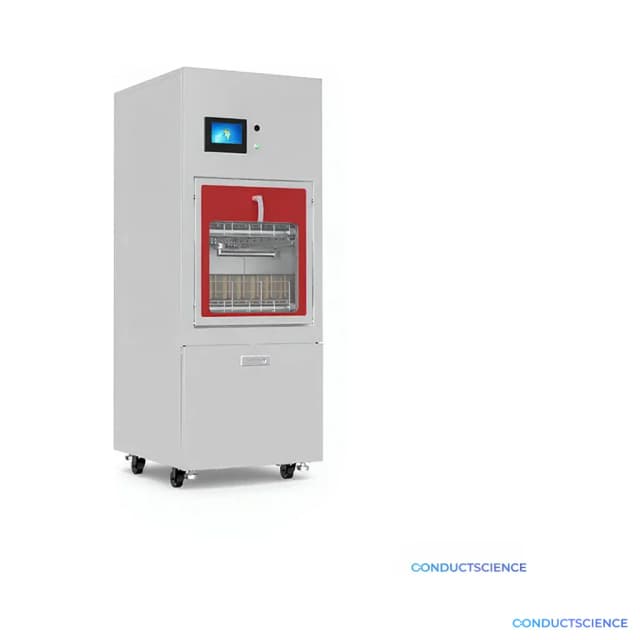
Table Top Full-automatic Glassware Washer
Automated 90L tabletop glassware washer with programmable temperature control, dual chemical dosing pumps, and integrated drying for laboratory cleaning workflows.
| Automation Level | fully-automated |
| Washer Load Level | 1 |
| Water Wash Power | 0.29KW |
| Water Heater Power | 3KW |
| MAX. Power | 3.5KW |
| Water Consumption/Step | 8L |
The ConductScience Table Top Full-automatic Glassware Washer is a compact laboratory cleaning system designed for automated processing of glassware, instruments, and laboratory consumables. This 90L capacity unit provides standardized cleaning protocols with programmable temperature control (0-99°C), dual peristaltic pump chemical dosing, and integrated drying functionality. The system operates on a single wash load level with 8L water consumption per step and utilizes a high-capacity Sweden washing pump rated at 150L/min for effective cleaning circulation.
The washer incorporates automated chemical management through two independent peristaltic pumps controlling detergent and neutralizing agents, with integrated level sensors for chemical monitoring. Water supply requirements of 0.3-1.0 MPa pressure accommodate standard laboratory plumbing, while the 3KW water heater provides rapid temperature adjustment for thermal cleaning protocols. The compact tabletop design (65.0 x 52.9 x 64.8 cm) enables installation in space-constrained laboratory environments while maintaining full automation capabilities for routine glassware decontamination workflows.
How It Works
The glassware washer operates through automated mechanical and thermal cleaning cycles combined with chemical dosing for comprehensive decontamination. The system fills the 90L capacity chamber with temperature-controlled water (0-99°C) and circulates cleaning solution using a high-flow Sweden washing pump rated at 150L/min. This circulation creates turbulent flow patterns that mechanically remove particulates and biological residues from glassware surfaces.
Two independent peristaltic pumps precisely dose detergent and neutralizing agents according to programmed protocols, with integrated level sensors monitoring chemical reservoir status. The thermal component utilizes a 3KW water heater to achieve and maintain target temperatures for protein denaturation and lipid solubilization. Following wash cycles, the integrated drying function removes residual moisture through controlled airflow, preparing cleaned items for immediate use or sterile storage.
Each cleaning step consumes 8L of water with automated drainage and refill sequences, ensuring fresh cleaning solution for each cycle phase. The single wash load level design optimizes cleaning efficiency for the 90L chamber capacity while maintaining consistent cleaning performance across different glassware types and contamination levels.
Features & Benefits
Automation Level
- fully-automated
Washer Load Level
- 1
Water Wash Power
- 0.29KW
Water Heater Power
- 3KW
MAX. Power
- 3.5KW
Water Consumption/Step
- 8L
Tank Internal Temperature
- 0~99℃
Water Supply Pressure
- 0.3~1.0Mpa
Peristaltic Pump for Cleaning Agent
- 2 independent pumps control detergent agent and neutralizing agent
Cleaning Agent Level Sensor
- YES
Washing Pump
- Sweden 150L/min
Standard Cleaning Racks
- Select the following cleaning rack(one)
Drying
- Drying Function
Steam Condenser
- NO
Brand
- ConductScience
Research Domain
- Analytical Chemistry
- Cell Biology
- Clinical Diagnostics
- Environmental Monitoring
- Food Science
- Microbiology
- Pharmaceutical QC
Capacity
- 90L
Weight
- 65.0 lbs
Dimensions
- L: 65.0 in
- W: 52.9 in
- H: 64.8 in
Comparison Guide
| Feature | This Product | Typical Alternative | Advantage |
|---|---|---|---|
| Chamber Capacity | 90L with single wash load level | Entry-level units often provide 30-60L capacity | Larger capacity reduces cleaning frequency and improves laboratory workflow efficiency for high-volume operations. |
| Washing Pump Flow Rate | Sweden 150L/min circulation pump | Standard models typically offer 50-100L/min flow rates | Higher flow rate provides more aggressive mechanical cleaning action for stubborn residues and complex glassware geometries. |
| Chemical Dosing System | Two independent peristaltic pumps with level sensors | Basic units may have single pump or manual dosing | Dual pump system enables separate detergent and neutralizer control for optimized cleaning chemistry and automated inventory monitoring. |
| Temperature Range | Programmable 0-99°C with 3KW heater | Limited temperature models often max at 60-80°C | Extended temperature range accommodates thermal sterilization protocols and protein denaturation requirements for biological contamination. |
| Installation Footprint | Tabletop design: 65.0 x 52.9 x 64.8 cm | Floor-standing units require dedicated floor space | Compact tabletop installation maximizes laboratory space utilization while maintaining full automation capabilities. |
| Integrated Functions | Combined washing and drying with automated cycles | Separate drying equipment may be required | Single-unit processing from dirty to dry reduces handling steps and contamination risk while simplifying equipment management. |
This glassware washer offers high-capacity processing in a space-efficient tabletop design, with advanced chemical dosing automation and extended temperature range capabilities. The Sweden high-flow pump and dual chemical management system provide comprehensive cleaning performance for diverse laboratory contamination challenges.
Practical Tips
Verify temperature accuracy using calibrated thermometer during initial installation and quarterly thereafter. Check chemical dosing pump calibration by measuring delivered volumes against programmed settings.
Why: Accurate temperature and chemical dosing ensure cleaning protocol effectiveness and validation compliance.
Inspect and clean the 150L/min washing pump filter weekly in high-use environments to maintain circulation performance. Descale heating elements monthly in hard water areas.
Why: Regular pump maintenance prevents flow reduction while descaling maintains heating efficiency and extends equipment life.
Pre-rinse heavily contaminated glassware to remove gross debris before loading. Group similar contamination types for batch processing with appropriate cleaning programs.
Why: Pre-rinsing prevents drain blockage and contamination carryover while batching optimizes chemical usage and cycle efficiency.
If cleaning results are inconsistent, check rack loading patterns for proper water circulation access. Verify chemical level sensors are clean and functioning properly.
Why: Poor circulation reduces cleaning effectiveness while faulty sensors can cause incomplete chemical dosing.
Document cleaning programs used for different contamination types and maintain cleaning validation records. Log chemical consumption rates for inventory planning.
Why: Systematic documentation supports cleaning validation requirements and enables optimization of chemical usage costs.
Always verify proper ventilation when using chemical cleaning agents and ensure emergency eyewash stations are accessible. Check electrical grounding before operation.
Why: Chemical vapors require adequate ventilation while proper grounding prevents electrical hazards from water and chemical exposure.
Replace chemical dosing tubing according to manufacturer schedule or when reduced flow is observed. Keep spare tubing sets in inventory for minimal downtime.
Why: Degraded tubing affects dosing accuracy and can cause cleaning protocol failures requiring re-processing of entire loads.
Run an empty cleaning cycle weekly to maintain system hygiene and remove any accumulated residues from previous loads. Use this for preventive system assessment.
Why: Regular empty cycles prevent cross-contamination between loads and provide opportunity to identify system issues before they affect cleaning performance.
Setup Guide
What’s in the Box
- Table Top Full-automatic Glassware Washer main unit
- Standard cleaning rack (one selected configuration)
- Power cable and electrical connections
- Water supply and drainage fittings (typical)
- Chemical dosing tubing and connectors (typical)
- User manual and operating instructions
- Installation guide and safety documentation (typical)
Warranty
ConductScience provides a comprehensive 1-year manufacturer warranty covering parts and labor for the glassware washer system. Technical support includes installation guidance, operational training, and maintenance protocols to ensure optimal cleaning performance throughout the warranty period.
Compliance
What types of cleaning racks are available and how do I select the appropriate configuration?
The system includes standard cleaning racks with one selectable configuration. Rack selection should be based on your primary glassware types - beakers, flasks, pipettes, or specialized analytical vessels. Consult product datasheet for specific rack options and loading capacities.
Can the washer handle biological safety level 2 (BSL-2) contaminated materials?
The programmable temperature control (0-99°C) and chemical dosing system can accommodate BSL-2 decontamination protocols. However, specific validation for your biosafety requirements should be confirmed with your institutional biosafety committee and cleaning program validation.
What cleaning agents are recommended and how much chemical consumption should I expect?
The dual peristaltic pump system accommodates standard laboratory detergents and neutralizing agents. Chemical consumption depends on programmed dosing rates and cycle frequency. The level sensors provide consumption monitoring for inventory management.
How does the drying function work and what are the typical drying times?
The integrated drying function uses controlled airflow to remove residual moisture post-cleaning. Drying times vary based on glassware type, load density, and ambient conditions. Consult product datasheet for specific drying cycle parameters.
What preventive maintenance is required and how often?
Regular maintenance includes cleaning pump filter inspection, chemical reservoir cleaning, and water system descaling. The high-flow Sweden pump and heating elements require periodic inspection. Maintenance frequency depends on usage intensity and water quality.
Can multiple cleaning programs be stored for different contamination types?
The system supports programmable cleaning protocols with variable temperature, time, and chemical dosing parameters. Multiple programs can accommodate different contamination levels from routine analytical cleaning to heavy biological decontamination.
What are the installation requirements for water supply and drainage?
Water supply requires 0.3-1.0 MPa pressure with standard laboratory plumbing connections. Drainage system must accommodate 8L volume discharge per cleaning step. Electrical requirements include 3.5KW maximum power capacity with appropriate safety grounding.
How does this compare to manual cleaning or ultrasonic baths?
Automated cleaning provides standardized protocols and documentation for validation requirements, unlike manual methods. Compared to ultrasonic baths, this system handles larger volumes with thermal and chemical cleaning combined with mechanical circulation for comprehensive decontamination.
Have a question about this product?
Accessories
Enhance your setup with compatible accessories
Frequently Bought Together
Upgrade Options