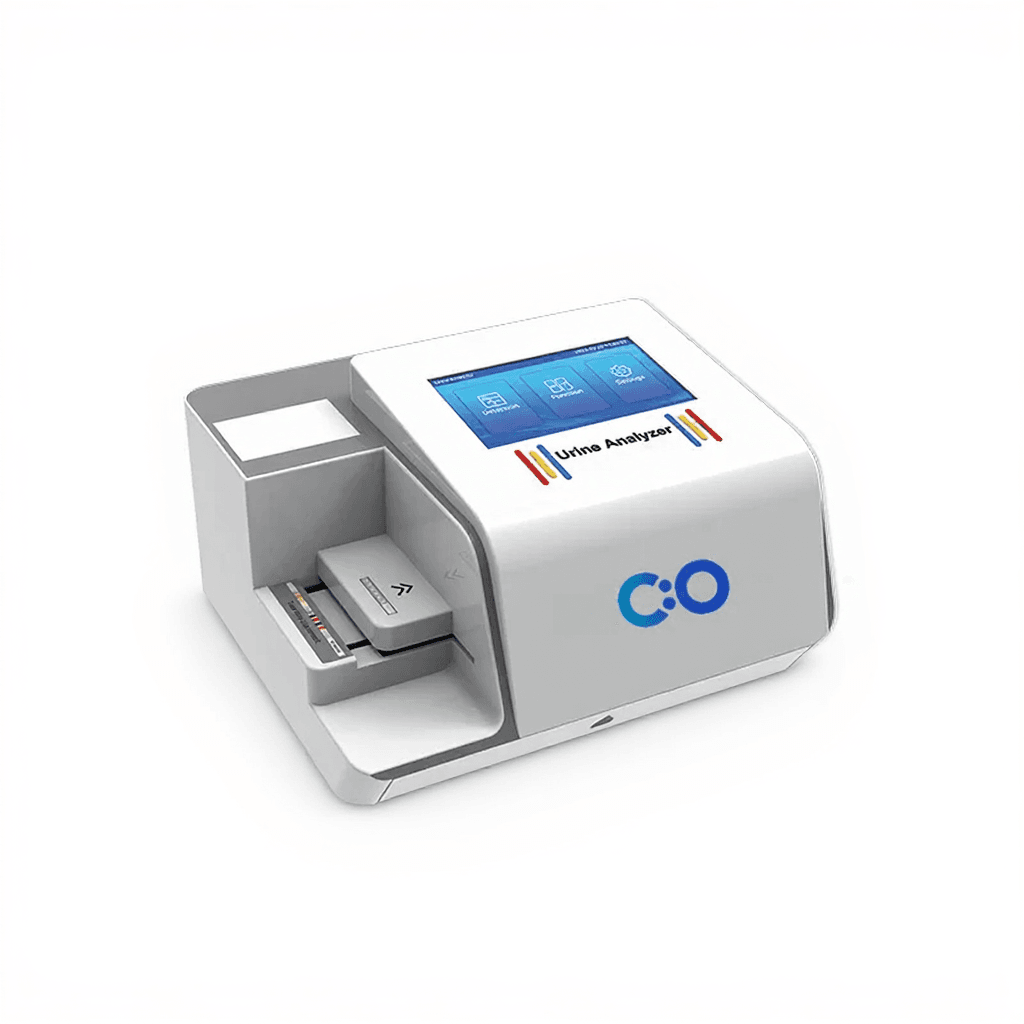
Urine Analyzer
Fully automated urine analyzer processing up to 14 parameters at 700 tests/hour with computer vision detection technology and integrated data management for high-throughput clinical research applications.
| Instrument Type | Clinical Analyzers |
| Application Area | Clinical Diagnostics |
| Automation Level | fully-automated |
| detection_parameters | up to 14 items |
| automation_level | automatic detection with intelligent identification |
| portability | small and light, easy to carry |
The Urine Analyzer (Model CS-BH-NY01) is a fully automated clinical analyzer designed for high-throughput urinalysis in research and clinical diagnostics applications. The system utilizes computer vision detection technology with intelligent identification algorithms to process urine test strips containing 9, 10, 11, or 14 analytical parameters at a throughput rate of 700 tests per hour. This eliminates manual reading errors and provides standardized, objective results for urinalysis endpoints in research protocols.
The analyzer features a 7-inch LCD touch screen interface, built-in thermal printer, and data storage capacity exceeding 37,000 test reports. Connectivity options include USB, RS232, and laboratory information system (LIS) protocols for seamless integration with existing laboratory workflows. The compact, portable design enables deployment across various research settings while maintaining the analytical performance required for mass screening applications and studies involving urinalysis biomarkers.
How It Works
The urine analyzer employs computer vision detection technology combined with colorimetric analysis to interpret biochemical reactions on urine test strips. When a urine sample is applied to a test strip containing multiple reagent pads, specific analytes in the sample react with corresponding reagents to produce characteristic color changes. The analyzer's optical system captures high-resolution images of the test strip at precisely timed intervals after sample application.
Intelligent identification algorithms process the captured images, analyzing color intensity and hue changes across each reagent pad to determine analyte concentrations. The system compares these colorimetric responses against calibrated reference standards stored in its database, automatically converting optical signals to quantitative or semi-quantitative results. This computer vision approach eliminates subjective visual interpretation and provides consistent, reproducible measurements across different operators and testing conditions.
The automated workflow processes test strips at 700 tests per hour, with each strip analyzed for up to 14 parameters simultaneously. Results are immediately available through the touch screen interface and can be printed via the integrated thermal printer or transmitted to laboratory information systems through multiple connectivity protocols.
Features & Benefits
Instrument Type
- Clinical Analyzers
Application Area
- Clinical Diagnostics
Automation Level
- fully-automated
detection_parameters
- up to 14 items
automation_level
- automatic detection with intelligent identification
portability
- small and light, easy to carry
software_features
- system upgrade function
test_speed
- fast (suitable for mass physical examination)
user_interface
- LCD touch screen for man-machine interaction
Display Type
- LCD
Research Domain
- Clinical Diagnostics
- Environmental Monitoring
- Metabolic Research
- Pharmaceutical QC
- Toxicology
Weight
- 2.0 lbs
Dimensions
- L: 42.0 in
- W: 43.6 in
- H: 38.0 in
Comparison Guide
| Feature | This Product | Typical Alternative | Advantage |
|---|---|---|---|
| Processing Throughput | 700 tests per hour | Entry-level analyzers typically process 100-300 tests per hour | Higher throughput enables large-scale epidemiological studies and population screening protocols with rapid sample processing. |
| Parameter Range | Supports 9, 10, 11, or 14 parameter test strips | Basic models often limited to 8-10 parameters | Flexible parameter selection accommodates diverse research requirements from basic screening to comprehensive urinalysis profiling. |
| Data Storage Capacity | Exceeds 37,000 test reports | Standard models typically store 10,000-20,000 results | Extended storage capacity supports longitudinal studies and large cohort research without requiring frequent data export. |
| User Interface | 7-inch LCD touch screen | Smaller displays or button-based interfaces common in basic models | Larger touch screen interface improves operator efficiency and reduces training time for multi-user research environments. |
| Connectivity Options | USB, RS232, and LIS protocols | Basic connectivity often limited to USB or serial connection | Multiple connectivity options facilitate integration with diverse laboratory information systems and research data management platforms. |
| Detection Technology | Computer vision with intelligent identification algorithms | Simpler optical systems may use basic colorimetric detection | Advanced detection algorithms provide more consistent result interpretation and reduced operator-dependent variability. |
The CS-BH-NY01 offers high-throughput processing at 700 tests per hour with flexible multi-parameter capability and extensive data storage. The computer vision detection system with intelligent algorithms provides standardized result interpretation, while comprehensive connectivity options support integration with various laboratory information systems.
Practical Tips
Run quality control samples at the beginning of each testing session and after any system updates or maintenance procedures.
Why: Regular QC verification ensures consistent analytical performance and identifies any drift in optical detection or algorithm processing.
Allow test strips to reach room temperature before processing and ensure proper sample application timing according to manufacturer specifications.
Why: Temperature variations and timing deviations can affect reagent chemistry and colorimetric development, impacting result accuracy.
Clean the optical detection area weekly with lint-free cloths and approved cleaning solutions to prevent dust accumulation.
Why: Optical surface contamination can interfere with computer vision detection and lead to inaccurate color interpretation.
Review and validate results for samples with unusual matrix characteristics or extreme parameter values before including in research datasets.
Why: Automated systems may flag unusual samples that require manual verification to ensure data integrity in research applications.
If processing errors occur, verify test strip orientation and check for proper insertion before reprocessing the sample.
Why: Incorrect strip positioning is a common cause of processing errors that can be easily corrected without sample loss.
Dispose of used test strips and samples according to institutional biohazard protocols, as urine samples may contain infectious agents.
Why: Proper waste disposal protects laboratory personnel and ensures compliance with biosafety regulations in research environments.
Establish standardized sample collection and handling protocols across all study sites to minimize pre-analytical variability.
Why: Consistent sample handling ensures that analytical results reflect true biological variation rather than procedural differences.
Regularly backup stored data and verify successful transmission to LIS systems to prevent data loss in longitudinal studies.
Why: Data integrity is critical for research validity, and backup procedures protect against equipment failure or system errors.
Setup Guide
What’s in the Box
- Urine Analyzer main unit (Model CS-BH-NY01)
- Power adapter and cord
- USB cable
- RS232 communication cable
- Thermal printer paper roll
- User manual and operation guide
- Quality control materials (typical)
- Installation and calibration documentation (typical)
Warranty
ConductScience provides a comprehensive one-year manufacturer warranty covering parts and labor, with technical support for installation, calibration, and operational guidance throughout the warranty period.
Compliance
References
Background reading relevant to this product:
What is the measurement precision for low-concentration analytes like microalbumin?
Measurement precision depends on the specific test strip chemistry and concentration range. Consult the product datasheet for coefficient of variation data at clinically relevant concentrations for each parameter.
Can the system process non-standard sample volumes or diluted specimens?
The analyzer is designed for standard test strip applications with recommended sample volumes. Diluted specimens may require validation studies to establish appropriate conversion factors for your specific research protocol.
How does the computer vision system handle hemolyzed or turbid urine samples?
The intelligent identification algorithms are designed to process typical urine matrices, but heavily hemolyzed or extremely turbid samples may require manual review. Quality flags indicate when results may be affected by sample matrix interference.
What data formats are supported for export to statistical analysis software?
The system supports standard laboratory data formats through LIS connectivity and USB export. Consult the technical specifications for specific file formats compatible with your data analysis workflow.
How frequently does the optical system require calibration or maintenance?
Routine maintenance schedules depend on testing volume and environmental conditions. The system includes automated calibration verification using control materials, with recommended preventive maintenance intervals detailed in the user manual.
Can multiple test strip manufacturers be used with the same analyzer?
The system is calibrated for specific test strip configurations. Using different manufacturers may require separate calibration validation to ensure analytical accuracy across parameter ranges.
What is the minimum sample processing time for urgent research samples?
Individual test processing occurs within the 700 tests per hour throughput rate, providing results in approximately 5 seconds per strip after insertion and proper sample application.
How does the system handle batch processing and sample identification?
The analyzer supports continuous processing with sample identification through manual entry or barcode scanning integration. Batch processing features enable efficient workflow management for large study cohorts.
Have a question about this product?