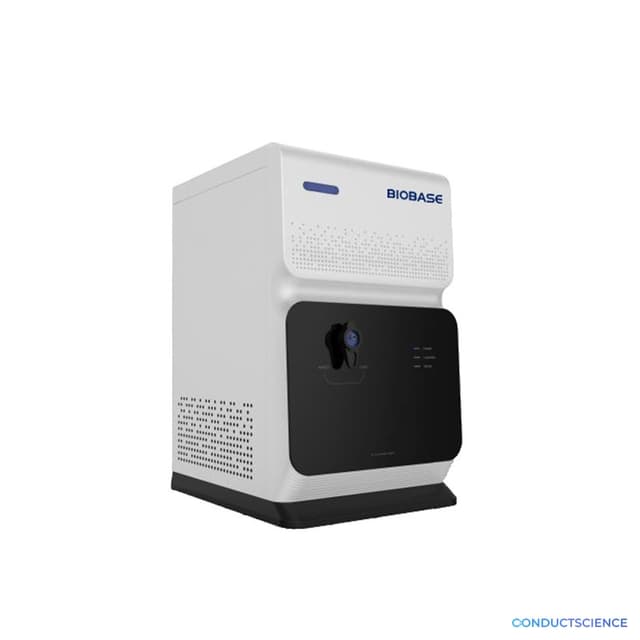
UV/VIS Spectrophotometer - 190-1100nm Range
Single-beam UV/VIS spectrophotometer with 190-1100nm range, ±0.3nm wavelength accuracy, and 7-inch touchscreen interface for quantitative absorption measurements.

Louise Corscadden, PhD
Director of Science · ConductScience
Ask Louise about UV/VIS Spectrophotometer - 190-1100nm Range fit, setup, configuration, or quote prep.
Already working with us? Sign in to connect this with My Scientist.
Key Specifications
Full details →- Model fit
- 1 selectable configurations
- SKU family
- BIO-0932
- Shipping box
- 42.0 x 43.6 x 38.0 cm
- Ordering
- Online checkout and quote request available
- Category
- Imaging & Analysis
- Build notes
- Confirm accessories, station layout, and support needs before purchase
The ConductScience UV/VIS Spectrophotometer is a single-beam analytical instrument designed for quantitative measurements of light absorption across ultraviolet and visible wavelengths. Operating from 190-1100nm with a C-T monochromator and blazed holographic grating (1200 lines/nm), this spectrophotometer provides wavelength accuracy of ±0.3nm and reproducibility of ±0.1nm for precise analytical measurements.
The instrument features a 7-inch high-definition touchscreen (1024×768 resolution) for intuitive operation and data visualization. With 4nm bandwidth (2nm optional) and manual wavelength setting capability, the system accommodates diverse analytical protocols requiring UV/VIS absorption spectroscopy. The single-beam optical design provides straightforward operation while maintaining measurement precision suitable for routine analytical work.
How It Works
UV/VIS spectrophotometry operates on the principle that molecules absorb electromagnetic radiation at specific wavelengths corresponding to electronic transitions between energy levels. When light passes through a sample, certain wavelengths are absorbed while others are transmitted, creating a characteristic absorption spectrum unique to the molecular structure.
The single-beam optical system directs monochromatic light from the source through the C-T monochromator, which uses a blazed holographic grating (1200 lines/nm) to separate polychromatic light into discrete wavelengths. The selected wavelength passes through the sample compartment where absorption occurs according to the Beer-Lambert law (A = εbc), relating absorbance to concentration, path length, and molar absorptivity.
The transmitted light intensity is measured by the detector and compared to a reference blank measurement to calculate absorbance values. The touchscreen interface displays real-time absorption data and enables wavelength scanning across the 190-1100nm range for comprehensive spectral analysis.
Features & Benefits
Shipping weight
- 29.98 lb
Shipping box
- L: 42.0 cm
- W: 43.6 cm
- H: 38.0 cm
| Feature | This Product | Typical Alternative | Advantage |
|---|---|---|---|
| Wavelength Range | 190-1100nm full UV/VIS coverage | Entry-level models often limited to 325-1000nm or visible-only ranges | Extended UV range enables analysis of compounds with electronic transitions below 325nm |
| Wavelength Accuracy | ±0.3nm precision specification | Basic instruments typically offer ±1-2nm accuracy | Superior wavelength precision supports method validation requirements in regulated environments |
| User Interface | 7-inch high-definition touchscreen (1024×768) | Many models require external computer or have basic LED displays | Integrated touchscreen simplifies operation and eliminates need for additional computer hardware |
| Monochromator Design | C-T monochromator with 1200 lines/nm blazed holographic grating | Lower-cost units may use fewer grating lines or different optical configurations | High-density grating provides superior wavelength resolution and light throughput |
| Bandwidth Options | 4nm standard bandwidth with 2nm optional | Fixed bandwidth systems without adjustment capability | Bandwidth flexibility allows optimization of resolution versus signal intensity for different analytical needs |
This spectrophotometer combines extended UV/VIS range with precision wavelength control and integrated touchscreen operation. The high-resolution monochromator and flexible bandwidth options provide analytical capability suitable for demanding quantitative applications.
Practical Tips
Perform wavelength calibration using certified holmium oxide standards and verify at multiple wavelengths across your analytical range.
Why: Multi-point calibration ensures accuracy across the entire working wavelength range rather than single-point verification.
Clean cuvette compartment monthly with lint-free cloths and appropriate solvents to remove sample residue.
Why: Contamination in the optical path can cause baseline drift and measurement errors over time.
Allow 30-60 minutes warm-up time before critical measurements to achieve thermal stability of the optical system.
Why: Thermal equilibrium ensures consistent lamp output and detector response for reliable quantitative results.
Use matched cuvettes for comparative measurements and rotate sample positioning to minimize path length variations.
Why: Cuvette variations can introduce systematic errors in quantitative analysis even with proper blanking procedures.
If baseline drift occurs, check lamp alignment and clean optical surfaces before assuming lamp replacement is needed.
Why: Many apparent lamp issues are actually caused by contaminated optics or mechanical misalignment.
Use appropriate UV-protective eyewear when working with the instrument during maintenance or alignment procedures.
Why: UV radiation from the deuterium lamp can cause eye damage if proper safety precautions are not followed.
Store frequently used cuvettes in distilled water to prevent mineral deposits and scratching during cleaning.
Why: Proper cuvette storage extends lifetime and maintains optical clarity for accurate measurements.
Setup Guide
What’s in the Box
- UV/VIS Spectrophotometer main unit
- Power cable and adapter
- Sample cuvette set (typical)
- User manual and operation guide
- Calibration certificate (typical)
- Software installation media (typical)
- USB cable for data transfer (typical)
Warranty
ConductScience provides a standard one-year manufacturer warranty covering parts and labor with comprehensive technical support. Extended warranty options and calibration services are available to maintain instrument qualification.
Compliance
What cuvette types are compatible with this spectrophotometer?
Standard 10mm path length cuvettes are typically used. Consult product datasheet for specific cuvette holder dimensions and compatible materials (glass, quartz, or plastic depending on wavelength requirements).
How frequently should wavelength calibration be performed?
Wavelength calibration should be verified monthly or after any significant environmental changes. Use certified reference standards like holmium oxide or didymium glass filters for calibration verification.
Can this instrument perform kinetic measurements?
The touchscreen interface may include kinetic measurement capabilities. Consult the user manual for specific time-course measurement functions and data acquisition rates available through the software.
What is the lamp lifetime and replacement procedure?
Lamp lifetime varies by usage patterns and wavelength range utilized. Consult product datasheet for expected lamp life specifications and replacement procedures for both deuterium and tungsten sources.
How does this compare to double-beam spectrophotometers?
Single-beam design requires separate blank measurements but offers simpler optics and lower cost. Double-beam instruments provide automatic drift correction but with increased complexity and higher maintenance requirements.
What data export formats are supported?
The touchscreen interface likely supports standard data formats for laboratory information systems. Consult product specifications for specific file formats and connectivity options available.
Can the instrument be computer-controlled for automated operation?
External computer control capabilities depend on available software and connectivity options. Check product specifications for automation software compatibility and communication interfaces.
Have a question about this product?
Have a question? Just ask.
Send it over and we'll email you a personalized answer — no call, no scheduling.
Prefer to talk it through?