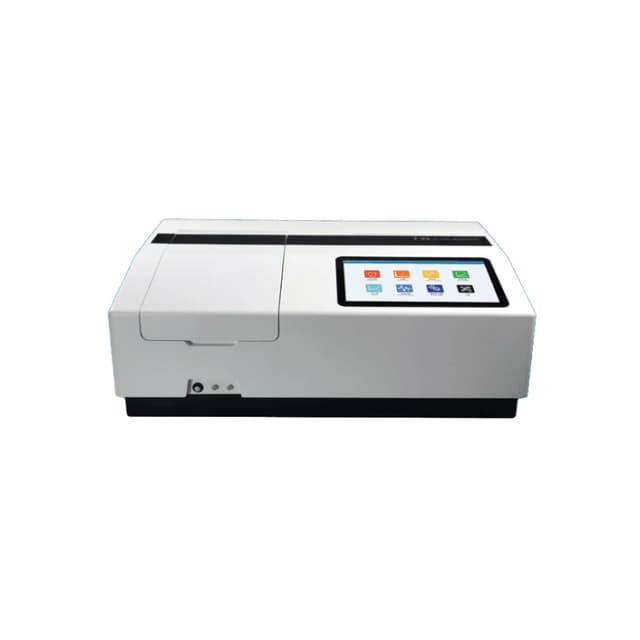
UV/VIS Spectrophotometer - Single Beam Series
Single-beam UV/VIS spectrophotometer with 1200 lines/mm diffraction grating for quantitative analysis across the UV and visible spectrum.
Available in multiple configurations covering 200–1100nm wavelength range with 2.0–4.0nm spectral bandwidth. Photometric accuracy of ±0.002A (0–0.5A) and four measurement modes (A/T/E/C). Compact desktop design with 4 cuvettes included.

Louise Corscadden, PhD
Director of Science · ConductScience
Ask Louise about UV/VIS Spectrophotometer - Single Beam Series fit, setup, configuration, or quote prep.
Already working with us? Sign in to connect this with My Scientist.
Key Specifications
Full details →- Model fit
- 4 selectable configurations
- SKU family
- BIO-0410
- Shipping box
- 20.0 x 46.6 x 36.5 cm
- Ordering
- Online checkout and quote request available
- Category
- Imaging & Analysis
- Build notes
- Confirm accessories, station layout, and support needs before purchase
The UV/VIS Spectrophotometer BK-V Series is a single-beam spectrophotometer designed for quantitative analysis across the UV and visible spectrum. Operating from 325-1020nm with 4.0nm spectral bandwidth, this grating-based instrument provides reliable absorbance and transmittance measurements for routine analytical applications. The system features a 1200 lines/mm diffraction grating optical design and matrix LCD display for straightforward operation.
With photometric accuracy of ±0.002A (0-0.5A range) and wavelength accuracy of ±1.5nm, the BK-V Series delivers consistent performance for standard laboratory measurements. The instrument's stray light specification of ≤0.1%T at 360nm ensures reliable baseline measurements across the operational wavelength range. Compact desktop design (46.6 x 36.5 x 20.0 cm) makes it suitable for laboratories with limited bench space while maintaining analytical capabilities required for quantitative UV/VIS spectrophotometry.
How It Works
The BK-V Series operates on the principle of molecular absorption spectrophotometry, where molecules absorb specific wavelengths of electromagnetic radiation corresponding to electronic transitions. A tungsten-halogen light source generates broad-spectrum illumination from 325-1020nm, which passes through a monochromator containing a 1200 lines/mm diffraction grating. This grating disperses polychromatic light into component wavelengths, allowing selection of specific narrow bandwidth (4.0nm) radiation.
Selected monochromatic light passes through the sample cuvette where molecules absorb characteristic wavelengths according to their electronic structure. A photodetector measures transmitted light intensity, comparing it to a reference blank to calculate absorbance values. The single-beam optical configuration requires sequential blank and sample measurements, with the instrument automatically calculating absorbance using A = -log(I/I₀) where I₀ is reference intensity and I is sample transmission.
Digital signal processing converts photodetector output to absorbance or transmittance values displayed on the matrix LCD screen. Wavelength positioning utilizes stepper motor control of the grating angle, providing ±1.5nm accuracy with ≤0.2nm repeatability for reliable analytical measurements.
Features & Benefits
Optical System
- High performance holographic grating 1200L/mm, single beam
Spectral Bandwidth
- 2.0nm
Wavelength Range
- 190-1100nm
Photometric Range
- -0.301 to 3.0A; 0-200%T; 0-9999C
Stability
- +/-0.001A/h (500nm)
Standard Accessories
- 4 cuvettes
Research Domain
- Analytical Chemistry
- Cell Biology
- Clinical Diagnostics
- Environmental Monitoring
- Food Science
- Pharmaceutical QC
Wavelength Accuracy
- +/-0.5nm
Wavelength Repeatability
- <=0.2nm
Photometric Accuracy
- +/-0.002Abs (0-0.5Abs); +/-0.004Abs (0.5-1.0Abs); +/-0.3%T (0-100%T)
Photometric Repeatability
- 0.001Abs (0-0.5Abs); 0.002Abs (0.5-1.0Abs); <=0.15%T (0-100%T)
Stray Light
- <=0.05%T (220nm and 360nm)
Display
- 7.0 inch LCD screen
Work Modes
- A (Absorbance), T (Transmittance), E (Energy), C (Concentration)
Wavelength Setup
- Automatic
Detector
- Imported silicon photodiode
Light Source
- Long-life deuterium lamp and tungsten lamp
Data Export
- USB
Shipping weight
- 10.1 lb
Shipping box
- L: 20.0 cm
- W: 46.6 cm
- H: 36.5 cm
| Feature | This Product | Typical Alternative | Advantage |
|---|---|---|---|
| Wavelength Range | 325-1020nm coverage | Entry-level models often limited to 400-700nm visible range | UV capability enables analysis of aromatic compounds and nucleic acids not detectable in visible-only instruments |
| Wavelength Accuracy | ±1.5nm accuracy | Basic instruments may offer ±2-3nm accuracy | Higher precision enables reliable compound identification and method transfer between laboratories |
| Photometric Accuracy | ±0.002A (0-0.5A range) | Standard instruments typically specify ±0.005A or lower precision | Superior accuracy enables quantitation of low-concentration samples with greater confidence |
| Spectral Bandwidth | 4.0nm bandwidth | Fixed bandwidth options vary widely by model | Optimized bandwidth balances resolution with signal strength for diverse analytical applications |
| Display Interface | Matrix LCD display | Basic models may use simple LED readouts | Enhanced display provides comprehensive measurement information and instrument status for improved workflow efficiency |
The BK-V Series combines UV/visible wavelength coverage with analytical-grade accuracy specifications in a compact desktop format. The grating-based optical system and precise photometric performance make it suitable for quantitative analytical work requiring reliable baseline measurements and consistent results.
| Model | SKU | Listed price | Status | Shipping box |
|---|---|---|---|---|
| UV1800G | BIO-0410-UV1800G | $4,419.99 | Available | 20.0 x 46.6 x 36.5 cm |
| UV1600G | BIO-0410-UV1600G | $3,739.99 | Available | 20.0 x 46.6 x 36.5 cm |
| UV1000G | BIO-0410-UV1000G | $3,059.99 | Available | 20.0 x 46.6 x 36.5 cm |
| UV1200 | BIO-0410-UV1200 | $2,379.99 | Available | 20.0 x 46.6 x 36.5 cm |
Practical Tips
Verify wavelength accuracy monthly using holmium oxide filter standards, particularly if instrument is moved or experiences temperature fluctuations.
Why: Wavelength accuracy directly impacts analytical results and method reproducibility.
Clean cuvette compartment weekly with lens tissue to remove dust and sample residues that can affect baseline measurements.
Why: Optical contamination increases stray light and degrades measurement precision.
Always measure samples and blanks at room temperature equilibrium to minimize thermal effects on absorption spectra.
Why: Temperature variations can shift absorption bands and affect quantitative accuracy.
Perform baseline correction across full wavelength range before each analytical session, especially after lamp warm-up.
Why: Proper baseline establishment ensures accurate absorbance calculations and removes instrumental artifacts.
If measurements drift during analysis, check for air bubbles in samples and ensure cuvettes are properly seated in holder.
Why: Physical inconsistencies cause measurement variability that masks true analytical differences.
Allow UV lamp to cool completely before instrument transport or optical component access.
Why: Hot lamp components can cause burns and thermal shock may damage delicate optical elements.
Use matched cuvettes from the same manufacturer batch for quantitative work to minimize pathlength variations.
Why: Cuvette differences directly affect absorbance measurements and can introduce systematic errors in analytical results.
Setup Guide
What’s in the Box
- UV/VIS Spectrophotometer main unit
- Power adapter and cord
- Sample cuvette holder
- User manual and operation guide
- Calibration certificate (typical)
- USB data cable (typical)
Warranty
ConductScience provides a standard one-year manufacturer warranty covering defects in materials and workmanship, with technical support available for operational questions and troubleshooting assistance.
Compliance
What is the optimal sample concentration range for this spectrophotometer?
For best accuracy, maintain absorbance values between 0.2-1.0A where photometric accuracy is ±0.002-0.004A. Higher concentrations may require dilution to stay within linear range.
How frequently should wavelength calibration be performed?
Verify wavelength accuracy weekly or after instrument relocation using holmium oxide filters or other certified standards to maintain ±1.5nm specification.
What cuvette types are compatible with this system?
Standard 10mm pathlength cuvettes are typical, though specific holder compatibility should be confirmed. Use matched cuvettes for quantitative work to minimize measurement errors.
Can this instrument perform kinetic measurements?
The basic model provides fixed-time measurements; kinetic capability depends on specific model configuration. Consult product datasheet for time-based measurement specifications.
What is the warm-up time required for stable measurements?
Allow minimum 30 minutes warm-up after power-on for lamp and detector stabilization, particularly critical for UV region measurements below 350nm.
How does this compare to double-beam spectrophotometers?
Single-beam design requires sequential blank and sample measurements but offers simpler optics and lower cost while maintaining analytical accuracy for routine applications.
What maintenance is required for optimal performance?
Regular cleaning of optical surfaces, lamp replacement as needed, and periodic wavelength verification. Specific maintenance schedules depend on usage frequency and laboratory environment.
How do I save and export measurement data to a USB drive?
Each function test interface on the spectrophotometer touchscreen includes an Export button. Insert a USB drive into the instrument USB port, then tap Export on the measurement screen to save data directly to the drive for further analysis.
How do I download and install the PC software for computer-based operation?
The PC software can be downloaded by scanning the QR code located on the side of the instrument. A data cable (available as an optional accessory) is required to connect the spectrophotometer to a computer for software-based operation and data transfer.
Have a question about this product?
Have a question? Just ask.
Send it over and we'll email you a personalized answer — no call, no scheduling.
Prefer to talk it through?