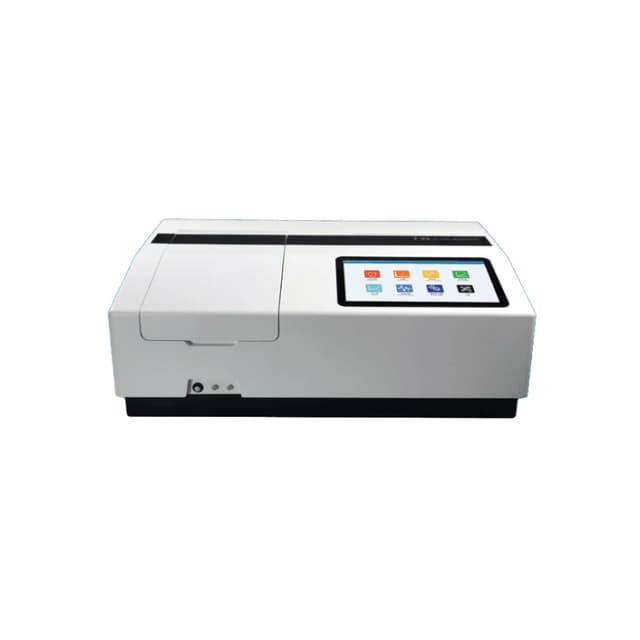
Benchtop Grating Spectrophotometer - UV/Vis/NIR
Precision benchtop spectrophotometer with grating monochromator for quantitative UV-Vis analysis of biological samples, chemical solutions, and material characterization.

Louise Corscadden, PhD
Director of Science · ConductScience
Ask Louise about Benchtop Grating Spectrophotometer - UV/Vis/NIR fit, setup, configuration, or quote prep.
Already working with us? Sign in to connect this with My Scientist.
Key Specifications
Full details →- Model fit
- 1 selectable configurations
- SKU family
- BIO-0935
- Shipping box
- 47.0 x 45.0 x 57.0 cm
- Ordering
- Online checkout and quote request available
- Category
- Imaging & Analysis
- Build notes
- Confirm accessories, station layout, and support needs before purchase
The Benchtop Grating Spectrophotometer is a precision optical instrument designed for quantitative analysis of light absorption and transmission across the ultraviolet, visible, and near-infrared spectral regions. This compact benchtop system utilizes a diffraction grating monochromator to deliver wavelength-specific illumination for accurate spectrophotometric measurements of liquid and solid samples.
The instrument provides researchers with a versatile platform for concentration determination, kinetic studies, and spectral characterization in applications ranging from protein quantification to compound identification. With its stable optical design and user-friendly operation, this spectrophotometer supports both routine analytical workflows and specialized research protocols requiring precise photometric data.
How It Works
The spectrophotometer operates on the principle of Beer-Lambert law, which relates the absorption of light to the properties of the material through which the light travels. A tungsten halogen lamp provides broad-spectrum illumination that passes through a diffraction grating monochromator, which disperses the white light into its component wavelengths and selects specific wavelengths for sample illumination.
The monochromatic light beam passes through the sample chamber where it interacts with the analyte. Molecules in the sample absorb photons at characteristic wavelengths corresponding to electronic transitions, resulting in attenuation of the transmitted light intensity. A photodetector measures the transmitted light intensity, and the instrument calculates absorbance values using the ratio of incident to transmitted light intensity.
The grating-based monochromator design provides superior wavelength accuracy and resolution compared to filter-based systems, enabling precise spectral measurements across the UV-visible range. This optical configuration ensures stable, reproducible results for both single-wavelength measurements and full spectral scans.
Features & Benefits
Shipping weight
- 16.0 lb
Shipping box
- L: 47.0 cm
- W: 45.0 cm
- H: 57.0 cm
| Feature | This Product | Typical Alternative | Advantage |
|---|---|---|---|
| Monochromator Type | Diffraction grating monochromator | Filter wheels or fixed filters in entry-level models | Provides continuously variable wavelength selection with superior spectral resolution for precise analytical work. |
| Physical Footprint | 47 x 45 x 57 cm benchtop design | Larger floor-standing models or smaller handheld units | Optimizes laboratory bench space while maintaining full analytical capabilities. |
| Weight and Portability | 16 kg total weight | Heavier floor models or lighter portable units with reduced capabilities | Balances stability for precision measurements with reasonable portability for lab reconfiguration. |
| Sample Compartment | Standard cuvette holder design | Varies by model and application | Ensures compatibility with existing laboratory cuvettes and sample preparation workflows. |
| Optical Design | Tungsten halogen source with grating dispersion | LED sources or simpler optical configurations | Delivers broad spectral coverage with consistent intensity for comprehensive analytical applications. |
This spectrophotometer combines grating monochromator precision with compact benchtop design, offering researchers accurate spectral measurements in a laboratory-friendly footprint. The 16 kg weight provides stability while remaining manageable for routine laboratory use.
Practical Tips
Verify wavelength accuracy monthly using holmium oxide or didymium standards at multiple wavelengths across the operating range.
Why: Ensures measurement accuracy for quantitative analytical work and regulatory compliance.
Clean optical surfaces quarterly with appropriate solvents and lint-free wipes to maintain light transmission.
Why: Prevents signal degradation and baseline drift that can affect measurement precision.
Allow 30 minutes warm-up time before critical measurements to ensure lamp and detector stabilization.
Why: Eliminates thermal drift and ensures reproducible results throughout the analytical session.
Use matched cuvettes for comparative measurements and rinse thoroughly between different sample types.
Why: Minimizes systematic errors from cuvette variations and prevents cross-contamination.
Perform blank measurements with the same solvent and cuvette used for samples immediately before sample analysis.
Check for air bubbles in liquid samples and ensure proper cuvette positioning in the light path.
Why: Air bubbles and misalignment cause light scattering that appears as increased absorbance readings.
Avoid looking directly into the light beam and ensure proper ventilation when analyzing volatile solvents.
Why: Protects vision from intense UV radiation and prevents accumulation of potentially hazardous vapors.
Setup Guide
What’s in the Box
- Benchtop Grating Spectrophotometer main unit
- Power adapter and cord
- Sample compartment cuvette holder (typical)
- Set of quartz cuvettes (typical)
- USB cable for data transfer (typical)
- User manual and quick start guide
- Wavelength calibration standards (typical)
- Software CD or download access (typical)
Warranty
ConductScience provides a comprehensive one-year manufacturer warranty covering parts and labor, with ongoing technical support for method development and troubleshooting assistance.
Compliance
What wavelength range and resolution can I expect for analytical measurements?
Consult the product datasheet for specific wavelength coverage and spectral resolution specifications. Most grating-based systems provide coverage from UV through visible regions with sub-nanometer resolution.
How do I ensure accurate quantitative results for protein assays?
Use appropriate blank solutions for baseline correction, verify wavelength calibration with certified standards, and maintain consistent sample preparation protocols. Allow adequate warm-up time for lamp stabilization.
What sample types and cuvette formats are compatible?
The instrument accepts standard 10mm pathlength cuvettes for liquid samples. Solid samples may require specialized holders. Consult documentation for specific compatibility with micro-volumes or flow cells.
How often should wavelength calibration be performed?
Perform wavelength calibration monthly or after any significant instrument movement. Daily verification with holmium oxide standards is recommended for critical quantitative work.
Can this instrument perform kinetic measurements?
Yes, the spectrophotometer can monitor absorbance changes over time at fixed wavelengths. Consult the user manual for specific kinetic measurement capabilities and time resolution.
What maintenance is required for optimal performance?
Regular lamp replacement as needed, periodic cleaning of optical surfaces, and annual professional calibration. Keep the sample compartment clean and protect from dust and moisture.
How does this compare to diode array spectrophotometers?
Grating monochromators provide excellent wavelength accuracy and resolution for single-wavelength measurements, while diode arrays offer simultaneous multi-wavelength detection. Choose based on your analytical requirements.
Have a question about this product?
Have a question? Just ask.
Send it over and we'll email you a personalized answer — no call, no scheduling.
Prefer to talk it through?
Upgrade Options