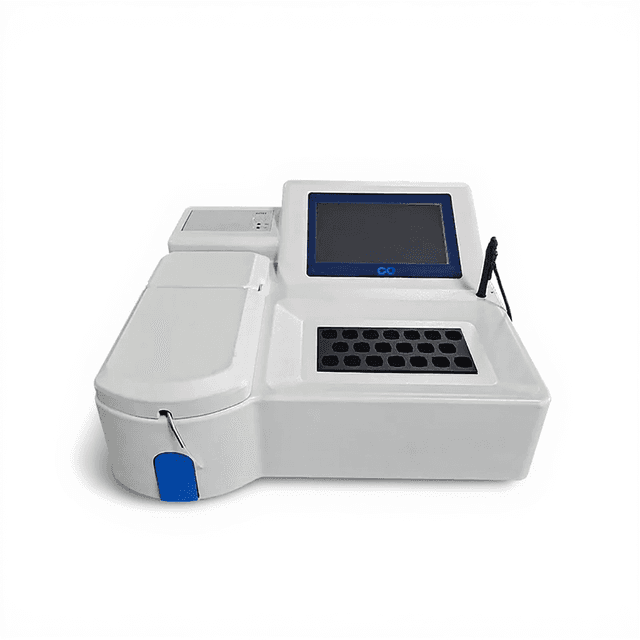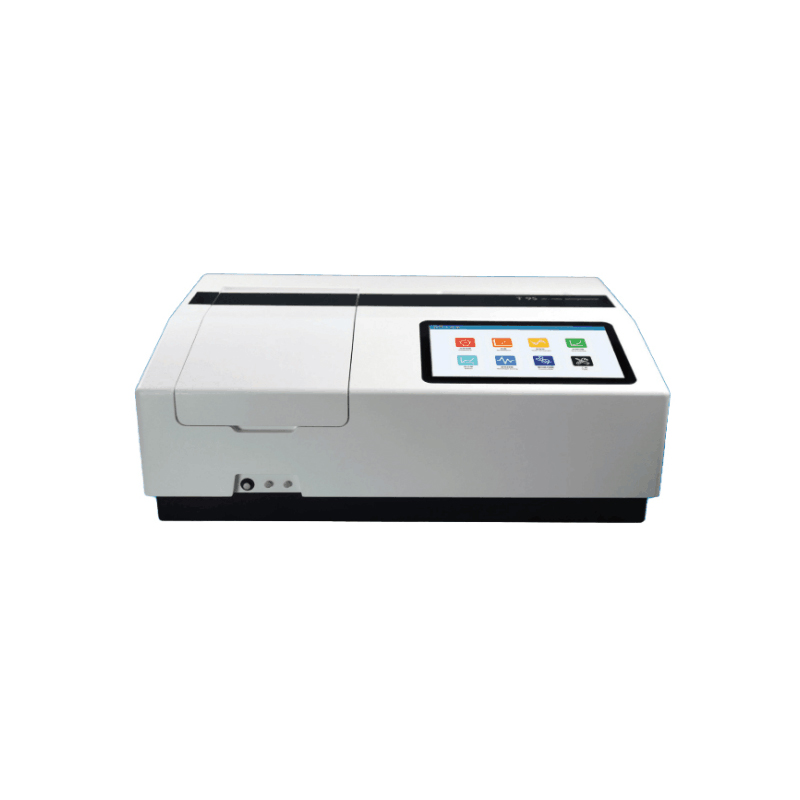
Touch Screen UV/Vis Spectrophotometer
Single-beam UV/Vis spectrophotometer with 190-1100 nm range, 7-inch touch screen interface, and photometric accuracy of ±0.002A for quantitative analysis applications.

Louise Corscadden, PhD
Director of Science · ConductScience
Ask Louise about Touch Screen UV/Vis Spectrophotometer fit, setup, configuration, or quote prep.
Already working with us? Sign in to connect this with My Scientist.
Key Specifications
Full details →- Model fit
- 3 selectable configurations
- SKU family
- BIO-0425
- Shipping box
- 42.0 x 43.6 x 38.0 cm
- Ordering
- Online checkout and quote request available
- Category
- Imaging & Analysis
- Build notes
- Confirm accessories, station layout, and support needs before purchase
Toggle main menu visibilityHomeProductsClinical Analytical InstrumentsBiochemistry AnalyzerBiochemistry ReagentELISA EquipmentELISA KitESR AnalyzerCoagulation AnalyzerHematology AnalyzerUrine AnalyzerElectrolyte AnalyzerBlood Gas Electrolyte AnalyzerNucleic Acid ExtractorNucleic Acid Extraction ReagentRapid Test KitAutomatic Chemiluminescence Immunoassay SystemFlow CytometerBlood CultureBlood Gas AnalyzerAir Protection ProductBiological Safety CabinetLaminar Flow CabinetFume HoodMobile Fume ExtractorFan Filter UnitClean BoothDispensing BoothPathology WorkstationChicken IsolatorAir PurifierAir
How It Works
UV/Vis spectrophotometry operates on the principle that molecules absorb electromagnetic radiation at specific wavelengths corresponding to electronic transitions. When light passes through a sample, certain wavelengths are absorbed by the analyte molecules, with the amount of absorption being proportional to concentration according to the Beer-Lambert law (A = εbc, where A is absorbance, ε is molar absorptivity, b is path length, and c is concentration).
This single-beam instrument uses a tungsten-halogen light source covering the visible and near-infrared regions, with a deuterium lamp for UV wavelengths. The 1200 line/mm diffraction grating disperses the polychromatic light, allowing selection of specific wavelengths with 2.0 nm spectral bandwidth. A photodiode detector measures the transmitted light intensity, which is compared to a reference measurement to calculate absorbance or transmittance values.
The touch screen interface provides direct control over wavelength selection, measurement modes, and data collection parameters. The system can operate in transmittance mode (%T), absorbance mode (A), concentration mode (C) using pre-programmed calibration curves, or energy mode (E) for radiometric measurements.
Features & Benefits
Automation Level
- semi-automated
Optical System
- 1200 line/mm Grating, Single Beam
Wavelength Range
- 190~1100mm
Spectral Bandwidth
- 2.0nm
Wavelength Accuracy
- ±0.5nm(@D656.1±0.1nm)
Wavelength Repeatability
- ≤0.2nm
Photometric Accuracy
- ±0.002A(0-0.5Abs), ±0.004A(0.5-1.0Abs), ±0.2% T(0-100% T)
Photometric Repeatability
- ±0.001A(0-0.5Abs), ±0.002A(0.5-1.0Abs), ±0.1%T(0-100%T)
Stray Light
- ≤0.04T@360nm; 220nm
Stability
- ±0.001A/h@500nm
Baseline Flatness
- ±0.001A
Noise
- ±0.001Abs
Photometric Mode
- T, A, C, E
Photometric Range
- 0-200%T,-4.0-4.0A,0-9999.9C
Brand
- ConductScience
Research Domain
- Analytical Chemistry
- Clinical Diagnostics
- Environmental Monitoring
- Food Science
- Materials Science
- Pharmaceutical QC
Display Type
- 1024*600 7 inch touch screen
Shipping weight
- 29.98 lb
Shipping box
- L: 42.0 cm
- W: 43.6 cm
- H: 38.0 cm
| Feature | This Product | Typical Alternative | Advantage |
|---|---|---|---|
| Wavelength Range | 190-1100 nm | Many entry-level models cover 325-1000 nm, omitting the deep UV region | Extended UV range enables analysis of biomolecules and pharmaceutical compounds with UV chromophores |
| Spectral Bandwidth | 2.0 nm | Basic instruments often provide 4-8 nm bandwidth | Narrower bandwidth improves wavelength selectivity and reduces spectral interference for complex samples |
| Photometric Accuracy | ±0.002A (0-0.5 Abs range) | Standard instruments typically specify ±0.005A or higher | Higher accuracy supports more precise quantitative analysis and lower detection limits |
| Display Interface | 7-inch touch screen (1024×600) | Many models use smaller LCD displays or basic LED readouts | Larger touch interface simplifies parameter adjustment and provides better data visualization during measurements |
| Stray Light Performance | ≤0.04%T at 360nm and 220nm | Entry-level systems often specify 0.1-0.5%T stray light | Lower stray light extends linear measurement range and improves accuracy at high absorbance values |
| Measurement Modes | T, A, C, E modes available | Basic models may offer only transmittance and absorbance modes | Concentration and energy modes provide direct results without manual calculations |
This spectrophotometer provides research-grade performance with extended UV range, high photometric accuracy, and modern touch screen operation. The combination of 2.0 nm bandwidth, low stray light, and multiple measurement modes supports diverse analytical applications from routine QC to specialized research measurements.
| Model | SKU | Listed price | Status | Shipping box |
|---|---|---|---|---|
| BK-DT9S | bk-dt9s | $6,290.00 | Available | 42.0 x 43.6 x 38.0 cm |
| BK-DT9P | bk-dt9p | $5,490.00 | Available | 42.0 x 43.6 x 38.0 cm |
| BK-DT9 | bk-dt9 | $4,990.00 | Available | 42.0 x 43.6 x 38.0 cm |
Practical Tips
Verify wavelength accuracy monthly using standard reference materials such as holmium oxide or didymium filters.
Why: Maintaining wavelength accuracy ensures reliable peak identification and quantitative analysis results.
Check photometric accuracy using neutral density filters or standard absorbance solutions at multiple absorbance levels.
Why: Regular photometric verification confirms measurement accuracy across the full analytical range.
Clean optical surfaces monthly using appropriate lens cleaning solutions and lint-free tissues.
Why: Dust and contamination on optical components degrade measurement accuracy and increase baseline noise.
Monitor lamp energy output regularly and replace lamps when output drops significantly below specifications.
Why: Declining lamp performance reduces signal-to-noise ratio and can affect measurement precision.
Allow 30-60 minutes warm-up time before critical measurements to ensure thermal stability.
Why: Electronic components and optical elements require thermal equilibrium for optimal stability and repeatability.
Use UV-grade quartz cuvettes for measurements below 320 nm and ensure cuvettes are matched for comparative analysis.
Why: Cuvette material and optical quality directly affect measurement accuracy, especially in the UV region.
Establish baseline correction with an appropriate blank solution before each measurement series.
Why: Proper baseline correction compensates for solvent absorption and instrumental drift.
If baseline drift occurs during measurements, check for temperature fluctuations, lamp stability, or contaminated optics.
Why: Identifying the source of drift prevents measurement errors and maintains data quality.
Setup Guide
What’s in the Box
- Touch Screen UV/Vis Spectrophotometer main unit
- Power cable and adapter (typical)
- Sample cuvettes set (typical)
- User manual and software documentation (typical)
- Calibration certificate (typical)
- USB cable for data transfer (typical)
Warranty
ConductScience provides a standard one-year manufacturer warranty covering defects in materials and workmanship. Technical support includes instrument troubleshooting, method development guidance, and software assistance.
Compliance
What is the minimum sample volume required for measurements?
Sample volume depends on the cuvette type used. Standard 10 mm path length cuvettes typically require 2-4 mL, while micro-cuvettes can accommodate volumes as low as 50-100 μL. Consult product datasheet for specific volumetric requirements with different cell types.
How does the single-beam design affect measurement protocols compared to double-beam instruments?
Single-beam systems require separate blank and sample measurements rather than simultaneous reference compensation. This necessitates baseline correction before each measurement series but provides simpler optics with potentially better light throughput.
What types of cuvettes are compatible with this instrument?
The system accommodates standard 10 mm path length cuvettes for most applications. UV-grade quartz cuvettes are required for measurements below 320 nm, while glass cuvettes are suitable for visible wavelengths above 320 nm.
Can the instrument perform kinetic measurements for enzyme assays?
The system supports time-based measurements in absorbance mode, enabling monitoring of enzymatic reactions and other kinetic processes. Specific timing intervals and data collection parameters can be configured through the touch screen interface.
What is the typical lamp replacement schedule?
Deuterium lamps typically require replacement after 1000-2000 hours of operation, while tungsten-halogen lamps last 2000-5000 hours. Lamp performance can be monitored through baseline stability and energy output measurements.
How does temperature affect measurement accuracy?
Temperature fluctuations can affect both sample properties and instrument electronics. Allow adequate warm-up time (30-60 minutes) for thermal equilibrium, and maintain stable ambient temperature during measurements for optimal accuracy.
What data export formats are available?
Consult product datasheet for specific data export capabilities and file formats supported by the instrument software. Many UV/Vis systems provide CSV, Excel-compatible, or ASCII text formats for data analysis.
Is the instrument suitable for turbid or particle-containing samples?
Suspended particles cause light scattering and can interfere with absorbance measurements. Samples should be filtered or clarified prior to analysis, or alternative measurement techniques should be considered for turbid samples.
Have a question about this product?
Have a question? Just ask.
Send it over and we'll email you a personalized answer — no call, no scheduling.
Prefer to talk it through?
Upgrade Options