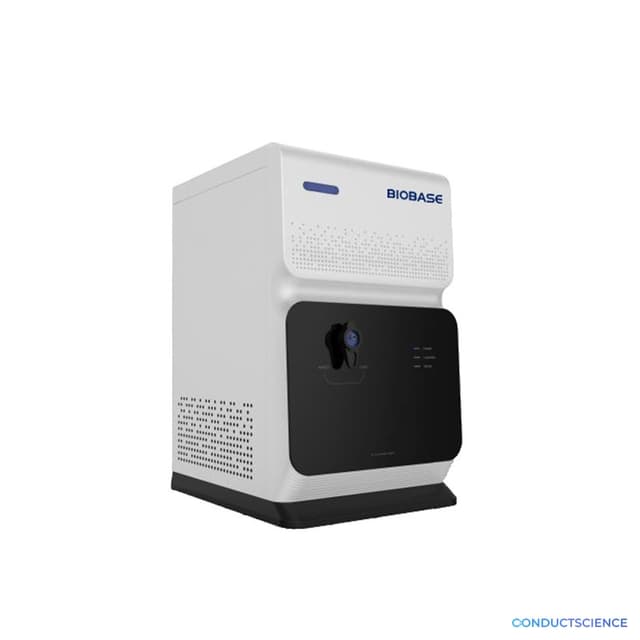
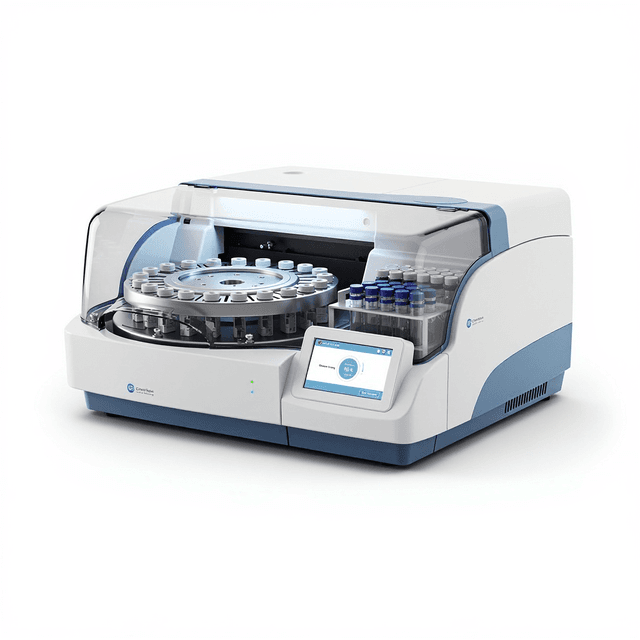
UV-Vis NIR Spectrophotometer
Single-beam UV-Vis NIR spectrophotometer covering 250-2500 nm wavelength range with multiple measurement modes and variable sampling intervals for quantitative optical analysis.

Louise Corscadden, PhD
Director of Science · ConductScience
Ask Louise about UV-Vis NIR Spectrophotometer fit, setup, configuration, or quote prep.
Already working with us? Sign in to connect this with My Scientist.
Key Specifications
Full details →- Model fit
- Configured during quote
- SKU family
- BIO-0408
- Shipping box
- 26.0 x 60.0 x 50.0 cm
- Ordering
- Online checkout and quote request available
- Category
- Imaging & Analysis
- Build notes
- Confirm accessories, station layout, and support needs before purchase
UV-Vis NIR Spectrophotometer BK-UN600PLUS
Advanced spectrophotometer for continuous scanning across ultraviolet, visible, and near-infrared spectral regions. Designed for building energy efficiency testing, construction engineering quality inspection, automotive safety glass testing, and materials science research.
Key Features
- Computer-based automatic control with automatic calibration and data acquisition
- Dual imported detectors for enhanced sensitivity and reduced noise
- USB 2.0 interface for improved communication speed
- Integrated optical test software for glass transmittance and reflectance measurements
- Real-time data measurement with export capabilities
- Double beam optical system
- Compatible with Windows XP and Windows 7 systems
Technical Specifications
| Parameter | Specification |
|---|---|
| Optical System | Double beam |
| Wavelength Range | 190~3200 nm (250~2500 nm with integrating sphere) |
| Wavelength Accuracy | ±0.5 nm (UV/Vis); ±4 nm (NIR) |
| Wavelength Repeatability | ≤0.3 nm (UV/Vis); ≤2 nm (NIR) |
| Spectral Bandwidth | 0.2~5 nm (UV/Vis); 1~20 nm (NIR) |
| Gratings | 1200 L/mm (UV/Vis); 300 L/mm (NIR) |
| Operating Modes | Transmittance, absorbance, reflectivity, energy |
| Transmittance Accuracy | ±0.3% T |
| Photometric Range | 0~3 A |
| Baseline Flatness | ±0.004 A (200~2500 nm after 30-min warmup) |
| Stray Light | ≤0.2% T (220 nm, NaI) |
| Sampling Intervals | 0.1, 0.2, 0.5, 1, 1.5, 2, 5, 10 nm |
| Interface | USB 2.0 |
| Power Supply | AC 220V, 50/60Hz (110V optional) |
| Dimensions | 700×600×260 mm |
| Net Weight | 50 kg |
| Gross Weight | 75 kg |
Operating Modes
- Transmittance: Measure light transmission through samples
- Absorbance: Measure light absorption by samples
- Reflectivity: Measure light reflection from surfaces
- Energy: Measure light energy levels
Applications
- Building energy efficiency testing
- Construction engineering quality inspection
- Automotive safety glass testing
- Materials science research
- Optical material characterization
- Quality control testing
- UV/Vis/NIR spectroscopy analysis
Optional Accessories
- Integrating sphere (60/100/150 mm options)
- Transmission and reflection accessories
How It Works
The spectrophotometer employs single-beam optical architecture where broadband light passes through a monochromator system to select specific wavelengths. The monochromatic light beam interacts with the sample through transmission or reflection, and the resulting light intensity is measured by a detector system. The ratio of transmitted or reflected light to incident light intensity provides quantitative information about sample optical properties.
Absorbance measurements follow the Beer-Lambert law (A = εcl), where absorbance is proportional to analyte concentration, molar absorptivity, and path length. The extended wavelength range from UV (250 nm) through visible (400-700 nm) to near-infrared (2500 nm) enables analysis of electronic transitions in organic molecules, d-d transitions in transition metals, and vibrational overtones in the NIR region. Variable sampling intervals allow optimization between spectral resolution and measurement speed depending on analytical requirements.
Features & Benefits
Automation Level
- semi-automated
Optical System
- Single beam
Wavelength Range
- 250~2500nm
Operate Mode
- Transmittance, reflectivity, spectral energy, absorbance
Transmittance Accuracy
- ±1%T
Transmission Specific Gravity Refolding
- ≤0.5%T
Stray Light
- 0.2%T(360nm, 420nm)
Sampling Interval
- 0.1nm, 0.2nm, 0.5nm, 1nm, 2nm, 5nm, 10nm
Photometric Range
- 0~2.5A
Baseline Flatness
- ±0.01A
Host Interface
- USB 2.0
Standard Accessory
- Operational software
Optional Accessory
- Integrating sphere accessory(60mm); universal reflectance/transmittance accessory(Cannot be configur
External Size(W*D*H)
- 600*500*260mm
Brand
- ConductScience
Research Domain
- Analytical Chemistry
- Clinical Diagnostics
- Environmental Monitoring
- Food Science
- Materials Science
- Pharmaceutical QC
Power/Voltage
- AC220V, 50/60Hz(Standard); 110V, 50/60Hz(Optional)
Shipping weight
- 35.0 lb
Shipping box
- L: 26.0 cm
- W: 60.0 cm
- H: 50.0 cm
| Feature | This Product | Typical Alternative | Advantage |
|---|---|---|---|
| Wavelength Range | 250-2500 nm UV-Vis-NIR coverage | Many instruments limited to UV-Vis only (190-1100 nm) | Extended NIR capability enables analysis of vibrational overtones and broader material characterization |
| Optical Configuration | Single beam design | Higher-end models often feature dual-beam systems | Simplified optical path reduces maintenance requirements while providing cost-effective operation |
| Sampling Interval Options | Seven selectable intervals from 0.1 nm to 10 nm | Basic models often limited to 1-2 nm intervals | Flexible resolution optimization allows balance between spectral detail and measurement speed |
| Photometric Range | 0-2.5A absorbance range | Entry-level instruments often limited to 2.0A | Extended dynamic range accommodates higher concentration samples without dilution |
| Stray Light Performance | 0.2%T at 360nm and 420nm | Basic instruments may have 0.5-1%T stray light | Lower stray light improves accuracy for high absorbance measurements |
| Computer Interface | USB 2.0 connectivity with operational software | Some models require separate interface modules | Integrated control enables automated measurements and data management |
This instrument combines broad UV-Vis-NIR spectral coverage with flexible sampling options and good photometric performance. The single-beam design provides cost-effective operation while maintaining measurement accuracy suitable for routine analytical applications.
Practical Tips
Use holmium oxide or didymium glass filters to verify wavelength accuracy across the spectral range.
Why: Regular wavelength calibration ensures accurate peak identification and quantitative analysis.
Clean sample compartment with lint-free cloths and appropriate solvents after each use.
Why: Preventing sample residue buildup maintains optical path cleanliness and measurement accuracy.
Allow 30-minute warm-up period before measurements and perform baseline correction with each new measurement session.
Why: Thermal equilibrium and fresh baseline reference minimize drift-related measurement errors.
Select appropriate sampling interval based on spectral features - use 0.1-0.5 nm for sharp peaks and 1-2 nm for broad features.
Why: Matching resolution to spectral characteristics optimizes data quality while minimizing acquisition time.
Check stray light performance using neutral density filters if high absorbance measurements show non-linearity.
Why: Stray light can cause deviations from Beer-Lambert law at high optical densities.
Use appropriate cuvettes rated for UV transmission when working below 320 nm wavelengths.
Why: Standard glass cuvettes absorb UV light leading to inaccurate measurements in the UV region.
Store instrument in temperature-controlled environment away from vibration sources.
Why: Stable conditions minimize baseline drift and mechanical disturbances affecting measurement precision.
Verify photometric accuracy using certified neutral density standards at multiple absorbance levels.
Why: Regular photometric calibration ensures quantitative accuracy across the full dynamic range.
Setup Guide
What’s in the Box
- UV-Vis NIR Spectrophotometer main unit
- Operational software
- Power cable
- USB 2.0 interface cable
- User manual and documentation
- Sample holders (typical)
- Calibration certificate (typical)
Warranty
ConductScience provides a standard one-year manufacturer warranty covering defects in materials and workmanship. Technical support is available to assist with installation, operation, and troubleshooting throughout the warranty period.
Compliance
What is the spectral resolution achievable with this instrument?
Sampling intervals are selectable from 0.1 nm to 10 nm. The actual spectral resolution depends on the monochromator bandwidth, which should be consulted in the product datasheet for specific resolution specifications.
Can this instrument measure solid samples directly?
The standard configuration is optimized for solution measurements. The optional integrating sphere accessory (60mm) enables diffuse reflectance measurements of solid samples and powders.
What is the measurement time for a full spectrum scan?
Scan time depends on wavelength range, sampling interval, and integration time settings. Consult the operational software documentation for specific timing parameters and optimization options.
How does the single-beam design affect baseline stability?
Single-beam systems require periodic baseline corrections to account for lamp intensity drift and environmental changes. The ±0.01A baseline flatness specification indicates good short-term stability for routine measurements.
What sample volume is required for cuvette measurements?
Sample volume depends on the cuvette type used. Standard 10mm path length cuvettes typically require 3-4 mL, while micro-cuvettes may need only 0.5-1 mL.
Is the instrument suitable for kinetic measurements?
The USB interface enables computer control for automated measurements. The software capabilities for time-based kinetic studies should be verified in the operational software specifications.
How frequently should wavelength calibration be performed?
Wavelength accuracy should be verified using standard reference materials such as holmium oxide or didymium filters. Calibration frequency depends on measurement requirements and environmental stability.
What maintenance is required for optimal performance?
Regular cleaning of sample compartment, lamp replacement when intensity decreases, and periodic wavelength/photometric accuracy verification using certified reference standards maintain optimal performance.
Have a question about this product?
Have a question? Just ask.
Send it over and we'll email you a personalized answer — no call, no scheduling.
Prefer to talk it through?
Frequently Bought Together