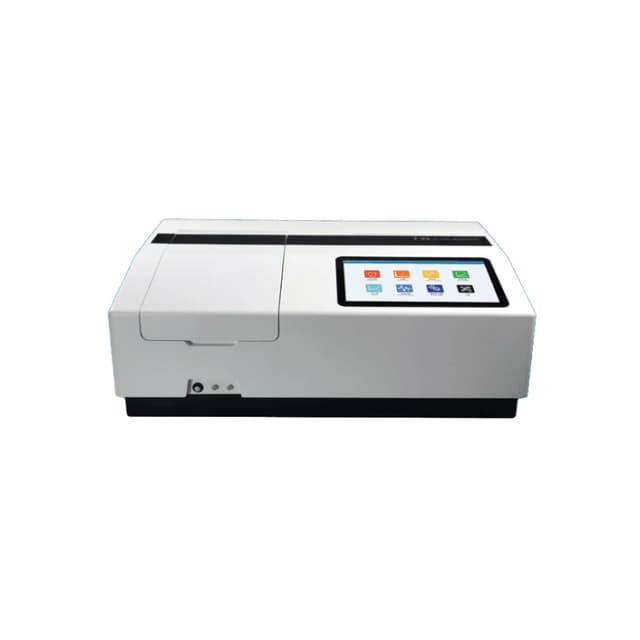
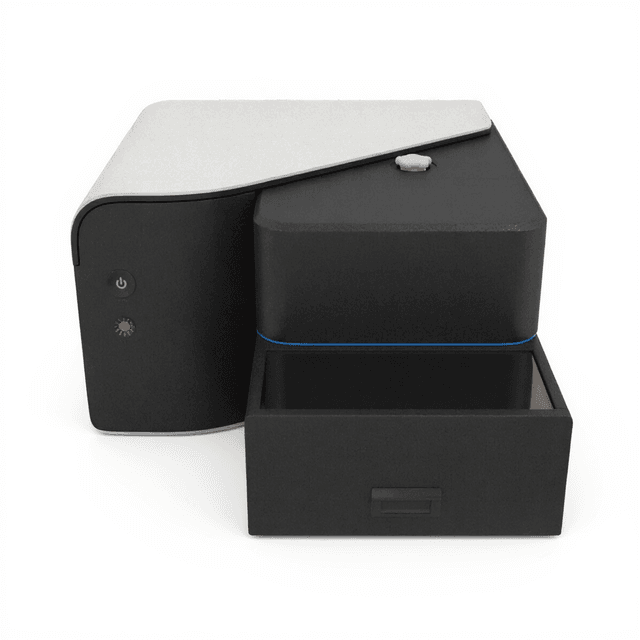
FT-IR Spectrometer
Desktop FT-IR spectrometer with DLATGS detector providing transmission accuracy better than 0.05 τ% for molecular identification and quantitative analysis.

Louise Corscadden, PhD
Director of Science · ConductScience
Ask Louise about FT-IR Spectrometer fit, setup, configuration, or quote prep.
Already working with us? Sign in to connect this with My Scientist.
Key Specifications
Full details →- Model fit
- Configured during quote
- SKU family
- BIO-0936
- Shipping box
- 21.0 x 45.0 x 35.0 cm
- Ordering
- Online checkout and quote request available
- Category
- Imaging & Analysis
- Build notes
- Confirm accessories, station layout, and support needs before purchase
The FT-IR Spectrometer (BIO-0397) is a Fourier-transform infrared spectroscopy system designed for molecular identification and quantitative analysis in research and analytical laboratories. Built around a non-orthogonal Michelson interferometer with KBr substrate germanium-coated beam splitter, this desktop instrument provides transmission measurements with better than 0.05 τ% accuracy across the infrared spectrum.
The system incorporates a DLATGS (deuterated L-alanine doped triglycine sulfate) detector for broadband infrared detection and includes FDA 21 CFR Part 11 compliance software for regulated environments. The compact design features a 190×160 mm sample compartment and USB 2.0/3.0 connectivity for integration with modern laboratory workflows. Standard accessories include sample holders and desiccant materials for optimal measurement conditions.
How It Works
Fourier-transform infrared spectroscopy operates on the principle that molecular bonds absorb infrared radiation at characteristic frequencies corresponding to their vibrational modes. The FT-IR system employs a Michelson interferometer to generate an interferogram by splitting a broadband infrared beam and recombining the beams after they travel different path lengths. Mathematical Fourier transformation converts the time-domain interferogram into a frequency-domain spectrum.
The KBr substrate beam splitter with germanium coating provides optimal transmission characteristics across the mid-infrared region while the DLATGS detector offers excellent sensitivity without requiring cooling. When infrared radiation passes through a sample, specific wavelengths are absorbed based on the molecular structure, creating a unique spectral fingerprint that enables both qualitative identification and quantitative analysis.
The non-orthogonal Michelson interferometer design minimizes optical aberrations and improves measurement precision, while the integrated desiccant system maintains low humidity levels to prevent water vapor interference in spectral measurements.
Features & Benefits
Shipping weight
- 14.0 lb
Shipping box
- L: 21.0 cm
- W: 45.0 cm
- H: 35.0 cm
| Feature | This Product | Typical Alternative | Advantage |
|---|---|---|---|
| Detector Type | DLATGS (room temperature operation) | Entry-level models often use basic pyroelectric detectors with lower sensitivity | Eliminates cooling requirements while maintaining excellent signal quality for routine analyses. |
| Transmission Accuracy | Better than 0.05 τ% | Budget systems typically offer 0.1-0.2% accuracy specifications | Enables precise quantitative measurements and reliable comparison with reference standards. |
| Beam Splitter Quality | KBr substrate with germanium coating (imported) | Standard models may use lower-grade coatings or substrates | Provides superior infrared transmission characteristics and long-term stability. |
| Sample Compartment Size | 190×160 mm | Compact instruments often have smaller compartments limiting sample flexibility | Accommodates larger samples and various accessory configurations for diverse analytical needs. |
| Regulatory Software | FDA 21 CFR Part 11 compliance included | Basic software packages may lack regulatory compliance features | Supports pharmaceutical and clinical workflows requiring electronic record validation. |
| Connectivity | USB 2.0/3.0 compatible | Some systems still use older serial interfaces | Ensures high-speed data transfer and compatibility with modern laboratory computers. |
The FT-IR spectrometer combines precision optics with regulatory-compliant software in a compact benchtop design. The DLATGS detector and high-quality beam splitter deliver laboratory-grade performance while the included FDA compliance software supports regulated environments.
Practical Tips
Collect fresh background spectra at the start of each analytical session and after any environmental changes.
Why: Background correction ensures accurate baseline subtraction and compensates for atmospheric and instrumental variations.
Replace desiccant when color indicators show saturation or if water vapor peaks appear in spectra.
Why: Moisture control prevents water vapor interference bands that can mask analytical peaks of interest.
Allow 15-30 minutes warm-up time before critical measurements to ensure thermal equilibration.
Why: Thermal stability of optical components is essential for reproducible interferometer performance and measurement precision.
Position samples consistently within the beam path to ensure reproducible measurement geometry.
Why: Sample positioning affects path length and beam interaction, directly impacting quantitative accuracy.
Optimize the number of scans based on sample concentration and required signal-to-noise ratio.
Why: Signal averaging improves spectral quality but increases measurement time, requiring balance for routine workflows.
Check beam splitter alignment and cleanliness if baseline drift or noise issues develop.
Why: Optical component degradation is often the first indicator of measurement performance decline.
Ensure adequate ventilation when analyzing volatile samples that may generate vapors in the sample compartment.
Why: Solvent vapors can condense on optical surfaces and potentially affect both measurement quality and instrument safety.
Setup Guide
What’s in the Box
- FT-IR Spectrometer main unit
- Sample holder
- Spare desiccant
- FDA 21 CFR Part 11 compliance software
- AC power adapter (100-240V)
- USB cable
- User manual (typical)
- Calibration certificate (typical)
Warranty
ConductScience provides a one-year manufacturer warranty covering defects in materials and workmanship. Technical support includes software updates and remote troubleshooting assistance.
Compliance
What is the spectral resolution and wavenumber range of this FT-IR system?
Consult product datasheet for specific resolution and wavenumber range specifications, as these parameters depend on optical configuration and measurement settings.
Can this instrument analyze liquid samples directly or are special accessories required?
The standard 190×160 mm sample compartment accommodates various sample formats. Specific liquid cell accessories should be confirmed with product datasheet based on sample volume and path length requirements.
How does the DLATGS detector performance compare to MCT detectors for quantitative analysis?
DLATGS detectors operate at room temperature without cooling and provide excellent linearity for quantitative work, though consult specifications for sensitivity and response time comparisons with MCT systems.
What data formats does the software export for integration with other analytical platforms?
The FDA 21 CFR Part 11 compliant software typically supports common spectroscopic formats, but consult software documentation for specific export capabilities and third-party compatibility.
How frequently does the desiccant require replacement in typical laboratory conditions?
Desiccant replacement frequency depends on ambient humidity and usage patterns. Monitor color indicators if present and replace when moisture absorption capacity appears saturated.
Can this system be used for ATR measurements or is it transmission-only?
The instrument provides transmission accuracy specifications but consult product datasheet regarding ATR accessory compatibility and measurement modes available.
What is the typical scan time for routine identification measurements?
Scan times depend on resolution settings and signal averaging parameters. Consult software manual for optimization guidelines based on analytical requirements.
Have a question about this product?
Have a question? Just ask.
Send it over and we'll email you a personalized answer — no call, no scheduling.
Prefer to talk it through?