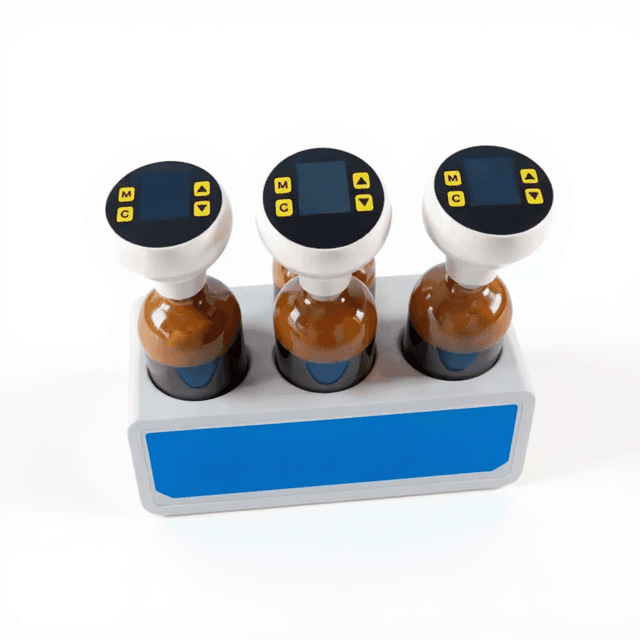
Micro-Volume UV/VIS Spectrophotometer
Micro-volume UV/VIS spectrophotometer requiring only 0.5-2 μL samples for nucleic acid and protein quantification across 190-1000 nm wavelength range with 0.001 Abs precision.

Louise Corscadden, PhD
Director of Science · ConductScience
Ask Louise about Micro-Volume UV/VIS Spectrophotometer fit, setup, configuration, or quote prep.
Already working with us? Sign in to connect this with My Scientist.
Key Specifications
Full details →- Model fit
- Configured during quote
- SKU family
- BIO-0413
- Shipping box
- 21.0 x 21.0 x 28.5 cm
- Ordering
- Online checkout and quote request available
- Category
- Imaging & Analysis
- Build notes
- Confirm accessories, station layout, and support needs before purchase
The Micro-Volume UV/VIS Spectrophotometer is a precision analytical instrument designed for quantitative analysis of nucleic acids and proteins using minimal sample volumes. With a 0.5 mm pathlength and sample volume requirement of only 0.5-2 μL, this spectrophotometer enables researchers to perform accurate measurements on precious samples where material conservation is critical. The instrument operates across a broad wavelength range from 190-1000 nm with ±1 nm wavelength precision and 0.5 nm resolution.
The system incorporates a long-life pulsed xenon lamp light source and provides absorbance measurements with 0.001 Abs precision and 0.3% accuracy across a dynamic range extending to 300 Abs. An integrated 8-inch color capacitive touch screen interface streamlines operation, while dual USB-A and single USB-B ports facilitate data transfer and connectivity. The instrument measures nucleic acids from 10-5000 ng/μL (dsDNA) and proteins from 0.05-300 mg/mL (BSA equivalent), making it suitable for diverse analytical workflows requiring high precision micro-volume measurements.
How It Works
The spectrophotometer operates on the Beer-Lambert law principle, where light absorption is proportional to analyte concentration and optical pathlength. A pulsed xenon lamp generates broad-spectrum light across the 190-1000 nm range, which passes through a monochromator system to select specific wavelengths with 0.5 nm resolution. The monochromatic light beam traverses the 0.5 mm pathlength sample chamber containing 0.5-2 μL of sample.
Transmitted light intensity is measured by a photodetector system, with absorbance calculated as the logarithmic ratio of incident to transmitted light intensity. The instrument's optical design compensates for variations in lamp intensity and electronic drift to maintain 0.001 Abs precision across the 300 Abs dynamic range. For nucleic acid analysis, measurements at 260 nm quantify total nucleic acid content, while 280 nm readings assess protein contamination through the A260/A280 ratio.
The integrated processing system converts raw absorbance data to concentration values using programmed extinction coefficients for common analytes including dsDNA (50 μg/mL per A260 unit) and BSA protein standards. The capacitive touch screen interface provides real-time spectral display and measurement control, with data export capabilities through USB connectivity.
Features & Benefits
Automation Level
- semi-automated
Pathlength
- 0.5mm
Sample Volume
- 0.5~2μL
Light Source
- Long-life pulsed xenon lamp
Wavelength Range
- 190~1000nm
Wavelength Precision
- ±1nm
Wavelength Resolution
- 0.5nm
Absorbance Precision
- 0.001Abs
Absorbance Accuracy
- 0.3%
Absorbance Range
- 0.001~300Abs(Equivalent to 10nm)
Nucleic Acid Measurement Range
- 10~5000ng/μL dsDNA
Protein Measurement Range
- 0.05~300mg/ml, BSA
Display Mode
- 8-inch color capacitive touch screen
Data Output
- USB-A*2; USB-B*1
Brand
- ConductScience
Research Domain
- Analytical Chemistry
- Cell Biology
- Clinical Diagnostics
- Microbiology
- Molecular Biology
- Pharmaceutical QC
Power/Voltage
- AC220V, 50/60Hz; 110V, 50/60Hz(Optional, external transformer)
Shipping weight
- 5.0 lb
Shipping box
- L: 21.0 cm
- W: 21.0 cm
- H: 28.5 cm
| Feature | This Product | Typical Alternative | Advantage |
|---|---|---|---|
| Sample Volume Requirement | 0.5-2 μL | Traditional spectrophotometers require 1-3 mL samples in standard cuvettes | Enables analysis of precious samples where material availability is limited, such as single-cell extracts or expensive biochemical preparations |
| Pathlength | 0.5 mm | Standard instruments use 1 cm pathlength requiring sample dilution for concentrated solutions | Accommodates highly concentrated samples without dilution, streamlining workflow and reducing preparation errors |
| Absorbance Range | 0.001-300 Abs | Conventional systems typically measure 0-4 Abs range | Covers extremely wide concentration range from dilute to concentrated samples in single measurement without range switching |
| Wavelength Range | 190-1000 nm | Entry-level models often cover 200-800 nm or require separate UV/VIS modules | Provides comprehensive spectral coverage for both UV and visible analysis in unified system without module changes |
| User Interface | 8-inch color capacitive touch screen | Basic models use LCD displays with button navigation | Simplifies method development and data visualization with modern interface reducing training time and operational complexity |
| Light Source | Long-life pulsed xenon lamp | Many systems use deuterium/tungsten lamp combinations requiring periodic replacement | Reduces maintenance frequency and provides stable output across full wavelength range without lamp changeover artifacts |
This micro-volume spectrophotometer offers significant sample conservation advantages with 0.5-2 μL requirements and 300 Abs dynamic range capability. The integrated pulsed xenon source and capacitive touch interface provide operational simplicity compared to traditional multi-lamp systems with basic displays.
Practical Tips
Perform wavelength calibration verification monthly using certified reference standards to maintain ±1 nm precision specification.
Why: Ensures measurement accuracy for critical A260/A280 ratios and maintains traceability to national standards.
Clean the micro-volume sample chamber with appropriate solvents after each use and inspect for residue buildup that could affect optical transmission.
Why: Prevents cross-contamination and maintains the 0.001 Abs precision by eliminating spurious absorption from sample carryover.
Allow 30 minutes warm-up time after power-on and establish fresh baseline readings before critical measurements.
Why: Thermal equilibration of the optical components ensures stable baseline and minimizes measurement drift during analytical sequences.
Use precision micropipettes calibrated for 0.5-2 μL volumes and verify pipette accuracy with gravimetric methods.
Why: Sample volume accuracy directly impacts concentration calculations in micro-volume measurements where traditional volume errors are magnified.
Verify sample chamber is free of air bubbles before measurement and check for proper sample wetting of optical surfaces.
Why: Air bubbles cause light scattering artifacts that compromise absorbance accuracy, particularly critical in high-precision micro-volume analysis.
If absorbance readings appear unstable, check for sample evaporation in the micro-volume chamber and consider using sealed sample accessories.
Why: Small sample volumes are susceptible to evaporation-induced concentration changes that appear as measurement drift.
Use appropriate UV-blocking safety glasses when working with samples in the 190-280 nm range and ensure proper ventilation for volatile solvents.
Why: UV wavelengths pose eye hazard risks, and micro-volume measurements often involve concentrated organic solvents requiring vapor control.
Establish standard curves using certified reference materials matched to your analyte matrix rather than relying solely on theoretical extinction coefficients.
Why: Matrix effects and measurement geometry in micro-volume systems can introduce systematic errors that empirical calibration corrects.
Setup Guide
What’s in the Box
- Micro-Volume UV/VIS Spectrophotometer main unit
- Power supply with regional adapter
- USB cable set (USB-A to USB-B)
- Sample loading accessories (typical)
- User manual and software documentation
- Calibration certificate
- Cleaning and maintenance kit (typical)
Warranty
ConductScience provides a standard one-year manufacturer warranty covering parts and labor, with comprehensive technical support including method development assistance and troubleshooting guidance.
Compliance
What is the minimum sample volume required for accurate measurements?
The instrument requires 0.5-2 μL sample volume with a 0.5 mm pathlength. Minimum volume of 0.5 μL provides sufficient optical path for reliable absorbance measurements down to 0.001 Abs precision.
How does the 300 Abs dynamic range compare to standard spectrophotometers?
The 300 Abs range (equivalent to 10 nm pathlength) is significantly higher than typical 1 cm pathlength instruments, allowing measurement of concentrated samples without dilution. This is particularly valuable for protein and nucleic acid stock solutions.
What wavelength accuracy can be expected for nucleic acid A260/A280 ratios?
Wavelength precision of ±1 nm with 0.5 nm resolution ensures accurate 260/280 nm ratio calculations for nucleic acid purity assessment. The system maintains spectral accuracy across the critical 250-300 nm range.
Can the instrument measure protein concentrations directly?
Yes, the system measures proteins from 0.05-300 mg/mL using BSA equivalents. Built-in extinction coefficients and calibration curves enable direct concentration readouts for common protein standards.
What data export formats are supported through USB connectivity?
Consult product datasheet for specific file formats. The dual USB-A and single USB-B ports support data transfer, though exact export formats and software compatibility should be verified with technical specifications.
How often does the pulsed xenon lamp require replacement?
The long-life pulsed xenon lamp design extends operational lifetime compared to traditional continuous sources. Specific lamp lifetime and replacement intervals should be confirmed from maintenance documentation.
Is the touch screen interface compatible with laboratory gloves?
The 8-inch color capacitive touch screen typically responds to conductive materials. Compatibility with specific glove types should be verified, as some non-conductive nitrile gloves may require special touch-screen compatible variants.
Have a question about this product?
Have a question? Just ask.
Send it over and we'll email you a personalized answer — no call, no scheduling.
Prefer to talk it through?