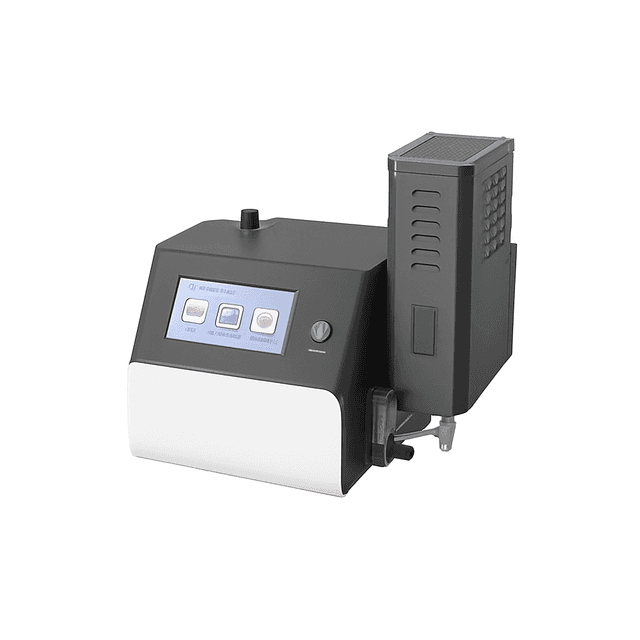
Fluorescence Spectrophotometer
Benchtop fluorescence spectrophotometer with Xenon lamp source, 200-900nm emission range, and ±1nm wavelength accuracy for quantitative fluorescence analysis.

Louise Corscadden, PhD
Director of Science · ConductScience
Ask Louise about Fluorescence Spectrophotometer fit, setup, configuration, or quote prep.
Already working with us? Sign in to connect this with My Scientist.
Key Specifications
Full details →- Model fit
- Configured during quote
- SKU family
- BIO-0405
- Shipping box
- 38.0 x 55.0 x 54.0 cm
- Ordering
- Online checkout and quote request available
- Category
- Imaging & Analysis
- Build notes
- Confirm accessories, station layout, and support needs before purchase
The ConductScience Fluorescence Spectrophotometer is a benchtop analytical instrument designed for fluorescence measurements across a broad wavelength range. Featuring a Hamamatsu 150W Xenon lamp light source and C-T diffraction grating emission monochromator, this spectrophotometer provides emission detection from 200-900nm with 10nm bandwidth resolution. The system delivers wavelength accuracy of ±1nm with repeatability of ≤0.5nm, supporting quantitative fluorescence analysis in research and analytical laboratories.
The instrument incorporates adjustable response time settings (0.1-4 seconds across 6 stages) and maintains signal stability better than 1.5% over 10 minutes, enabling both rapid screening and precise quantitative measurements. With linear measurement correlation ≥0.995 and fluorescence display range of 0.00-600.00 units, the spectrophotometer supports applications requiring reliable fluorescence detection and quantification across diverse sample types.
How It Works
Fluorescence spectrophotometry operates on the principle of molecular fluorescence, where target molecules absorb photons at specific wavelengths and re-emit light at longer wavelengths. The instrument's Hamamatsu 150W Xenon lamp provides broad-spectrum excitation light, which is directed onto the sample. When fluorescent molecules in the sample absorb this excitation energy, they transition to excited electronic states before returning to ground state through photon emission.
The emitted fluorescence passes through a C-T diffraction grating monochromator that separates wavelengths from 200-900nm with 10nm bandwidth resolution. The monochromator uses diffraction grating technology to isolate specific emission wavelengths for detection. A photodetector measures the intensity of selected wavelengths, with the signal processed to provide quantitative fluorescence readings from 0.00-600.00 units. The adjustable response time (0.1-4 seconds) allows optimization between measurement speed and signal averaging for different sample types.
Wavelength accuracy is maintained at ±1nm through precision optical components and calibration, while the system's stability specification of better than 1.5% over 10 minutes ensures consistent measurements during extended analytical sequences. The linear measurement correlation of ≥0.995 confirms proportional response between fluorophore concentration and detected signal intensity.
Features & Benefits
Automation Level
- semi-automated
Light Source
- Hamamatsu 150W Xenon lamp
Emission Monochromator
- C-T diffraction grating(Em 200~900nm, bandwidth 10nm)
Wavelength Accuracy
- ±1nm
Wavelength Repeatability
- ≤0.5nm
Linear Measurement(r)
- ≥0.995
Stability
- better than 1.5%/10min
Response Time
- (0.1~4)s, 6 stages adjustable
Fluorescence Display Value
- 0.00~600.00
Package Size(W*D*H)
- 550*540*380mm
Brand
- ConductScience
Research Domain
- Analytical Chemistry
- Cell Biology
- Environmental Monitoring
- Food Science
- Materials Science
- Pharmaceutical QC
Power/Voltage
- AC110/220V, 50/60Hz
Weight
- 13kg
Shipping weight
- 13.0 lb
Shipping box
- L: 38.0 cm
- W: 55.0 cm
- H: 54.0 cm
| Feature | This Product | Typical Alternative | Advantage |
|---|---|---|---|
| Emission Wavelength Range | 200-900nm with C-T diffraction grating | Many entry-level models offer 300-700nm ranges with narrower coverage | Extended UV and near-IR coverage enables analysis of diverse fluorophores including UV-excited compounds and long-wavelength dyes. |
| Wavelength Accuracy | ±1nm accuracy with ≤0.5nm repeatability | Basic instruments often specify ±2-5nm accuracy | Higher precision supports accurate identification of emission peaks and reliable quantitative measurements across batches. |
| Response Time Adjustment | 6-stage adjustable (0.1-4 seconds) | Fixed response times or limited adjustment options | Optimizes measurement speed versus precision for different sample concentrations and analytical requirements. |
| Signal Stability | Better than 1.5% over 10 minutes | Entry-level models may show 3-5% drift | Maintains measurement consistency during extended analytical sequences and kinetic studies without frequent recalibration. |
| Linear Range | ≥0.995 correlation coefficient | Standard instruments typically achieve 0.99 linearity | Enhanced linearity supports accurate quantification across wider concentration ranges with reduced calibration points. |
| Light Source | Hamamatsu 150W Xenon lamp | Lower-power lamps or LED sources with limited spectral range | High-power Xenon source provides intense, stable excitation across broad wavelength range for sensitive detection. |
This spectrophotometer combines broad wavelength coverage (200-900nm), high wavelength accuracy (±1nm), and flexible response time adjustment in a stable platform suitable for quantitative fluorescence analysis. The Hamamatsu Xenon lamp and precision monochromator support both routine analytical work and method development applications.
Practical Tips
Verify wavelength accuracy monthly using certified fluorescence standards with known emission peaks across your working range.
Why: Maintains the ±1nm accuracy specification and ensures reliable peak identification.
Monitor Xenon lamp output intensity regularly and replace when output drops below 80% of initial intensity.
Why: Prevents measurement drift and maintains sensitivity for trace-level detection applications.
Allow 30 minutes warm-up time before measurements to achieve specified stability performance.
Why: Ensures lamp and detector thermal equilibrium for consistent baseline and reduced measurement variability.
Use appropriate response time settings: shorter times for concentrated samples, longer times for low-concentration measurements.
Why: Optimizes signal-to-noise ratio while maintaining measurement throughput for different sample types.
If measurements exceed the 0.00-600.00 display range, dilute samples or reduce excitation intensity to prevent detector saturation.
Why: Prevents non-linear response and ensures measurements remain within the instrument's quantitative range.
Use appropriate UV-blocking eyewear when working with UV-fluorescent samples and ensure proper ventilation.
Why: Protects against UV exposure from both excitation light and sample fluorescence in the UV range.
Establish blank corrections using solvent or matrix-matched references to account for background fluorescence.
Why: Improves measurement accuracy by subtracting interfering fluorescence from sample matrices or solvents.
Check linear correlation (≥0.995) using serial dilutions of fluorescent standards across your working concentration range.
Why: Confirms quantitative performance and identifies concentration ranges requiring dilution or alternative approaches.
Setup Guide
What’s in the Box
- Fluorescence Spectrophotometer main unit
- Power cord (typical)
- Sample cuvettes (typical)
- User manual and operation guide (typical)
- Calibration certificate (typical)
- Software installation media (typical)
Warranty
ConductScience provides a standard 1-year manufacturer warranty covering defects in materials and workmanship. Technical support includes installation guidance, method development assistance, and troubleshooting for optimal instrument performance.
Compliance
What sample volumes are required for fluorescence measurements?
Consult product datasheet for specific cuvette dimensions and minimum sample volume requirements, which depend on the optical path length and cuvette type used.
How do I optimize response time settings for different sample types?
Use shorter response times (0.1-1 second) for high-concentration samples requiring rapid screening, and longer times (2-4 seconds) for low-concentration samples needing signal averaging to improve signal-to-noise ratio.
What wavelength calibration standards are recommended?
Use certified fluorescence standards with known emission peaks across your working wavelength range to verify the ±1nm accuracy specification during routine maintenance.
Can the instrument measure both steady-state and time-resolved fluorescence?
This spectrophotometer is designed for steady-state fluorescence measurements with adjustable response times; consult product specifications for time-resolved capabilities.
What maintenance is required for the Xenon lamp?
Xenon lamps typically require replacement after 1000-2000 hours of use; monitor lamp intensity and spectral output to determine optimal replacement intervals.
How do I account for inner filter effects in concentrated samples?
Dilute samples to maintain absorbance below 0.1 at excitation wavelength, or apply mathematical corrections based on measured absorbance values to compensate for inner filter effects.
What data output formats are available?
Consult product datasheet for specific data export options, file formats, and computer interface capabilities for integration with laboratory data management systems.
How does this compare to filter-based fluorometers?
This grating-based monochromator system provides continuous wavelength scanning and higher spectral resolution compared to filter-based systems, enabling detailed spectral analysis and wavelength optimization.
Have a question about this product?
Have a question? Just ask.
Send it over and we'll email you a personalized answer — no call, no scheduling.
Prefer to talk it through?

Upgrade Options