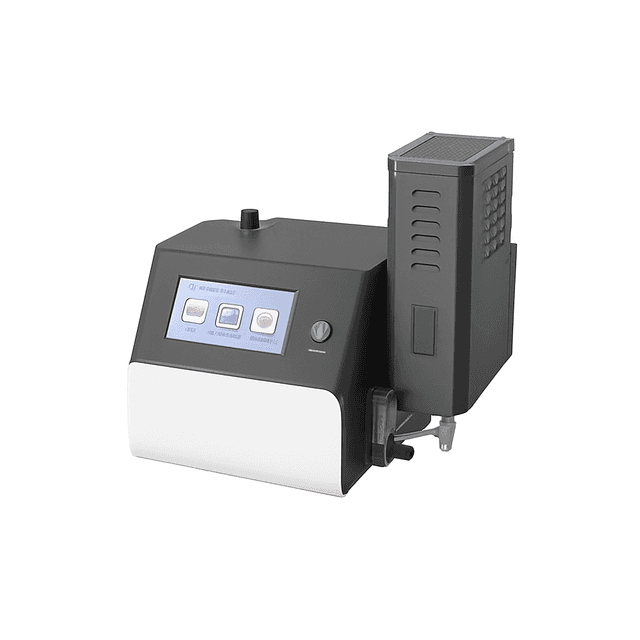
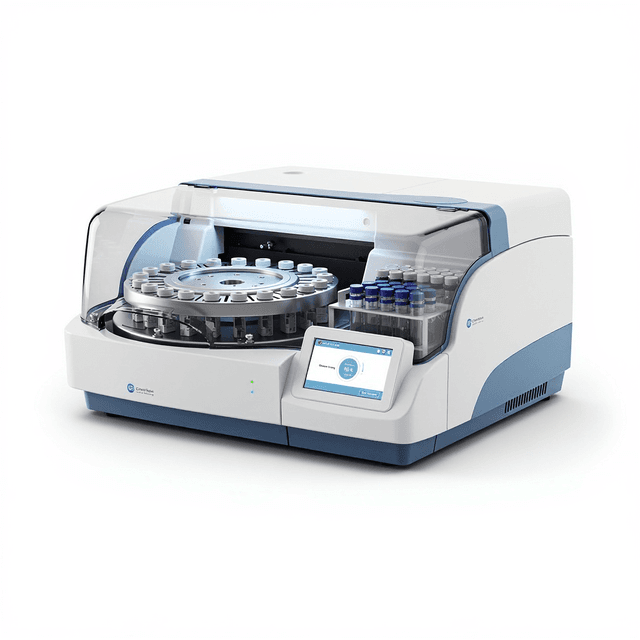
Pro Atomic Absorption Spectrophotometer
Atomic absorption spectrophotometer with 170-900nm wavelength range, Zeeman background correction, and 8-lamp capacity for quantitative trace metal analysis in research and analytical laboratories.

Louise Corscadden, PhD
Director of Science · ConductScience
Ask Louise about Pro Atomic Absorption Spectrophotometer fit, setup, configuration, or quote prep.
Already working with us? Sign in to connect this with My Scientist.
Key Specifications
Full details →- Model fit
- Configured during quote
- SKU family
- BIO-0411
- Shipping box
- 63.0 x 101.0 x 62.0 cm
- Ordering
- Online checkout and quote request available
- Category
- Imaging & Analysis
- Build notes
- Confirm accessories, station layout, and support needs before purchase
this spectrophotometer atomic absorption spectrophotometer delivers quantitative elemental analysis with a wavelength range of 170-900nm and spectral bandwidth options from 0.1-2.6nm. The system employs a classic Czerny-Turner monochromator configuration with a 430mm focal length optical system and photomultiplier tube detector for sensitive trace metal detection. Zeeman background correction capability provides background correction ability ≥1.8Abs with background correction ≥150 times, enabling analysis in complex sample matrices.
The instrument features an 8-position lamp stand supporting simultaneous preheating of 1-4 hollow cathode lamps, with wavelength accuracy of ±0.1nm and repeatability ≤0.05nm. Standard configuration includes copper and mercury element lamps plus software workstation for method development and data analysis. The plane diffraction grating (1800 grooves/mm, blazed at 250nm) provides efficient light dispersion across the UV-visible spectrum for multi-element analytical workflows.
How It Works
Atomic absorption spectrophotometry measures the absorption of specific wavelengths of light by ground-state atoms in the vapor phase. The sample is atomized in a flame or graphite furnace, breaking molecular bonds and creating free atoms. A hollow cathode lamp emits characteristic wavelengths specific to the target element, and this light passes through the atomic vapor where ground-state atoms absorb photons corresponding to electronic transitions.
The BK-AA860B Pro utilizes a classic Czerny-Turner monochromator with a plane diffraction grating (1800 grooves/mm) to isolate specific wavelengths from the hollow cathode lamp emission. The photomultiplier tube detector measures transmitted light intensity, with absorbance following Beer's law relationship to analyte concentration. Zeeman background correction uses a magnetic field to split atomic absorption lines, enabling separation of atomic absorption from molecular absorption and light scattering interferences.
The 430mm focal length optical system provides high resolution with selectable spectral bandwidths from 0.1-2.6nm, allowing optimization for different analytical requirements. The 8-lamp turret enables rapid switching between elements without manual lamp changes, supporting sequential multi-element analysis protocols.
Features & Benefits
Automation Level
- semi-automated
Wavelength Range
- 170~900nm
Spectral Bandwidth
- 0.1, 0.2, 0.4, 0.8, 1.2, 1.6, 2.6nmnm
Wavelength Accuracy
- ±0.1nm
Wavelength Repeatability
- ≤0.05nm
Detector
- Photomultiplier tube detector
Monochromator
- Classic Czerny-Turner configuration
Optical System Focal Length
- 430mm
Characteristic Concentration
- Flame method for Cu: ≤0.03μg/mL/1%
Detection Limit
- Flame method for Cu: ≤0.002μg/mL
Preciseness
- Flame method for Cu: ≤0.25%
Background Correction Ability
- Zeeman correction: ≥1.8Abs, background ≥150 times
Diffraction Grating
- Plane diffraction grating(1800 grooves/mm, blazed at 250nm)
Lamp Stand
- 8(Support simultaneous preheating of 1~4 lights)
Standard Accessory
- Element lamp(Cu*1, Hg*1), software working station
Brand
- ConductScience
Research Domain
- Analytical Chemistry
- Clinical Diagnostics
- Environmental Monitoring
- Food Science
- Industrial Hygiene
- Materials Science
- Pharmaceutical QC
Shipping weight
- 115.0 lb
Shipping box
- L: 63.0 cm
- W: 101.0 cm
- H: 62.0 cm
| Feature | This Product | Typical Alternative | Advantage |
|---|---|---|---|
| Background Correction Method | Zeeman correction with ≥1.8Abs capability and ≥150x background correction | Entry-level models typically use deuterium lamp correction with lower correction capability | Zeeman correction provides superior performance in complex matrices with structured background interferences |
| Lamp Capacity | 8-position lamp stand with simultaneous preheating of 1-4 lamps | Basic models often feature 2-4 lamp positions without simultaneous preheating | Reduces analysis time and improves workflow efficiency for multi-element determination protocols |
| Wavelength Range | 170-900nm covering UV and visible regions | Some instruments have limited UV capability below 190nm | Extended UV range enables analysis of elements with primary resonance lines in the far UV region |
| Spectral Bandwidth Options | Variable selection from 0.1-2.6nm | Fixed bandwidth instruments typically offer 0.2-0.5nm | Bandwidth optimization allows balancing of resolution and sensitivity for specific analytical requirements |
| Optical System | Classic Czerny-Turner configuration with 430mm focal length | Compact systems may use shorter focal lengths or alternative designs | Longer focal length provides improved optical resolution and reduced stray light for enhanced analytical precision |
| Detection System | Photomultiplier tube detector | Some systems use solid-state detectors or lower-gain PMT configurations | PMT technology provides high sensitivity and wide dynamic range essential for trace metal analysis |
The BK-AA860B Pro provides advanced analytical capabilities with Zeeman background correction, 8-lamp capacity, and variable spectral bandwidth selection. The 430mm focal length optical system and comprehensive wavelength coverage support demanding trace metal analysis applications in research and analytical laboratories.
Practical Tips
Perform wavelength calibration using mercury lamp emission lines at 253.7nm and 365.0nm to verify the ±0.1nm accuracy specification.
Why: Regular wavelength verification ensures analytical accuracy and compliance with method requirements.
Clean the nebulizer and spray chamber daily when analyzing samples with high dissolved solids content.
Why: Salt buildup reduces nebulization efficiency and can cause memory effects between samples.
Allow hollow cathode lamps to stabilize for 15-30 minutes before analysis and use appropriate lamp currents to maximize lamp life.
Why: Proper lamp conditioning ensures stable emission intensity and extends operational lifetime.
If background absorption exceeds Zeeman correction capability, dilute samples or use matrix modifiers to reduce interference.
Why: Excessive background can saturate the correction system and compromise analytical accuracy.
Run quality control standards at the beginning, middle, and end of each analytical batch to monitor instrument drift.
Why: Regular QC monitoring ensures analytical results remain within acceptable precision and accuracy limits.
Ensure adequate ventilation when using flame atomization and follow proper procedures for compressed gas handling.
Why: Flame operation produces combustion products and requires safe gas handling to prevent exposure risks.
Use matrix-matched calibration standards when analyzing complex samples to minimize matrix effects.
Why: Matrix matching compensates for physical and chemical interferences that can affect atomization efficiency.
Optimize spectral bandwidth based on spectral line characteristics - use narrower bandwidths for complex spectra and wider for maximum sensitivity.
Why: Proper bandwidth selection balances resolution and signal intensity for optimal analytical performance.
Setup Guide
What’s in the Box
- BK-AA860B Pro main unit
- Copper hollow cathode lamp
- Mercury hollow cathode lamp
- Software workstation package
- Power cable
- Communication cable
- User manual and documentation
- Lamp installation tools (typical)
- Sample introduction accessories (typical)
- Calibration certificate (typical)
Warranty
ConductScience provides a standard 1-year manufacturer warranty covering parts and labor with technical support for troubleshooting and method development assistance. Extended warranty options and service contracts are available for high-throughput analytical laboratories.
Compliance
What is the detection limit performance for elements other than copper?
Detection limits vary by element and atomization method. The specified ≤0.002µg/mL for copper by flame represents typical performance. Consult the product datasheet for detection limits of other elements and graphite furnace atomization capabilities.
Can the instrument perform both flame and graphite furnace atomization?
The specifications indicate flame atomization capabilities with the listed copper performance data. Graphite furnace compatibility should be confirmed by consulting the complete product specifications or contacting technical support.
What sample preparation methods are compatible with this system?
The system accepts liquid samples for direct aspiration into the flame atomizer. Sample preparation typically involves acid digestion for solid samples, dilution for high-concentration samples, and matrix matching for calibration standards.
How does the Zeeman background correction compare to deuterium correction?
Zeeman correction provides superior background correction capability (≥1.8Abs, ≥150x background) compared to deuterium lamps, particularly for structured background interferences and high-temperature atomization conditions.
What is the analysis time for multi-element determination?
Analysis time depends on the number of elements and replicates. The 8-lamp turret with simultaneous preheating capability reduces switching time between elements, enabling sequential multi-element analysis in automated sample runs.
What calibration standards and reference materials are recommended?
Use certified reference standards traceable to NIST or equivalent national standards. Matrix-matched standards are recommended for complex samples to minimize matrix effects and ensure analytical accuracy.
How often does the instrument require maintenance and calibration?
Daily performance checks using quality control standards are recommended. Wavelength calibration should be verified weekly or when changing analytical methods. Lamp replacement intervals depend on usage but typically range from 6-12 months.
What data output formats are supported by the software?
The included software workstation provides data acquisition and analysis capabilities. Specific export formats and LIMS integration capabilities should be confirmed from the software documentation or technical specifications.
Have a question about this product?
Have a question? Just ask.
Send it over and we'll email you a personalized answer — no call, no scheduling.
Prefer to talk it through?
Accessories
Enhance your setup with compatible accessories