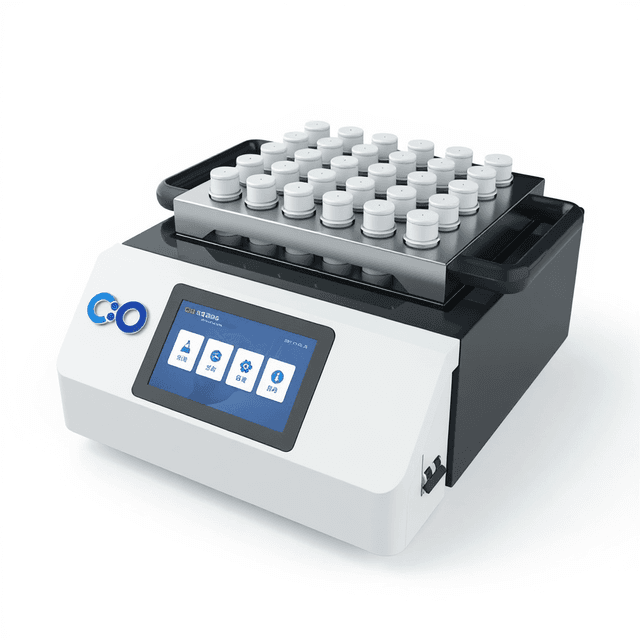
Vertical Planetary Ball Mill (Square type)
High-energy planetary ball mill with four 50-500 ml jars, dual-speed control (35-335 rpm revolution, 70-670 rpm rotation), achieving particle size reduction to 0.1 μm for materials processing and sample preparation.
| design_shape | 3D curve shape |
| gear_type | Special gear with low noise |
| Automation Level | semi-automated |
| Pot Quantity | 4pcs |
| Revolution (Adjustable) | 35~335rpm |
| Output Granularity | Minimum 0.1μm |
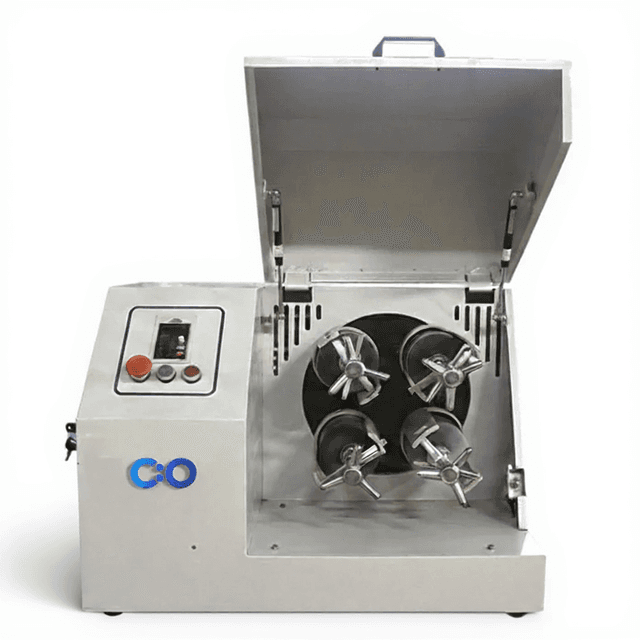
The Vertical Planetary Ball Mill (Square type) provides high-energy mechanical milling for particle size reduction and homogenization through planetary motion mechanics. This laboratory-scale mill employs four grinding jars operating simultaneously at independently adjustable revolution speeds (35-335 rpm) and rotation speeds (70-670 rpm), enabling precise control over milling intensity and particle size distribution. The system accommodates individual jar volumes from 50-500 ml with a total capacity of 2 L, supporting parallel processing of multiple samples or large batch operations.
The unit features frequency-controlled speed adjustment and specialized low-noise gear drive transmission for consistent performance across extended run times up to 9999 minutes. With minimum particle size reduction capability to 0.1 μm and compatibility with both soft/crispy materials (≤10 mm feed size) and harder materials (≤3 mm feed size), this mill supports comprehensive sample preparation workflows requiring controlled mechanical energy input for materials research, pharmaceutical development, and analytical chemistry applications.
How It Works
The planetary ball mill operates through a unique dual-rotation mechanism where grinding jars rotate around their own axes while simultaneously revolving around a central sun wheel. This planetary motion creates intense mechanical forces through repeated ball-sample-jar wall collisions at high frequencies. The grinding balls and sample material experience centrifugal forces alternating between the jar rotation and planetary revolution, generating impact energies significantly higher than conventional ball mills.
The milling process relies on three primary mechanisms: impact (high-energy collisions between balls and material), attrition (shearing forces during ball sliding), and compression (material trapped between colliding balls). The adjustable revolution and rotation speed ratios allow precise control over the relative contributions of these mechanisms. Higher speed ratios favor impact-dominated milling for brittle materials, while lower ratios promote attrition for ductile materials.
The frequency-controlled drive system maintains consistent speed relationships throughout the milling cycle, while the low-noise gear transmission ensures stable operation during extended processing times up to 9999 minutes. The four-jar configuration enables parallel processing with identical conditions or simultaneous optimization of different milling parameters.
Features & Benefits
design_shape
- 3D curve shape
gear_type
- Special gear with low noise
Automation Level
- semi-automated
Pot Quantity
- 4pcs
Revolution (Adjustable)
- 35~335rpm
Output Granularity
- Minimum 0.1μm
External Size (W×D×H)
- 750×470×565mm
Research Domain
- Analytical Chemistry
- Environmental Monitoring
- Food Science
- Materials Science
- Pharmaceutical QC
Capacity
- 2L
Power/Voltage
- AC110/220V±10%, 50/60Hz
Weight
- 80kg
Weight
- 176.37 lbs
Dimensions
- L: 29.53 in
- W: 22.24 in
- H: 18.5 in
Comparison Guide
| Feature | This Product | Typical Alternative | Advantage |
|---|---|---|---|
| Jar Capacity and Configuration | Four jars with 50-500 ml individual capacity (2L total) | Entry-level models often offer 1-2 jars with fixed volumes | Enables parallel processing of multiple samples or flexible batch sizing for different experimental requirements. |
| Speed Control Range | 35-335 rpm revolution, 70-670 rpm rotation with frequency control | Basic models provide limited speed ranges with fewer adjustment points | Allows precise optimization of milling intensity for different material types and target particle sizes. |
| Minimum Particle Size | 0.1 μm minimum achievable particle size | Standard mills typically achieve 1-5 μm minimum sizes | Enables nanoscale material preparation and enhanced surface area development for advanced applications. |
| Operating Duration | Up to 9999 minutes continuous operation capability | Basic models often limit cycles to 60-480 minutes | Supports extended mechanical alloying and nanocrystalline synthesis processes requiring long processing times. |
| Drive System | Low-noise gear drive with frequency-controlled speed adjustment | Standard models use basic motor drives with higher noise levels | Enables laboratory operation with minimal disruption and maintains precise speed relationships throughout extended cycles. |
| Design Geometry | 3D curve design with square-type configuration | Conventional designs use circular or basic geometric configurations | Optimizes ball trajectory and collision patterns for improved milling efficiency and particle size uniformity. |
This vertical planetary ball mill combines high-capacity parallel processing with precise dual-speed control and extended operation capability. The four-jar configuration and wide speed ranges (35-335 rpm revolution, 70-670 rpm rotation) provide exceptional versatility for diverse materials processing requirements, while the 0.1 μm minimum particle size achievement supports advanced nanomaterial preparation workflows.
Practical Tips
Verify speed accuracy monthly using a tachometer on empty jars, checking both revolution (35-335 rpm) and rotation (70-670 rpm) settings across the full range.
Why: Speed accuracy directly affects milling energy and reproducibility of particle size results.
Lubricate the gear drive system every 500 operating hours and inspect belt tension weekly during heavy use periods.
Why: The low-noise gear system requires regular maintenance to preserve precision and prevent premature wear.
Fill jars to maximum 1/3 volume with combined sample and grinding media to optimize ball movement and collision efficiency.
Why: Proper fill ratios ensure maximum energy transfer while preventing excessive wear and heat generation.
Always verify jar clamp security and safety interlock function before starting, especially when processing reactive or toxic materials.
Why: Proper containment prevents exposure to hazardous materials and ensures safe operation during high-energy milling.
Document speed settings, processing times, and ball-to-sample ratios for each material type to develop reproducible protocols.
Why: Systematic record-keeping enables optimization and ensures consistent particle size results across experiments.
Monitor jar temperature during extended cycles and implement cooling pauses if temperature exceeds material thermal limits.
Why: Temperature control prevents material degradation and maintains consistent milling conditions throughout long processing cycles.
Use dedicated grinding media and jars for different material classes to prevent cross-contamination between sample types.
Why: Material-specific equipment prevents contamination and maintains analytical integrity in research applications.
Clean grinding jars thoroughly with appropriate solvents after each use and inspect for wear patterns that could affect particle size distribution.
Why: Clean equipment prevents carryover between samples and worn surfaces can introduce artifacts in particle size analysis.
Setup Guide
What’s in the Box
- Vertical planetary ball mill main unit
- Four grinding jars (50-500 ml capacity range) (typical)
- Grinding media set (various ball sizes) (typical)
- Jar clamps and safety locks
- Power cord
- User manual and operation guide
- Calibration certificate (typical)
- Basic maintenance tools (typical)
Warranty
ConductScience provides a standard one-year manufacturer warranty covering mechanical components and drive systems, with technical support for operation and maintenance procedures.
Compliance
References
Background reading relevant to this product:
What ball-to-sample ratio should I use for different materials?
For hard, brittle materials use 15:1 to 20:1 ball-to-sample ratios with higher revolution speeds (200-335 rpm) to maximize impact forces. For soft or ductile materials, use 10:1 to 15:1 ratios with lower speeds (35-150 rpm) to prevent excessive heating and promote gradual size reduction.
How do I optimize speed settings for different target particle sizes?
For coarse grinding (>10 μm), use moderate speeds (100-200 rpm revolution) with short cycles. For fine grinding (1-10 μm), increase to 250-335 rpm revolution with extended cycles. For nanoscale reduction (<1 μm), use maximum speeds (335 rpm revolution, 670 rpm rotation) with controlled temperature and inert atmosphere.
What is the maximum processing time for temperature-sensitive materials?
The system supports up to 9999 minutes continuous operation, but temperature-sensitive materials typically require cycle interruptions every 30-60 minutes for cooling. Monitor jar temperature and implement pause cycles to prevent thermal degradation of heat-sensitive compounds.
How do I prevent contamination during grinding?
Use appropriate jar and ball materials (zirconia for ceramics, tungsten carbide for metals, agate for organics) and clean thoroughly between samples. The individual 50-500 ml jar capacity allows dedicated jars for different material types to prevent cross-contamination.
What maintenance is required for the gear drive system?
The low-noise gear drive requires lubrication every 500 operating hours and inspection of gear wear every 1000 hours. Monitor vibration patterns during operation and check belt tension monthly to maintain the precision speed control between revolution and rotation mechanisms.
How do I verify particle size achievement without external analysis?
Monitor milling progress through periodic sampling and visual inspection under magnification. Establish time-speed curves for your specific materials using the adjustable parameters (35-335 rpm revolution, 70-670 rpm rotation) to develop reproducible protocols for target size ranges.
Can I process reactive or hazardous materials safely?
Yes, when using appropriate jar materials and inert atmosphere purging. The enclosed jar system with secure clamps provides containment, while the extended timer capability (up to 9999 minutes) allows low-intensity processing of reactive materials at reduced speeds to minimize heat generation.
What factors affect the 0.1 μm minimum particle size capability?
Achieving 0.1 μm requires optimal ball size selection (typically 1-5 mm), high-speed settings (maximum 335 rpm revolution), extended processing times, and materials with favorable fracture properties. Soft or plastic materials may require cryogenic cooling to achieve this size reduction.
Have a question about this product?
Accessories
Enhance your setup with compatible accessories
Frequently Bought Together