Behavioral Tracking for Betta Fish
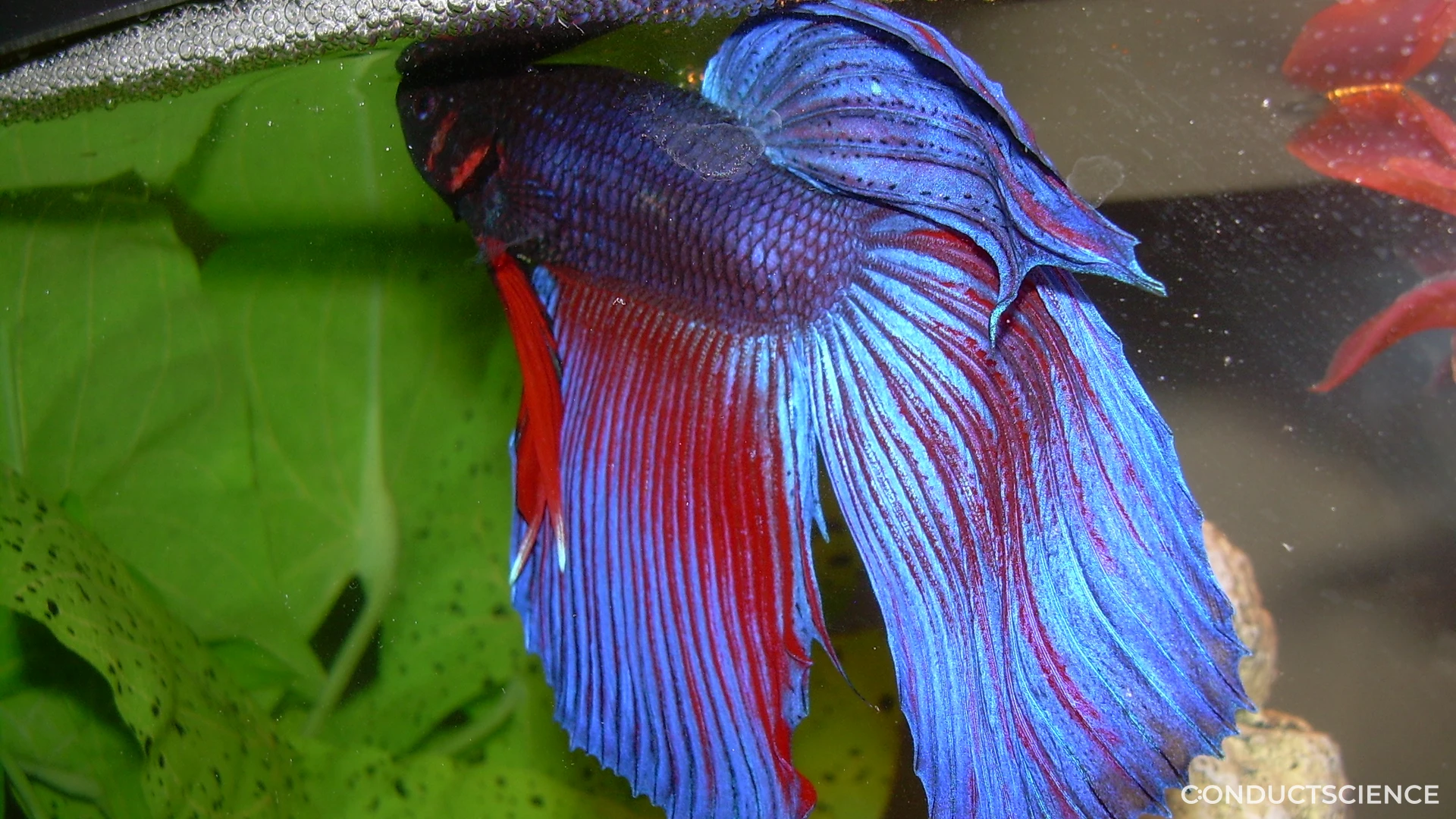
Betta splendens
ConductVision delivers automated tracking of betta fish aggression, boldness, and lateralization. Quantify mirror-elicited displays, exploration behavior, and turning bias in Betta splendens.

Why Betta Fish in Behavioral Research
The Siamese fighting fish (Betta splendens) is a classic model for studying aggression, individual differences in behavior, and lateralization. Their elaborate mirror-elicited aggressive displays — including opercular flaring, lateral displays, and approach behavior — provide robust, easily quantifiable behavioral endpoints. Boldness/exploration paradigms reveal consistent personality traits across contexts, making bettas ideal for behavioral syndrome research.
Eisenreich BR, Szalda-Petree A. (2015). Behavioral effects of fluoxetine on aggression and associative learning in Siamese fighting fish (Betta splendens). Behav Processes, 121, 37-42. PMID: 26514564
Forsatkar MN, et al. (2017). An overview of the Siamese fighting fish (Betta splendens) as a model for behavioral research. J Mar Biol Assoc UK, 97(7), 1373-1389.
What We Measure in Betta Fish
Validated assays with quantitative parameter tracking for Betta splendens.
Mirror tests elicit robust aggressive displays without risk of injury. Opercular flaring, lateral displays, and approach latency provide reliable, repeatable measures of aggression intensity and individual differences.
| Parameter | Unit | Description |
|---|---|---|
| Opercular flaring duration | s | Gill cover display |
| Lateral display frequency | count | Broadside threat posture |
| Approach latency to mirror | s | Aggression onset |
| Total display time | s | Cumulative aggressive behavior |
Eisenreich BR, Szalda-Petree A. (2015). Behavioral effects of fluoxetine on aggression and associative learning in Siamese fighting fish (Betta splendens). Behav Processes, 121, 37-42. PMID: 26514564
Boldness assays measure willingness to explore unfamiliar environments. Emergence latency from shelter, total distance traveled, and area covered reveal consistent personality traits that correlate with aggression across contexts.
| Parameter | Unit | Description |
|---|---|---|
| Latency to emerge | s | Time to leave shelter |
| Total distance | mm | Exploration extent |
| Area covered | mm² | Spatial exploration |
Forsatkar MN, et al. (2017). An overview of the Siamese fighting fish (Betta splendens) as a model for behavioral research. J Mar Biol Assoc UK, 97(7), 1373-1389.
Betta fish show consistent lateralized turning preferences in T-maze and Y-maze paradigms, reflecting brain hemispheric specialization. Laterality indices quantify the strength and direction of behavioral asymmetry.
| Parameter | Unit | Description |
|---|---|---|
| Turning bias | % | Left vs right eye preference |
| Laterality index | -1 to +1 | Strength and direction of bias |
Eisenreich BR, Szalda-Petree A. (2015). Behavioral effects of fluoxetine on aggression and associative learning in Siamese fighting fish (Betta splendens). Behav Processes, 121, 37-42. PMID: 26514564
More Behavioral Tests for Betta Fish
Color Preference
Key Parameters: Time near each color stimulus, approach frequency
Arnott G, Elwood RW. (2009).
Breathing Rate / Surfacing
Key Parameters: Surface visits/min, inter-breath interval, stress-induced changes
ConductScience Hardware for Betta Fish Research
Mirror Aggression Setup
Controlled display testing
Novel Environment Arena
Boldness and exploration
Lateralization Maze (T/Y)
Turning bias measurement
Video Tracking System
Automated behavior scoring
Color Stimulus Display
Visual preference testing
Citations & Further Reading
- Eisenreich BR, Szalda-Petree A. (2015). Behavioral effects of fluoxetine on aggression and associative learning in Siamese fighting fish (Betta splendens). Behav Processes, 121, 37-42. PMID: 26514564
- Forsatkar MN, et al. (2017). An overview of the Siamese fighting fish (Betta splendens) as a model for behavioral research. J Mar Biol Assoc UK, 97(7), 1373-1389.
Other Model Systems

Discuss Your Betta Research
Tell us about your models, assays, and experimental goals — we’ll show you how ConductVision fits your workflow.