Behavioral Tracking for Crayfish
Procambarus clarkii
ConductVision delivers automated tracking of crayfish escape responses, aggression hierarchies, and anxiety-like behavior. Quantify tail-flip responses, dominance interactions, and light/dark preference in Procambarus clarkii.

Why Crayfish in Behavioral Research
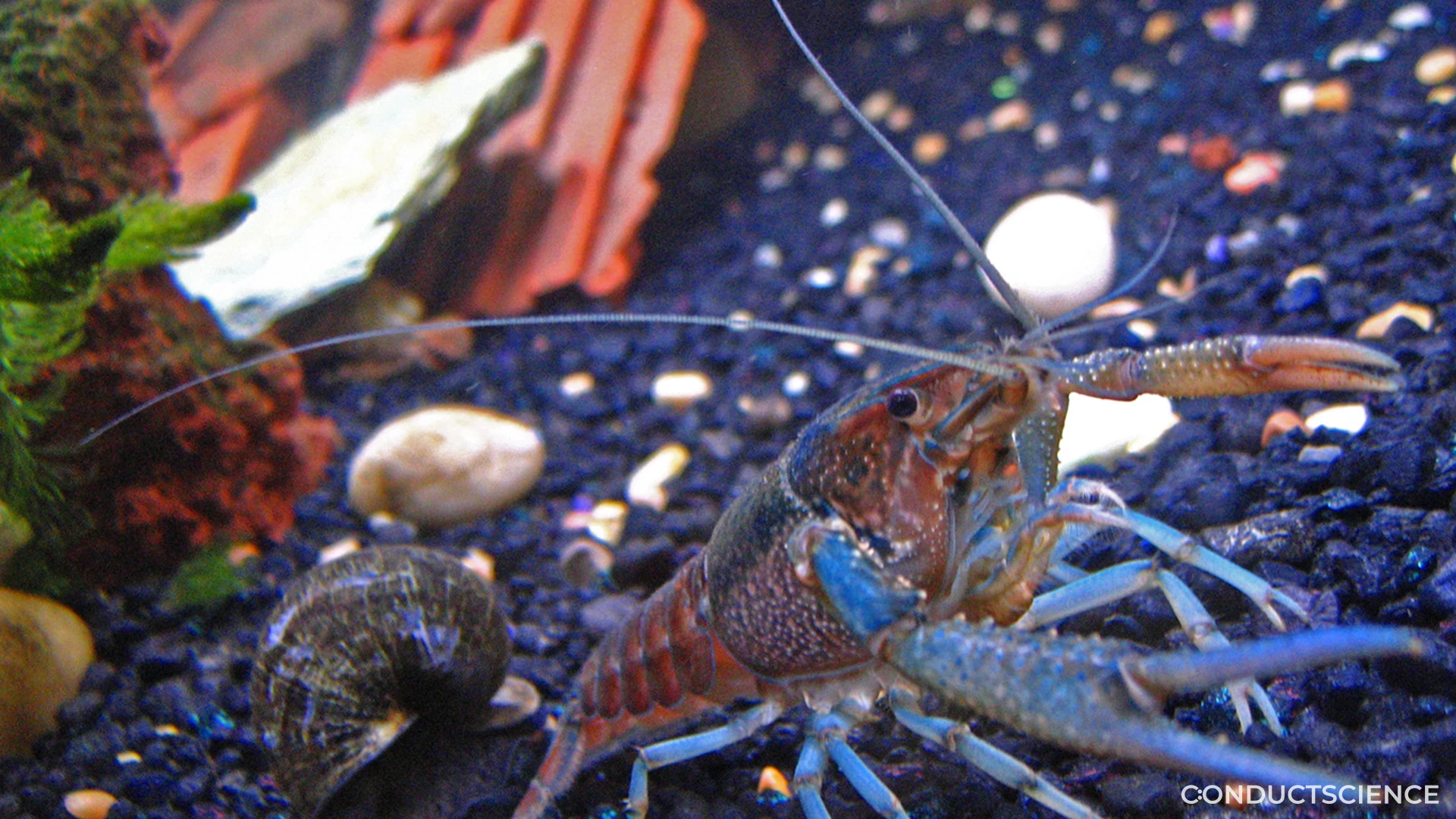
Crayfish (Procambarus clarkii) have emerged as a key model for studying the neurobiology of aggression, anxiety, and social hierarchy. The landmark finding that serotonin controls anxiety-like behavior in crayfish — paralleling mammalian systems — established them as a powerful translational model. Tail-flip escape responses, dominance hierarchies, and light/dark preference assays provide robust, quantifiable behavioral endpoints.
Huber R, et al. (1997). Serotonin and aggressive motivation in crustaceans: altering the decision to retreat. Proc Natl Acad Sci U S A, 94(11), 5939-5942. PMID: 9159179
Fossat P, et al. (2014). Anxiety-like behavior in crayfish is controlled by serotonin. Science, 344(6189), 1293-1297. PMID: 24926022
What We Measure in Crayfish
Validated assays with quantitative parameter tracking for Procambarus clarkii.
The tail-flip escape is a rapid, stereotyped response mediated by giant interneurons. Response latency, escape distance, and flip frequency provide quantifiable measures of neural circuit function and threat sensitivity.
| Parameter | Unit | Description |
|---|---|---|
| Response latency | ms | Time to initiate tail flip |
| Escape distance | cm | Total displacement |
| Flip frequency | flips/event | Number of consecutive flips |
Huber R, et al. (1997). Serotonin and aggressive motivation in crustaceans: altering the decision to retreat. Proc Natl Acad Sci U S A, 94(11), 5939-5942. PMID: 9159179
Crayfish establish linear dominance hierarchies through ritualized agonistic encounters involving chelae displays, body raises, and wrestling. Hierarchy formation provides a model for studying serotonergic modulation of social behavior.
| Parameter | Unit | Description |
|---|---|---|
| Approach frequency | events/min | Agonistic contact initiation |
| Chelae display duration | s | Weapon presentation |
| Fight escalation level | 1-5 scale | Threat → contact → wrestling → retreat |
| Dominance establishment time | min | Time to stable hierarchy |
Huber R, et al. (1997). Serotonin and aggressive motivation in crustaceans: altering the decision to retreat. Proc Natl Acad Sci U S A, 94(11), 5939-5942. PMID: 9159179
Crayfish show robust scototaxis that is modulated by serotonin, directly paralleling mammalian anxiety paradigms. Time in dark zones, zone transitions, and latency to enter illuminated areas quantify anxiety-like states.
| Parameter | Unit | Description |
|---|---|---|
| Time in dark zone | % | Anxiety-like scototaxis |
| Zone transitions | count | Exploration balance |
| Latency to enter light | s | Risk-taking measure |
Fossat P, et al. (2014). Anxiety-like behavior in crayfish is controlled by serotonin. Science, 344(6189), 1293-1297. PMID: 24926022
More Behavioral Tests for Crayfish
Exploration (Open Field Analog)
Key Parameters: Distance, velocity, thigmotaxis
Fossat P, et al. (2014). PMID: 24926022
Social Status Effects
Key Parameters: Dominance-dependent behavioral shifts, serotonin modulation
Huber R, et al. (1997). PMID: 9159179
Shelter Competition
Key Parameters: Shelter occupancy time, eviction latency, winner determination
Fero K, et al. (2007). PMID: 17321087
ConductScience Hardware for Crayfish Research
Crayfish Arena with Shelter
Aggression and shelter competition
Dark/Light Choice Chamber
Anxiety-like behavior testing
High-Speed Camera System
Tail-flip escape capture
Social Interaction Tank
Dominance hierarchy establishment
Infrared Tracking System
Activity monitoring
Citations & Further Reading
- Huber R, et al. (1997). Serotonin and aggressive motivation in crustaceans: altering the decision to retreat. Proc Natl Acad Sci U S A, 94(11), 5939-5942. PMID: 9159179
- Fossat P, et al. (2014). Anxiety-like behavior in crayfish is controlled by serotonin. Science, 344(6189), 1293-1297. PMID: 24926022
Other Model Systems
Discuss Your Crayfish Research
Tell us about your models, assays, and experimental goals — we’ll show you how ConductVision fits your workflow.