Primary Assay — Common Cuttlefish
Lateralization
Sepia officinalis
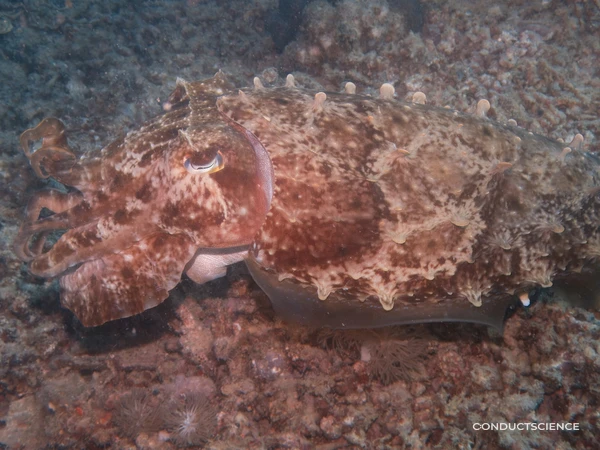
Cuttlefish show lateralized eye use and turning preferences that vary with context. Turning bias, laterality index, and context-dependent switching reveal brain hemispheric specialization in cephalopods.

Quantitative Output
Measured Parameters
Every parameter is automatically tracked frame-by-frame in the ConductVision pipeline for Sepia officinalis.
| Parameter | Unit | Description |
|---|---|---|
| Turning bias | % | Left vs right eye preference |
| Laterality index | -1 to +1 | Strength and direction |
| Context-dependent switching | events | Flexibility of bias |
References
Citations for Lateralization
- Schnell AK, et al. (2021). Cuttlefish exert self-control in a delay of gratification task. Proc R Soc B, 288(1946), 20203161. PMID: 33653139
Compatible Equipment
Hardware for Common Cuttlefish Research
Camouflage Substrate Array
Body pattern testing
High-Speed Camera System
Tentacle strike capture
Prawn-in-a-Tube Apparatus
Self-control paradigm
Cuttlefish Maze System
Spatial learning
Seawater Flow-Through System
Cephalopod maintenance
Related Assays
Other Common Cuttlefish Primary Assays
04
Camouflage / Body Pattern Quantification
Sepia officinalis
Cuttlefish deploy three basic body pattern types — uniform, mottle, and disruptive — in response to visual background fe…
04
Prey Capture (Tentacle Strike)
Sepia officinalis
Cuttlefish capture prey with a rapid tentacle strike reaching completion in milliseconds. Strike latency, distance, succ…
04
Prawn-in-a-Tube (Delay of Gratification)
Sepia officinalis
The prawn-in-a-tube paradigm demonstrated that cuttlefish can delay gratification — waiting for a preferred prey when an…
Run Lateralization on ConductVision
Our team will configure the protocol, camera rig, and analysis pipeline for your common cuttlefish facility.