Behavioral Tracking for Common Cuttlefish
Sepia officinalis
ConductVision delivers automated tracking of cuttlefish camouflage, prey capture, self-control, and spatial learning. Quantify body pattern responses, tentacle strikes, and delay-of-gratification in Sepia officinalis.

Why Common Cuttlefish in Behavioral Research
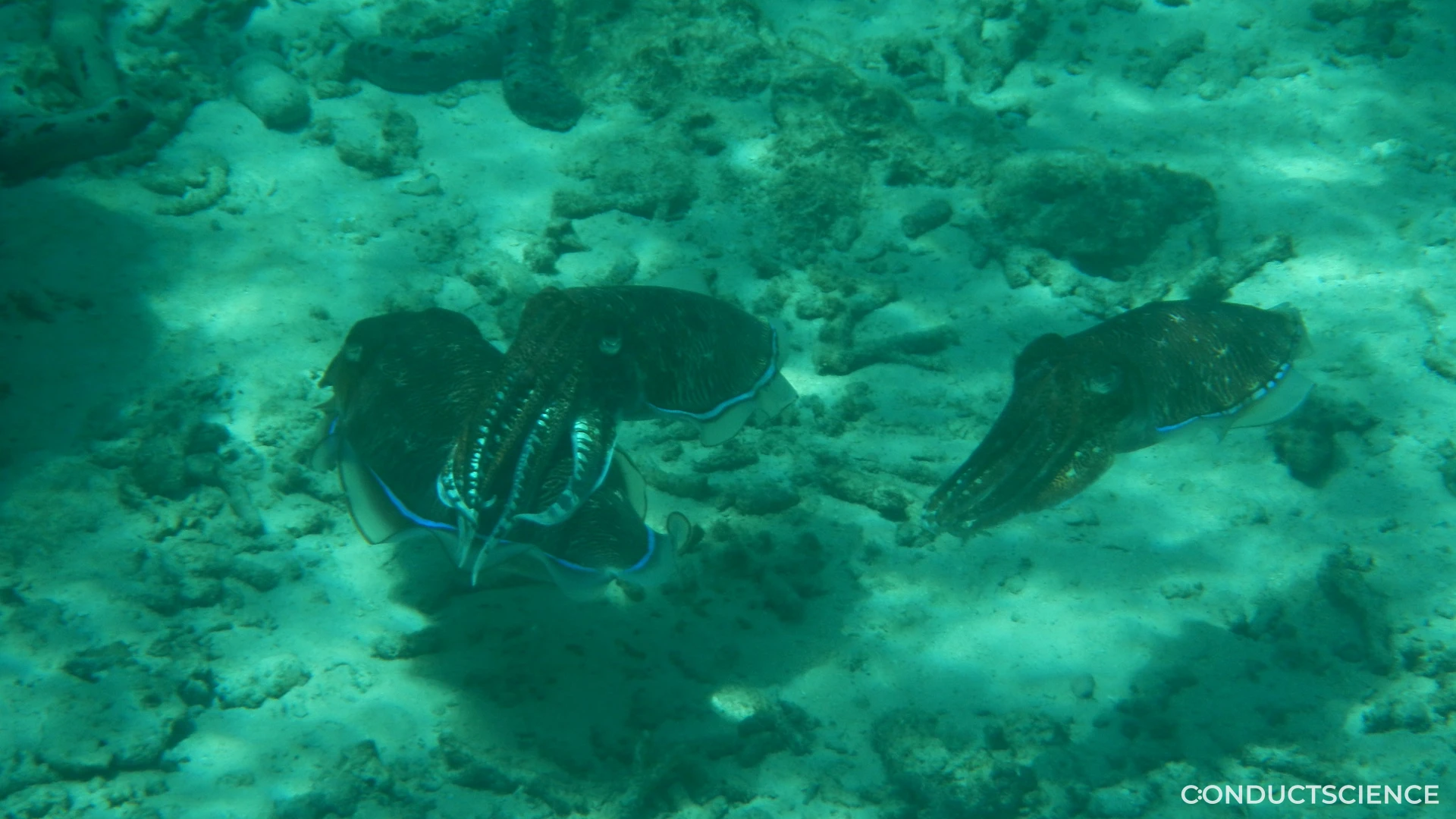
The common cuttlefish (Sepia officinalis) has emerged as a star of comparative cognition following the landmark demonstration that they can exert self-control in a delay-of-gratification task — previously thought exclusive to large-brained vertebrates. Their unparalleled camouflage abilities, sophisticated prey capture, spatial learning, and lateralized behavior provide rich behavioral repertoires for studying cephalopod intelligence and adaptive behavior.
Schnell AK, et al. (2021). Cuttlefish exert self-control in a delay of gratification task. Proc R Soc B, 288(1946), 20203161. PMID: 33653139
What We Measure in Common Cuttlefish
Validated assays with quantitative parameter tracking for Sepia officinalis.
Cuttlefish deploy three basic body pattern types — uniform, mottle, and disruptive — in response to visual background features. Pattern onset latency, classification, and background match accuracy quantify this sophisticated sensorimotor integration.
| Parameter | Unit | Description |
|---|---|---|
| Pattern onset latency | s | Time to first pattern change |
| Pattern type classification | categorical | Uniform, mottle, disruptive |
| Chromatic component score | 0-10 | Body pattern complexity |
| Background match accuracy | % | Visual match assessment |
Schnell AK, et al. (2021). Cuttlefish exert self-control in a delay of gratification task. Proc R Soc B, 288(1946), 20203161. PMID: 33653139
Cuttlefish capture prey with a rapid tentacle strike reaching completion in milliseconds. Strike latency, distance, success rate, and pre-strike assessment time quantify hunting efficiency and visual-motor coordination.
| Parameter | Unit | Description |
|---|---|---|
| Strike latency | ms | Tentacle deployment speed |
| Strike distance | cm | Effective range |
| Capture success rate | % | Hunting efficiency |
| Prey assessment time | s | Pre-strike evaluation |
Schnell AK, et al. (2021). Cuttlefish exert self-control in a delay of gratification task. Proc R Soc B, 288(1946), 20203161. PMID: 33653139
The prawn-in-a-tube paradigm demonstrated that cuttlefish can delay gratification — waiting for a preferred prey when an immediate but less-preferred option is available. Maximum wait time and learning across sessions measure self-control capacity.
| Parameter | Unit | Description |
|---|---|---|
| Maximum wait time | s | Self-control duration |
| Quality vs quantity preference | ratio | Value-based decision |
| Learning across sessions | Δs | Improvement in patience |
Schnell AK, et al. (2021). Cuttlefish exert self-control in a delay of gratification task. Proc R Soc B, 288(1946), 20203161. PMID: 33653139
Cuttlefish navigate mazes and demonstrate spatial memory. Completion time, error rate, and retention across days measure navigation, learning speed, and long-term spatial memory.
| Parameter | Unit | Description |
|---|---|---|
| Maze completion time | s | Navigation speed |
| Error rate | entries/trial | Incorrect turns |
| Retention across days | % correct | Long-term memory |
Schnell AK, et al. (2021). Cuttlefish exert self-control in a delay of gratification task. Proc R Soc B, 288(1946), 20203161. PMID: 33653139
Cuttlefish show lateralized eye use and turning preferences that vary with context. Turning bias, laterality index, and context-dependent switching reveal brain hemispheric specialization in cephalopods.
| Parameter | Unit | Description |
|---|---|---|
| Turning bias | % | Left vs right eye preference |
| Laterality index | -1 to +1 | Strength and direction |
| Context-dependent switching | events | Flexibility of bias |
Schnell AK, et al. (2021). Cuttlefish exert self-control in a delay of gratification task. Proc R Soc B, 288(1946), 20203161. PMID: 33653139
ConductScience Hardware for Common Cuttlefish Research
Camouflage Substrate Array
Body pattern testing
High-Speed Camera System
Tentacle strike capture
Prawn-in-a-Tube Apparatus
Self-control paradigm
Cuttlefish Maze System
Spatial learning
Seawater Flow-Through System
Cephalopod maintenance
Citations & Further Reading
- Schnell AK, et al. (2021). Cuttlefish exert self-control in a delay of gratification task. Proc R Soc B, 288(1946), 20203161. PMID: 33653139
Other Model Systems
Discuss Your Cuttlefish Research
Tell us about your models, assays, and experimental goals — we’ll show you how ConductVision fits your workflow.