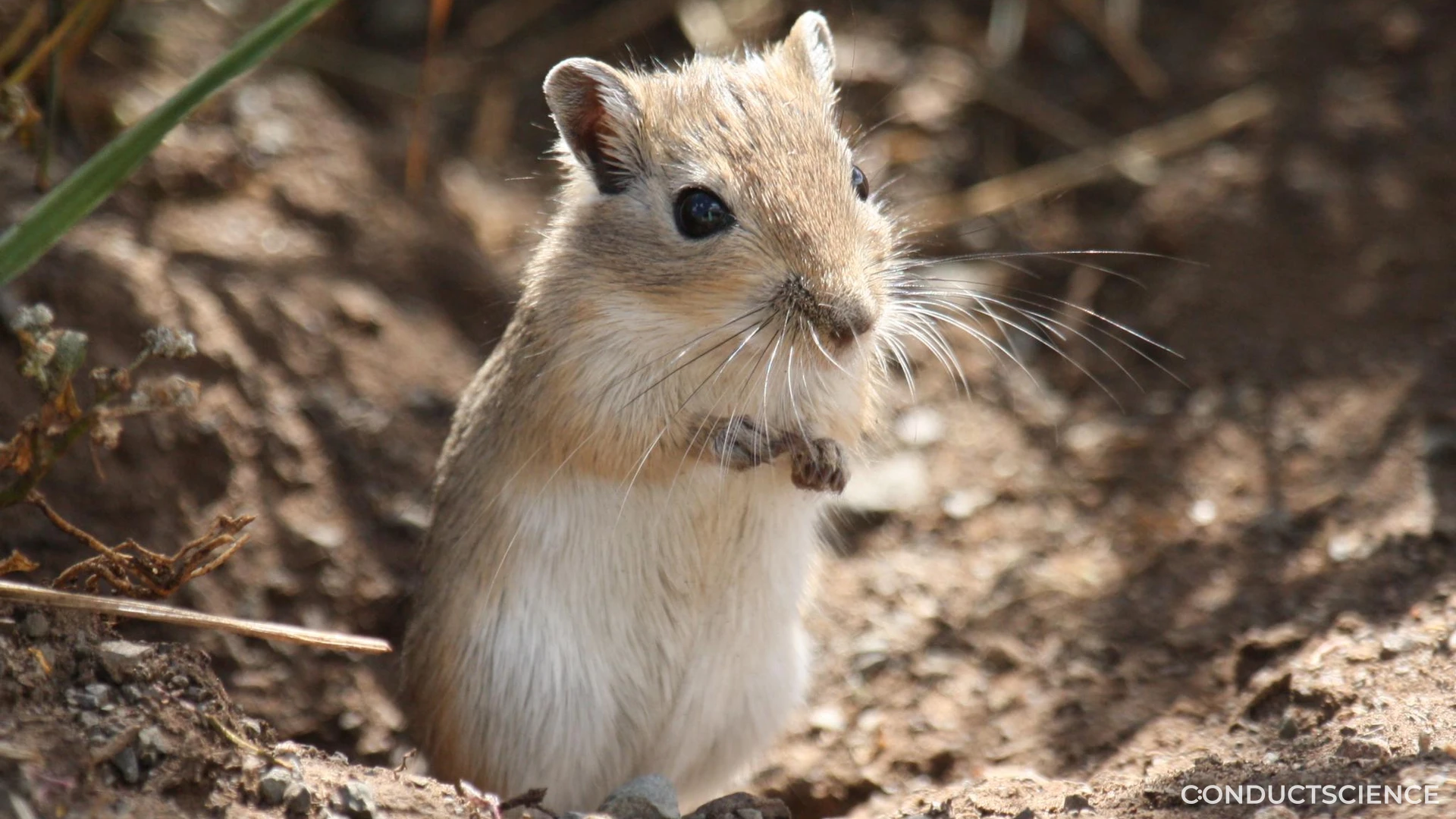
Behavioral Tracking for Mongolian Gerbil
Meriones unguiculatus
ConductVision delivers automated tracking of gerbil seizure scoring, digging behavior, and foot drumming signals. Quantify epileptic seizure severity, burrowing activity, and alarm communication in Meriones unguiculatus.

Why Mongolian Gerbil in Behavioral Research
The Mongolian gerbil (Meriones unguiculatus) is a naturally seizure-prone species, making them a key model for epilepsy research without requiring chemical or electrical kindling. Their species-typical digging behavior, foot-drumming alarm signals, and robust open field exploration provide distinct behavioral endpoints not easily studied in standard rodent models. Genetic seizure susceptibility combined with tractable behavioral assays makes gerbils uniquely valuable for anticonvulsant screening.
Loskota WJ, Lomax P, Rich ST. (1974). The gerbil as a model for the study of the epilepsies. Epilepsia, 15(1), 109-119. PMID: 4522520
What We Measure in Mongolian Gerbil
Validated assays with quantitative parameter tracking for Meriones unguiculatus.
Gerbils exhibit spontaneous seizures scored on the Racine scale. Seizure severity, latency, duration, and post-ictal suppression provide standardized measures for anticonvulsant drug screening and epilepsy genetics research.
| Parameter | Unit | Description |
|---|---|---|
| Seizure severity score | 0-5 Racine | Behavioral seizure grade |
| Seizure latency | s | Time from stimulus to seizure |
| Seizure duration | s | Total seizure episode |
| Post-ictal suppression | s | Recovery time |
Loskota WJ, Lomax P, Rich ST. (1974). The gerbil as a model for the study of the epilepsies. Epilepsia, 15(1), 109-119. PMID: 4522520
Gerbils are prolific diggers, and burrowing behavior provides a species-typical behavioral endpoint reflecting motivation, motor function, and environmental enrichment engagement.
| Parameter | Unit | Description |
|---|---|---|
| Dig bout frequency | events/session | Digging episodes |
| Burrow depth | cm | Excavation depth |
| Substrate displaced | g | Material moved |
| Digging duration | s | Time spent digging |
Loskota WJ, Lomax P, Rich ST. (1974). The gerbil as a model for the study of the epilepsies. Epilepsia, 15(1), 109-119. PMID: 4522520
Foot drumming is a species-specific alarm signal in gerbils. Drum rate, bout duration, and stimulus threshold quantify alarm signaling behavior and its modulation by fear and social context.
| Parameter | Unit | Description |
|---|---|---|
| Drum rate | drums/min | Signaling frequency |
| Bout duration | s | Drumming episode length |
| Latency to drum | s | Alarm onset time |
| Stimulus threshold | dB/lux | Minimum trigger |
Loskota WJ, Lomax P, Rich ST. (1974). The gerbil as a model for the study of the epilepsies. Epilepsia, 15(1), 109-119. PMID: 4522520
Open field exploration in gerbils reveals locomotor activity, anxiety-like behavior (center avoidance), and vertical exploration (rearing). These standard measures complement species-specific assays.
| Parameter | Unit | Description |
|---|---|---|
| Distance | cm | Locomotor activity |
| Rearing | count | Vertical exploration |
| Center time | % | Anxiety-like behavior |
Loskota WJ, Lomax P, Rich ST. (1974). The gerbil as a model for the study of the epilepsies. Epilepsia, 15(1), 109-119. PMID: 4522520
More Behavioral Tests for Mongolian Gerbil
Object Recognition
Key Parameters: Discrimination index, exploration time
Cheal ML. (1986). PMID: 3709586
Audiogenic Startle
Key Parameters: Startle amplitude, habituation, PPI
Loskota WJ, et al. (1974). PMID: 4522520
ConductScience Hardware for Mongolian Gerbil Research
Seizure Scoring Arena
Epilepsy model testing
Digging Substrate Chamber
Burrowing behavior quantification
Vibration-Sensitive Floor
Foot drumming detection
Open Field Arena
Locomotion and anxiety testing
Video Tracking System
Automated behavior scoring
Citations & Further Reading
- Loskota WJ, Lomax P, Rich ST. (1974). The gerbil as a model for the study of the epilepsies. Epilepsia, 15(1), 109-119. PMID: 4522520
Other Model Systems
Discuss Your Gerbil Research
Tell us about your models, assays, and experimental goals — we’ll show you how ConductVision fits your workflow.