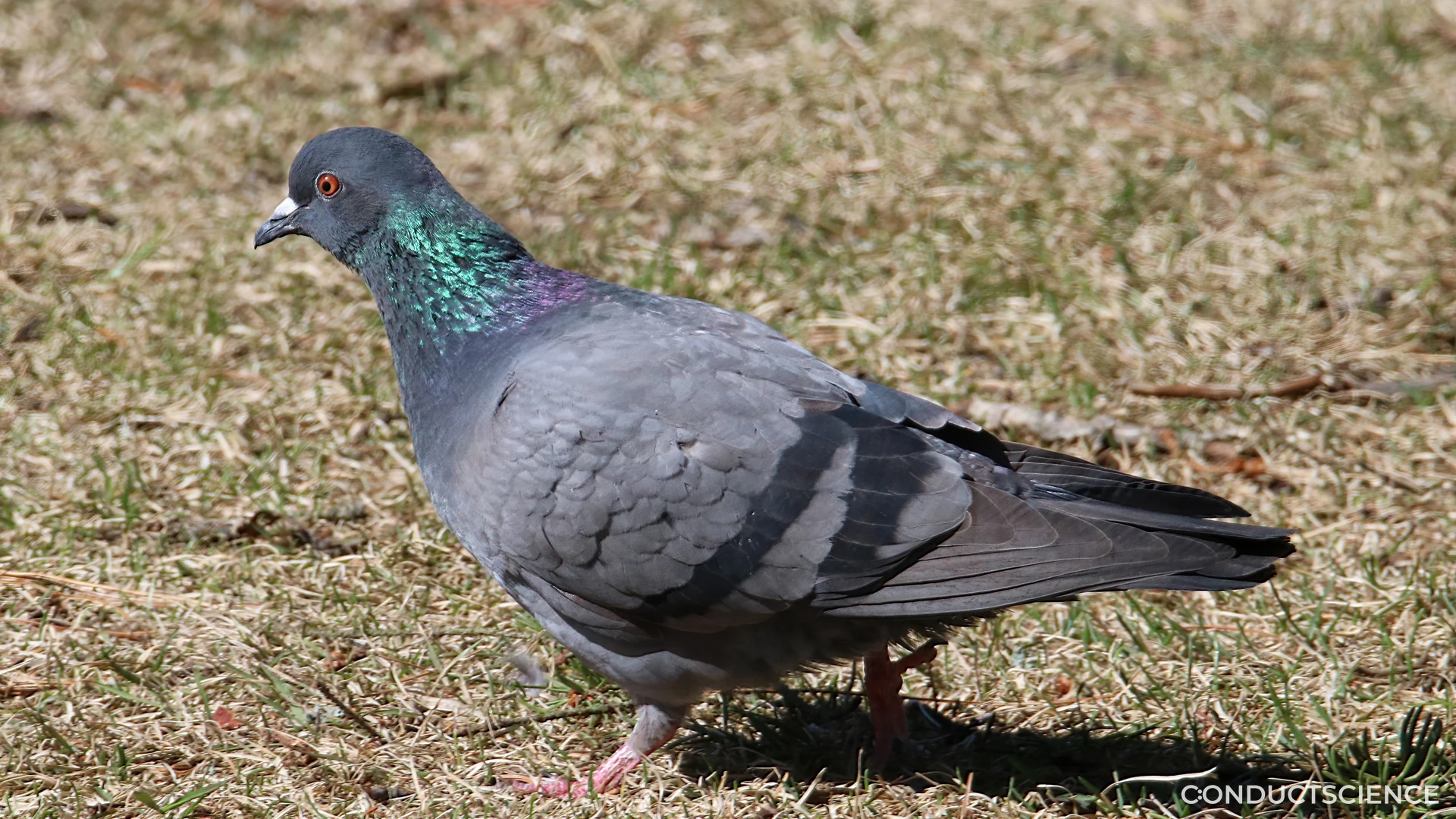
Behavioral Tracking for Pigeon
Columba livia
ConductVision enables automated scoring of pigeon visual discrimination, homing navigation, working memory, serial learning, and social dominance with GPS and video tracking.

Why Pigeons in Behavioral Research
The pigeon (Columba livia) has been a cornerstone of comparative cognition and operant conditioning research for over a century. Their exceptional visual discrimination abilities — including the capacity to distinguish cancer pathology slides — make them ideal for studying categorization and perceptual learning. Homing navigation studies reveal sophisticated spatial memory, while serial learning and matching-to-sample paradigms probe working memory and cognitive flexibility.
Herold C, et al. (2015). The maturation of research into the avian hippocampal formation. Hippocampus, 25(11), 1308-1327. PMID: 25850561
Dittrich W, et al. (1998). Categorization of natural movements by pigeons. J Exp Anal Behav, 70(3), 281-299. PMID: 16812887
What We Measure in Pigeon
Validated assays with quantitative parameter tracking for Columba livia.
Operant-based visual categorization tasks including natural image classification and medical pathology screening. Pigeons achieve expert-level accuracy in distinguishing benign from malignant tissue.
| Parameter | Unit | Description |
|---|---|---|
| Discrimination accuracy | % correct | Category identification |
| Trials to criterion | count | Learning speed |
| Generalization gradient | slope | Transfer to novel stimuli |
Levenson RM, et al. (2015). Pigeons as Trainable Observers of Pathology and Radiology Breast Cancer Images. PLoS ONE, 10(11), e0141357. PMID: 26581091
Qadri MA, et al. (2014). Visual control of an action discrimination in pigeons. J Vis, 14(5), 16. PMID: 24879863
GPS tracking of homing flights measuring directional accuracy, speed, and route efficiency. Tests theories of magnetic, olfactory, and visual navigation.
| Parameter | Unit | Description |
|---|---|---|
| Homeward component (Vt) | ratio | Directional accuracy |
| Homing speed | km/h | Return velocity |
| Route efficiency | ratio | Straight-line / actual path |
Holland R, et al. (2013). A magnetic pulse does not affect homing pigeon navigation: a GPS tracking experiment. J Exp Biol, 216(Pt 12), 2192-2200. PMID: 23470658
Delayed matching-to-sample paradigm measuring visual working memory capacity and decay. Systematic delay manipulation reveals memory dynamics and proactive interference effects.
| Parameter | Unit | Description |
|---|---|---|
| % correct (delayed MTS) | % | Accuracy across delays |
| Delay function slope | %/s | Memory decay rate |
| Proactive interference | Δ% | Accuracy drop with competing memories |
Zentall TR, et al. (2016). Delayed matching-to-sample: A tool to assess memory and other cognitive processes in pigeons. Behav Processes, 123, 26-34. PMID: 26165174
Sequential list learning tasks revealing chunking strategies, serial position effects, and cognitive representation of ordinal sequences.
| Parameter | Unit | Description |
|---|---|---|
| Trials to criterion | count | Learning speed |
| Chunking index | ratio | Grouping strategy |
| Serial position curve | shape | Primacy/recency effects |
Terrace HS. (1987). Chunking by a pigeon in a serial learning task. Nature, 325(6100), 149-151. PMID: 3808071
Terrace HS. (1991). Chunking during serial learning by a pigeon. J Exp Psychol Anim Behav Process, 17(1), 81-93. PMID: 2002309
Quantification of flock hierarchy using David's dominance score, linearity indices, and leadership influence during group flights.
| Parameter | Unit | Description |
|---|---|---|
| David's dominance score | index | Rank position |
| Linearity index (h') | 0-1 | Hierarchy structure |
| Leadership influence | ratio | Flock direction control |
Nagy M, et al. (2013). Context-dependent hierarchies in pigeons. Proc Natl Acad Sci U S A, 110(32), 13049-13054. PMID: 23878247
Watts I, et al. (2016). Misinformed leaders lose influence over pigeon flocks. Biol Lett, 12(9), 20160544. PMID: 27624797
More Behavioral Tests for Pigeon
Operant Conditioning
Key Parameters: Response rate (pecks/min), schedule adherence, IRT
Schwartz B. (1977). PMID: 16811992
Temporal Discrimination
Key Parameters: Peak time accuracy, coefficient of variation, scalar timing
Subramaniam S, et al. (2019). PMID: 28750595
ConductScience Hardware for Pigeon Research
Operant Conditioning Chamber (Skinner Box)
Visual discrimination and MTS
GPS/RFID Tracking System
Homing and navigation studies
Touchscreen Interface
Computerized learning tasks
Serial Learning Apparatus
Sequence memory paradigms
Video Tracking System
Social dominance and group behavior
Citations & Further Reading
- Herold C, et al. (2015). The maturation of research into the avian hippocampal formation. Hippocampus, 25(11), 1308-1327. PMID: 25850561
- Dittrich W, et al. (1998). Categorization of natural movements by pigeons. J Exp Anal Behav, 70(3), 281-299. PMID: 16812887
- Levenson RM, et al. (2015). Pigeons as Trainable Observers of Pathology and Radiology Breast Cancer Images. PLoS ONE, 10(11), e0141357. PMID: 26581091
- Qadri MA, et al. (2014). Visual control of an action discrimination in pigeons. J Vis, 14(5), 16. PMID: 24879863
- Holland R, et al. (2013). A magnetic pulse does not affect homing pigeon navigation: a GPS tracking experiment. J Exp Biol, 216(Pt 12), 2192-2200. PMID: 23470658
- Zentall TR, et al. (2016). Delayed matching-to-sample: A tool to assess memory and other cognitive processes in pigeons. Behav Processes, 123, 26-34. PMID: 26165174
- Terrace HS. (1987). Chunking by a pigeon in a serial learning task. Nature, 325(6100), 149-151. PMID: 3808071
- Terrace HS. (1991). Chunking during serial learning by a pigeon. J Exp Psychol Anim Behav Process, 17(1), 81-93. PMID: 2002309
- Nagy M, et al. (2013). Context-dependent hierarchies in pigeons. Proc Natl Acad Sci U S A, 110(32), 13049-13054. PMID: 23878247
- Watts I, et al. (2016). Misinformed leaders lose influence over pigeon flocks. Biol Lett, 12(9), 20160544. PMID: 27624797
Other Model Systems
Discuss Your Pigeon Research
Tell us about your models, assays, and experimental goals — we’ll show you how ConductVision fits your workflow.