Behavioral Tracking for Sea Lamprey
Petromyzon marinus
ConductVision delivers automated tracking of sea lamprey swimming locomotion, rheotaxis, and pheromone navigation. Quantify undulatory locomotor circuits, current orientation, and migratory behavior in Petromyzon marinus.

Why Sea Lamprey in Behavioral Research
The sea lamprey (Petromyzon marinus) is a living fossil that has been central to our understanding of vertebrate locomotor circuits. Grillner's foundational work on lamprey spinal CPGs defined how vertebrate movement is generated at the neural level. Their unique pheromone-guided migration, rheotactic behavior, and larval burrowing provide behavioral endpoints spanning motor control, chemical ecology, and invasive species management.
Grillner S. (2003). The motor infrastructure: from ion channels to neuronal networks. Nat Rev Neurosci, 4(7), 573-586. PMID: 12838332
Grillner S, et al. (2008). Neural bases of goal-directed locomotion in vertebrates — an overview. Brain Res Rev, 57(1), 2-12. PMID: 17916382
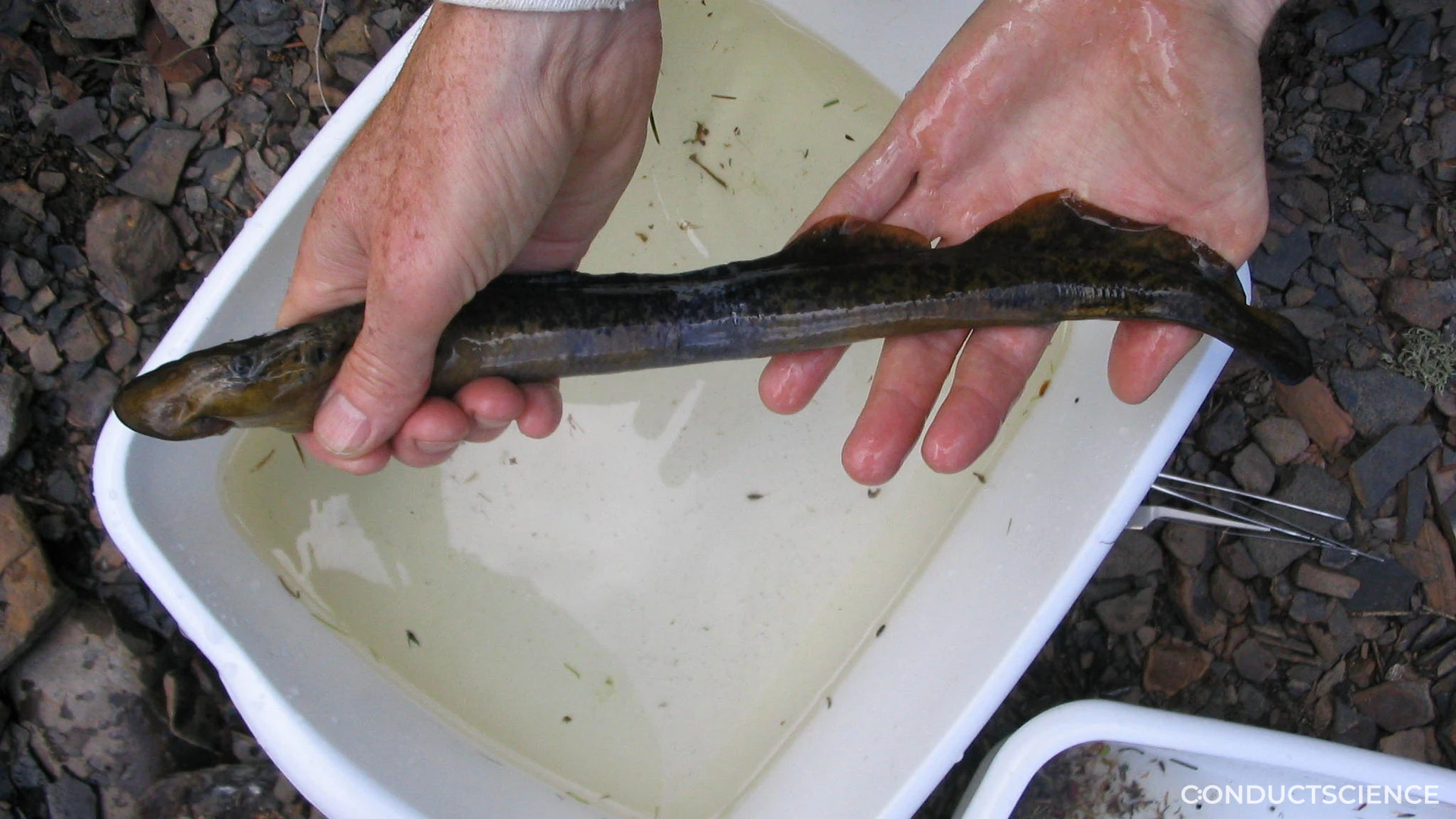
What We Measure in Sea Lamprey
Validated assays with quantitative parameter tracking for Petromyzon marinus.
Lamprey swimming is generated by spinal central pattern generators producing alternating left-right muscle activation. Swimming frequency, speed, wave amplitude, and burst-coast dynamics characterize locomotor circuit output.
| Parameter | Unit | Description |
|---|---|---|
| Swimming frequency | Hz | Body wave cycle rate |
| Swimming speed | body lengths/s | Forward velocity |
| Wave amplitude | mm | Lateral displacement |
| Burst-and-coast ratio | % | Active vs glide phases |
Grillner S. (2003). The motor infrastructure: from ion channels to neuronal networks. Nat Rev Neurosci, 4(7), 573-586. PMID: 12838332
Sea lampreys orient and maintain position against water current during upstream migration. Upstream orientation, station-keeping success, and current speed thresholds measure rheotactic performance.
| Parameter | Unit | Description |
|---|---|---|
| Upstream orientation | % time | Body alignment to current |
| Station-keeping success | % time at position | Holding against flow |
| Current speed threshold | cm/s | Maximum navigable flow |
Grillner S, et al. (2008). Neural bases of goal-directed locomotion in vertebrates — an overview. Brain Res Rev, 57(1), 2-12. PMID: 17916382
Sea lampreys use larval-released pheromones to select spawning tributaries. Migration speed, tributary choice accuracy, and attraction distance quantify chemosensory navigation during the spawning run.
| Parameter | Unit | Description |
|---|---|---|
| Upstream migration speed | km/day | Migratory progress |
| Pheromone choice accuracy | % | Correct tributary selection |
| Attraction distance | m | Effective range of cue |
Grillner S. (2003). The motor infrastructure: from ion channels to neuronal networks. Nat Rev Neurosci, 4(7), 573-586. PMID: 12838332
Larval lampreys burrow into stream substrates where they filter-feed for years. Burrowing latency, depth, and substrate preference characterize this ecologically important behavior.
| Parameter | Unit | Description |
|---|---|---|
| Burrowing latency | s | Time to begin digging |
| Burial depth | cm | Depth achieved |
| Substrate preference | categorical | Sand, silt, gravel |
Grillner S, et al. (2008). Neural bases of goal-directed locomotion in vertebrates — an overview. Brain Res Rev, 57(1), 2-12. PMID: 17916382
ConductScience Hardware for Sea Lamprey Research
Flow Chamber / Flume
Rheotaxis and swimming assays
Pheromone Delivery System
Chemical navigation testing
High-Speed Camera System
Undulatory locomotion analysis
Burrowing Substrate Chamber
Larval behavior observation
Migration Tracking System
Long-distance movement
Citations & Further Reading
- Grillner S. (2003). The motor infrastructure: from ion channels to neuronal networks. Nat Rev Neurosci, 4(7), 573-586. PMID: 12838332
- Grillner S, et al. (2008). Neural bases of goal-directed locomotion in vertebrates — an overview. Brain Res Rev, 57(1), 2-12. PMID: 17916382
Other Model Systems

Discuss Your Sea Lamprey Research
Tell us about your models, assays, and experimental goals — we’ll show you how ConductVision fits your workflow.