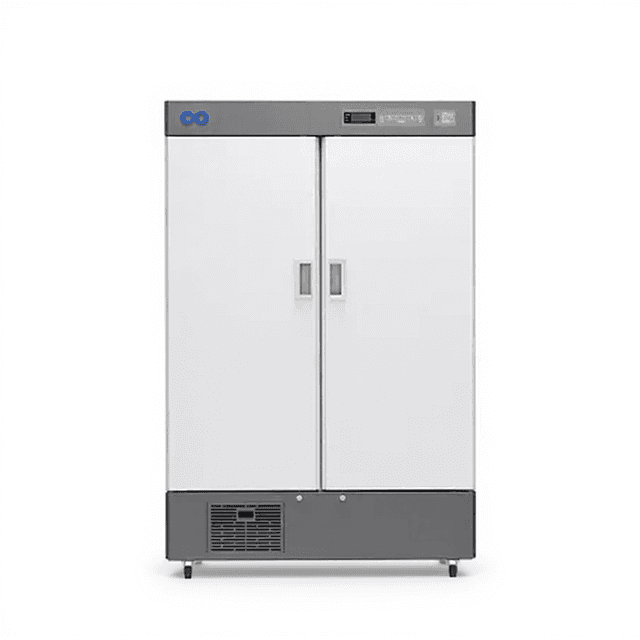
2~8℃ Laboratory Refrigerator 1500L
High-capacity 1500L laboratory refrigerator maintaining precise 2-8°C temperature control for biological sample storage, reagent preservation, and pharmaceutical cold chain applications.
| Automation Level | manual |

The 2~8℃ Laboratory Refrigerator 1500L provides precise temperature-controlled storage for biological samples, reagents, and temperature-sensitive materials in research and clinical laboratory environments. With a substantial 1500-liter capacity, this unit accommodates large-volume storage requirements while maintaining consistent refrigeration within the critical 2-8°C range required for vaccine storage, enzyme preservation, and biological specimen banking.
The refrigerator's dimensions (142 cm length × 168 cm width × 64 cm height) provide efficient laboratory floor space utilization while maximizing internal storage volume. Temperature stability within the 2-8°C range ensures optimal preservation of heat-labile compounds, biological samples, and pharmaceutical preparations that require cold chain maintenance but cannot tolerate freezing temperatures.
How It Works
The laboratory refrigerator operates through vapor compression refrigeration using a hermetically sealed compressor system with environmentally controlled refrigerant circulation. The cooling cycle begins when the compressor pressurizes refrigerant vapor, which then condenses in the external condenser coil, releasing heat to the ambient environment. The high-pressure liquid refrigerant passes through an expansion valve, creating a pressure drop that allows the refrigerant to evaporate in the internal evaporator coil.
Temperature regulation is achieved through a feedback control system that monitors internal chamber temperature via calibrated sensors and modulates compressor operation to maintain the setpoint within the 2-8°C range. Forced air circulation distributes cooled air throughout the storage chamber, ensuring uniform temperature distribution across all storage areas. Insulated cabinet construction minimizes heat transfer from the external environment while internal air circulation prevents temperature stratification that could compromise sample integrity.
Features & Benefits
Automation Level
- manual
Research Domain
- Analytical Chemistry
- Cell Biology
- Clinical Diagnostics
- Immunology
- Microbiology
- Pharmaceutical QC
Weight
- 245.0 kg
Dimensions
- L: 142.0 mm
- W: 168.0 mm
- H: 64.0 mm
Comparison Guide
| Feature | This Product | Typical Alternative | Advantage |
|---|---|---|---|
| Storage Capacity | 1500L internal volume | Entry-level laboratory refrigerators typically offer 300-600L capacity | Accommodates larger sample collections and reagent inventories in a single controlled environment, reducing equipment redundancy. |
| Design Configuration | Horizontal design with 64 cm height | Most laboratory refrigerators use vertical reach-in configurations | Maximizes storage volume while minimizing floor space and providing easier bulk loading access. |
| Temperature Range | 2-8°C controlled range | Standard laboratory refrigerators often operate at 2-8°C | Maintains the critical temperature range required for vaccine storage and biological sample preservation. |
| Physical Footprint | 142×168×64 cm dimensions | Comparable capacity units often require larger floor areas | Efficient laboratory space utilization with high storage density in a compact horizontal format. |
| Air Circulation | Forced air circulation system | Basic models may use natural convection cooling | Ensures uniform temperature distribution and faster temperature recovery after door openings. |
This 1500L laboratory refrigerator provides high-capacity temperature-controlled storage in a space-efficient horizontal design. The forced air circulation system and 2-8°C temperature range make it well-suited for bulk storage applications requiring precise refrigeration control.
Practical Tips
Verify temperature accuracy using NIST-traceable thermometers placed in multiple locations throughout the storage chamber.
Why: Temperature variation across the chamber can affect sample integrity and regulatory compliance documentation.
Clean condenser coils monthly to maintain efficient heat transfer and prevent temperature fluctuations.
Why: Dust accumulation on condenser coils reduces cooling efficiency and increases energy consumption.
Allow adequate spacing between stored items and avoid blocking air circulation vents.
Why: Proper airflow ensures uniform temperature distribution and prevents thermal dead zones that could compromise sample stability.
Pre-cool samples and containers before placing them in the refrigerator to minimize temperature excursions.
Why: Large thermal loads can cause temporary temperature increases that may affect other stored materials.
Monitor door seal integrity and replace gaskets if air leakage is detected during routine inspections.
Why: Compromised door seals increase energy consumption and reduce temperature stability throughout the storage chamber.
Implement continuous temperature monitoring with data logging to document storage conditions for regulatory compliance.
Why: Temperature documentation is required for validated storage of pharmaceuticals, biologics, and clinical samples.
Ensure adequate ventilation around the unit and never store flammable materials in the refrigerated compartment.
Why: Proper ventilation prevents overheating while avoiding flammable storage reduces fire risk from electrical components.
Schedule annual professional service to verify refrigeration system performance and temperature control accuracy.
Why: Regular professional maintenance prevents system failures and ensures continued compliance with storage requirements.
Setup Guide
What’s in the Box
- Laboratory refrigerator unit (typical)
- Adjustable storage shelves (typical)
- Temperature control system (typical)
- User manual and operating instructions (typical)
- Electrical power cord (typical)
- Warranty documentation (typical)
Warranty
ConductScience provides a standard one-year manufacturer warranty covering parts and labor for defects in materials and workmanship. Technical support is available for installation guidance, operational questions, and troubleshooting assistance throughout the warranty period.
Compliance
What is the temperature uniformity throughout the storage chamber?
Temperature uniformity specifications should be verified in the product datasheet. The forced air circulation system is designed to minimize temperature variations, but specific uniformity tolerances depend on chamber design and sensor placement.
How quickly does the unit recover to setpoint after door opening?
Temperature recovery time varies with ambient conditions, door opening duration, and thermal load. Consult the product datasheet for specific recovery time specifications under standard testing conditions.
Can the unit be validated for pharmaceutical storage applications?
The refrigerator can support pharmaceutical storage workflows requiring 2-8°C control. Formal validation protocols should be developed according to applicable regulatory guidelines and site-specific requirements.
What type of temperature monitoring system is included?
Basic temperature control is included with the unit. External monitoring systems with data logging and alarm capabilities may be required for regulatory compliance and should be specified based on application requirements.
How does this compare to reach-in refrigerators for laboratory use?
This horizontal design offers higher storage capacity (1500L) in a lower profile compared to vertical reach-in units, making it suitable for bulk storage applications where frequent access is less critical.
What maintenance is required for optimal performance?
Regular maintenance includes condenser coil cleaning, door seal inspection, temperature calibration verification, and refrigerant system service as specified in the user manual maintenance schedule.
Can the shelving be customized for specific container types?
The adjustable shelving system allows modification of storage configurations. Custom shelving solutions may be available to accommodate specific container sizes or sample organization requirements.
What are the electrical requirements for installation?
Electrical specifications including voltage, amperage, and circuit requirements are detailed in the product datasheet and should be reviewed with qualified electrical personnel before installation.
Have a question about this product?