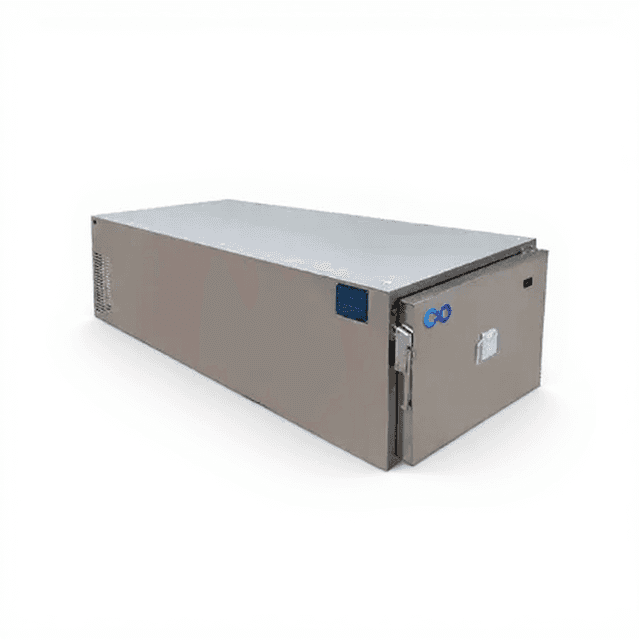
Static Storage Liquid Nitrogen Container YDS-47-127-FS
High-vacuum insulated liquid nitrogen storage container with 47-125L capacity options, featuring ultra-low evaporation rates and extended holding times up to 127 days for cryogenic sample preservation.

Louise Corscadden, PhD
Director of Science · ConductScience
Ask Louise about Static Storage Liquid Nitrogen Container YDS-47-127-FS fit, setup, configuration, or quote prep.
Already working with us? Sign in to connect this with My Scientist.
Key Specifications
Full details →- Model fit
- 9 selectable configurations
- SKU family
- BIO-DS-47-127-FS | BIO-YDS-47-127LS(6) | BIO-YDS-47-127 | BIO-YDS-65-216-FS | BIO-YDS-65-216S | BIO-YDS-95-216-FS | BIO-YDS-95-216S | BIO-YDS-120-216-FS | BIO-YDS-120-216S
- Shipping box
- 3307.09 x 3228.35 x 27.56 cm
- Ordering
- Online checkout and quote request available
- Category
- Lab Equipment
- Build notes
- alloy aluminum
The Static Storage Liquid Nitrogen Container YDS-47-127-FS is a high-performance cryogenic storage vessel designed for long-term preservation of biological samples at -196°C. This model features high vacuum multi-layer thermal insulation constructed from high-quality alloy aluminum, providing exceptional thermal performance with static evaporation rates as low as 0.45 L/day and holding times up to 105 days for the 47L capacity model.
The YDS series encompasses multiple capacity options from 47L to 125L, with caliber specifications ranging from 127mm to 216mm to accommodate different sample storage requirements. Each container utilizes advanced vacuum insulation technology backed by a 5-year vacuum warranty, ensuring reliable cryogenic storage for research applications requiring ultra-low temperature sample preservation.
How It Works
Liquid nitrogen containers achieve cryogenic storage through high-vacuum multi-layer thermal insulation systems that minimize heat transfer by radiation and gaseous conduction. The annular vacuum space between inner and outer vessels maintains pressures below 10^-6 Torr, while reflective insulation layers redirect thermal radiation away from the liquid nitrogen chamber.
Static evaporation occurs as ambient heat gradually penetrates the insulation system, causing liquid nitrogen to vaporize at -196°C. The evaporation rate depends on the vacuum quality, insulation effectiveness, and thermal mass of the container. Advanced designs incorporate super-insulation materials and optimized neck tube geometry to minimize heat leak paths.
Sample storage occurs within the liquid nitrogen or vapor phase, with canisters and inventory systems allowing organized specimen placement. Vapor phase storage maintains temperatures of -150°C to -190°C while preventing direct liquid nitrogen contact, reducing contamination risk while preserving specimen viability through cryogenic arrest of biological processes.
Features & Benefits
Insulation Design
- High vacuum, multi-layer thermal insulation
Evaporation Rate
- Low static evaporation rate, ultra-low evaporation loss
Vacuum Warranty
- 5 years
Optional Accessories
- liquid level ruler
Capacity Range
- 3~31.5L
Empty Weight Range
- 4.2~22kg
Caliber Range
- 50~125mm
Static Evaporation Loss
- 0.12~0.42 L/day
Material
- alloy aluminum
Shipping weight
- 44.53 lb
Shipping box
- L: 3307.09 cm
- W: 3228.35 cm
- H: 27.56 cm
| Feature | This Product | Typical Alternative | Advantage |
|---|---|---|---|
| Static Holding Time | 105-127 days depending on model capacity | Entry-level containers typically offer 30-60 day holding times | Extended holding times reduce refill frequency and operational costs while providing greater security against supply interruptions. |
| Vacuum Warranty Coverage | 5-year vacuum performance warranty | Standard models often provide 1-2 year vacuum warranties | Longer warranty protection ensures sustained thermal performance and reduces long-term replacement costs for research facilities. |
| Construction Material | High-quality alloy aluminum | Basic models commonly use standard stainless steel construction | Alloy aluminum provides superior thermal conductivity and lighter weight while maintaining structural integrity for cryogenic applications. |
| Static Evaporation Rate | 0.45-0.98 L/day across model range | Budget containers often exhibit 1-3 L/day evaporation rates | Lower evaporation rates reduce liquid nitrogen consumption costs and extend unattended storage periods for remote or backup applications. |
| Capacity Range Options | 47L to 125L with multiple caliber specifications | Limited size options in competitive product lines | Multiple capacity and caliber combinations enable optimal sizing for specific laboratory requirements and sample storage workflows. |
This YDS series provides extended holding times up to 127 days with ultra-low evaporation rates backed by 5-year vacuum warranties. The alloy aluminum construction offers superior thermal performance compared to standard stainless steel alternatives, while multiple capacity options accommodate diverse laboratory storage requirements.
| Model | SKU | Listed price | Status | Shipping box |
|---|---|---|---|---|
| BIO-YDS-120-216S | BIO-YDS-120-216S | $3,150.00 | Available | 3307.09 x 3228.35 x 27.56 cm |
| BIO-YDS-120-216-FS | BIO-YDS-120-216-FS | $3,400.00 | Available | 3307.09 x 3228.35 x 27.56 cm |
| BIO-YDS-95-216S | BIO-YDS-95-216S | $2,550.00 | Available | 3307.09 x 3228.35 x 27.56 cm |
| BIO-YDS-95-216-FS | BIO-YDS-95-216-FS | $2,800.00 | Available | 3307.09 x 3228.35 x 27.56 cm |
| BIO-YDS-65-216S | BIO-YDS-65-216S | $1,900.00 | Available | 3307.09 x 3228.35 x 27.56 cm |
| BIO-YDS-65-216-FS | BIO-YDS-65-216-FS | $2,100.00 | Available | 3307.09 x 3228.35 x 27.56 cm |
| BIO-YDS-47-127 | BIO-YDS-47-127 | $1,150.00 | Available | 3307.09 x 3228.35 x 27.56 cm |
| BIO-YDS-47-127LS(6) | BIO-YDS-47-127LS(6) | $1,300.00 | Available | 3307.09 x 3228.35 x 27.56 cm |
| BIO-DS-47-127-FS | BIO-DS-47-127-FS | $1,550.00 | Available | 3307.09 x 3228.35 x 27.56 cm |
Practical Tips
Perform monthly visual inspection of container exterior for frost accumulation or ice formation, which may indicate vacuum loss or insulation degradation.
Why: Early detection of thermal performance issues prevents sample loss and enables warranty claims before complete vacuum failure.
Pre-cool cryovials and canisters in liquid nitrogen vapor before sample loading to minimize temperature shock and reduce initial boil-off.
Why: Gradual cooling prevents rapid liquid nitrogen vaporization and maintains stable storage temperatures during sample loading procedures.
Install liquid nitrogen level monitoring equipment or use the optional liquid level ruler to prevent complete depletion without opening the container.
Why: Non-invasive level monitoring maintains thermal stability while preventing sample warming due to unexpected liquid nitrogen depletion.
Maintain detailed inventory logs including sample location within canisters and liquid nitrogen refill dates to ensure traceability and storage quality.
Why: Systematic record keeping enables rapid sample location and provides documentation of storage conditions for regulatory compliance and quality assurance.
If evaporation rates exceed specifications by >20%, contact technical support for vacuum integrity assessment before warranty expiration.
Why: Performance degradation often progresses rapidly after initial vacuum loss, making early intervention critical for maintaining sample storage integrity.
Calibrate liquid level measurement devices monthly using known liquid nitrogen volumes to ensure accurate inventory management.
Why: Accurate level monitoring prevents unexpected depletion and enables precise liquid nitrogen consumption tracking for cost management.
Establish backup storage protocols and emergency liquid nitrogen supply arrangements for critical sample collections.
Why: Redundant storage systems prevent sample loss during container maintenance, vacuum failure, or supply chain disruptions.
Setup Guide
What’s in the Box
- YDS liquid nitrogen storage container (model-specific capacity)
- Storage canisters (square 82×84mm for 127mm caliber models, specifications vary by model)
- Neck plug and safety accessories
- User manual with safety protocols
- Vacuum warranty certificate
- Liquid level ruler (optional accessory, if ordered)
Warranty
ConductScience provides comprehensive warranty coverage including 5-year vacuum performance warranty and 1-year manufacturer warranty on construction and accessories, with technical support for operational guidance and maintenance protocols.
Compliance
References
Background reading relevant to this product:
What is the practical difference between vapor phase and liquid phase storage in these containers?
Vapor phase storage occurs in the neck region at -150°C to -190°C, preventing direct liquid nitrogen contact and reducing contamination risk. Liquid phase storage at -196°C provides slightly lower temperatures but requires submersion of samples in liquid nitrogen, increasing potential for cross-contamination between specimens.
How do I calculate refill schedules based on static evaporation rates?
Static evaporation rates are specified for each model (0.45-0.98 L/day). For the 47L model with 0.45 L/day loss and 105-day holding time, plan refills every 90 days to maintain safety margin. Actual rates may vary based on ambient temperature and usage patterns.
What sample storage density can I achieve with the provided canisters?
The 47L model with 127mm caliber uses square canisters (82×84mm) designed for 750 pieces of 2ml vials. Larger models with 216mm calibers accommodate different canister configurations - consult product datasheet for specific storage capacities and vial compatibility.
How do I verify vacuum integrity for long-term performance?
Monitor static evaporation rates against manufacturer specifications. Significant increases in evaporation loss indicate vacuum degradation. The 5-year vacuum warranty covers performance degradation, but regular monitoring enables early detection of thermal performance changes.
What safety protocols are required for liquid nitrogen container operation?
Implement proper ventilation to prevent oxygen displacement, use appropriate PPE including cryogenic gloves and face protection, ensure containers are stored upright in well-ventilated areas, and maintain emergency protocols for liquid nitrogen exposure or container damage.
Can these containers be used for automated sample storage systems?
These are static storage containers designed for manual sample loading and retrieval. For automated systems, consider compatibility with robotic sample handling equipment and ensure adequate clearance for automated canister manipulation within the container geometry.
How does ambient temperature affect holding times and evaporation rates?
Higher ambient temperatures increase heat transfer through insulation, reducing holding times and increasing evaporation rates. Specified performance assumes standard laboratory conditions (20-25°C). Extreme temperatures or direct heat exposure will significantly impact performance.
Have a question about this product?
Have a question? Just ask.
Send it over and we'll email you a personalized answer — no call, no scheduling.
Prefer to talk it through?