Laboratory Refrigerator 628L 1008L
Precision laboratory refrigerators providing 2-8°C storage with microprocessor control, dual alarms, and capacities of 628L or 1008L for biological samples and reagents.

Louise Corscadden, PhD
Director of Science · ConductScience
Ask Louise about Laboratory Refrigerator 628L 1008L fit, setup, configuration, or quote prep.
Already working with us? Sign in to connect this with My Scientist.
Key Specifications
Full details →- Model fit
- 2 selectable configurations
- SKU family
- BIO-BPR-5V628F | BIO-BPR-5V1008F
- Shipping box
- 74.21 x 48.03 x 24.8 cm
- Ordering
- Online checkout and quote request available
- Category
- Lab Equipment
- Build notes
- Confirm accessories, station layout, and support needs before purchase
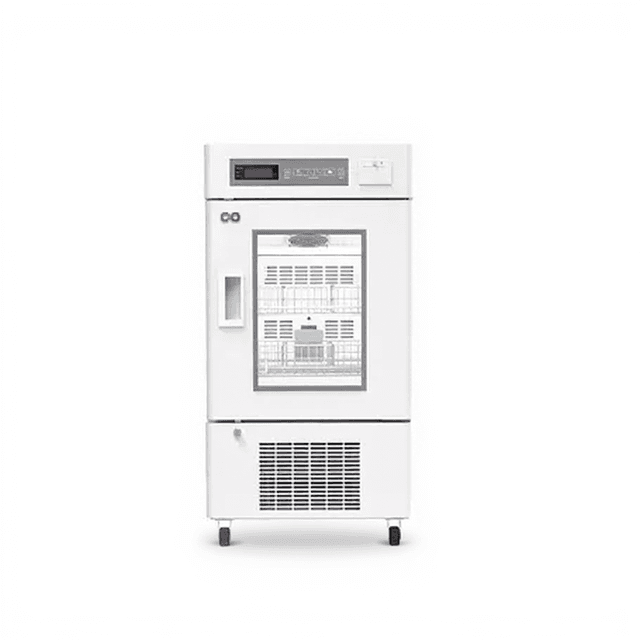
The Laboratory Refrigerator series provides precise temperature control for storage of biological samples, reagents, and temperature-sensitive materials in research environments. Available in 628L and 1008L capacities, these units maintain the 2-8°C range required for vaccine storage, enzyme preservation, and biological specimen banking. The microprocessor control system delivers 0.1°C temperature accuracy with comprehensive alarm systems for temperature excursions, power failure, and door monitoring.
Engineered with polyurethane cyclopentane insulation and air-cooling refrigeration using R290 refrigerant, these units provide reliable storage conditions for laboratories requiring consistent cold chain maintenance. The dual-door design with integral foam construction minimizes temperature fluctuations during access while automatic defrost functionality ensures continuous operation without manual intervention.
How It Works
The refrigeration system operates through vapor compression cooling using R290 refrigerant in a closed-loop cycle. The compressor pressurizes refrigerant vapor, which condenses in the copper tube aluminum fin condenser, releasing heat to ambient air. The liquid refrigerant then expands through the evaporator coils, absorbing heat from the storage chamber interior and maintaining the specified temperature range.
Microprocessor control continuously monitors chamber temperature via integrated sensors, modulating compressor operation to maintain setpoint within 0.1°C accuracy. The polyurethane cyclopentane insulation provides thermal barrier properties while the automatic defrost cycle prevents ice accumulation that could compromise temperature uniformity. Air circulation ensures even temperature distribution throughout the storage volume, maintaining the specified ≤2°C uniformity across all chamber locations.
Features & Benefits
Automation Level
- semi-automated
Temperature Accuracy
- 0.1°C
Temperature Uniformity
- ≤2°C
Internal Dimensions (W×D×H)
- 1100×454×1325mm
External Dimensions (W×D×H)
- 1220×630×1885mm
Research Domain
- Analytical Chemistry
- Cell Biology
- Clinical Diagnostics
- Environmental Monitoring
- Immunology
- Microbiology
- Pharmaceutical QC
Capacity
- 628L
Temperature Range
- 2~8°C
Power/Voltage
- 537W
Weight
- 189kg
Shipping weight
- 416.67 lb
Shipping box
- L: 74.21 cm
- W: 48.03 cm
- H: 24.8 cm
| Feature | This Product | Typical Alternative | Advantage |
|---|---|---|---|
| Temperature Accuracy | 0.1°C accuracy with microprocessor control | Entry-level units often provide ±0.5°C or ±1°C accuracy | Precise temperature control protects temperature-sensitive biologics and meets stringent storage requirements |
| Alarm System Coverage | High/low temperature, thermostat fault, door switch, and 8-hour power failure alarms | Basic models may offer only temperature alarms without power backup | Comprehensive monitoring protects valuable samples through multiple failure modes and power interruptions |
| Recovery Performance | ≤15 minute recovery to 8°C after door opening | Standard units may require 30+ minutes for temperature recovery | Rapid recovery minimizes temperature exposure time protecting sample integrity during routine access |
| Insulation Construction | Polyurethane cyclopentane insulation with integral foam doors | Basic models may use standard foam insulation | Superior thermal efficiency provides better temperature stability and reduced energy consumption |
| Storage Capacity Options | 628L and 1008L capacity models available | Limited size options in laboratory-grade units | Multiple capacity options accommodate different laboratory space requirements and storage volumes |
This laboratory refrigerator series offers precise microprocessor control with comprehensive alarm monitoring in two capacity options. The combination of rapid temperature recovery, superior insulation, and multi-mode alarm protection provides reliable storage for temperature-sensitive biological materials in research environments.
| Model | SKU | Listed price | Status | Shipping box |
|---|---|---|---|---|
| BIO-BPR-5V1008F | BIO-BPR-5V1008F | $4,990.00 | Available | 74.21 x 48.03 x 24.8 cm |
| BIO-BPR-5V628F | BIO-BPR-5V628F | $3,990.00 | Available | 74.21 x 48.03 x 24.8 cm |
Practical Tips
Place calibrated temperature loggers in multiple locations throughout the storage volume during initial validation and quarterly verification.
Why: Temperature uniformity verification ensures all storage locations meet specification requirements for sample protection.
Clean condenser coils monthly using appropriate cleaning tools to remove dust and debris accumulation.
Why: Clean condenser surfaces maintain heat transfer efficiency and prevent temperature stability issues from reduced cooling capacity.
Allow adequate air circulation space around stored materials and avoid blocking internal airflow patterns.
Why: Proper airflow ensures temperature uniformity throughout the storage volume and prevents localized warm spots.
If temperature alarms activate, first verify door closure and check for any airflow obstructions before investigating mechanical issues.
Why: Most temperature excursions result from access-related causes rather than equipment failure, enabling rapid problem resolution.
Maintain continuous temperature monitoring records using independent data loggers for regulatory documentation.
Why: Independent monitoring provides validation data for storage conditions and supports regulatory compliance requirements.
Test power failure alarm functionality monthly and verify backup notification systems are operational.
Why: Power failure protection prevents sample loss during electrical interruptions which could compromise research materials.
Organize samples by access frequency, placing frequently used materials near the door to minimize opening time.
Why: Reduced door opening duration minimizes temperature fluctuations and maintains stable storage conditions for all samples.
Setup Guide
What’s in the Box
- Laboratory refrigerator main unit
- Power cord and connection hardware
- Adjustable storage shelves (typical)
- Temperature monitoring display unit
- User manual and installation guide
- Warranty documentation
Warranty
ConductScience provides standard one-year manufacturer warranty covering parts and labor for normal laboratory use. Technical support includes installation guidance and troubleshooting assistance throughout the warranty period.
Compliance
References
Background reading relevant to this product:
What temperature validation procedures are recommended for qualifying this refrigerator for regulated storage?
Perform temperature mapping using calibrated data loggers positioned throughout the storage volume. Record temperature data for 24-48 hours under loaded and unloaded conditions to verify uniformity specifications and establish qualified storage zones.
How should the alarm system be configured for different types of stored materials?
Set high/low alarm limits based on specific storage requirements - typically ±1°C from setpoint for critical biologics, wider ranges for less sensitive materials. Test alarm notification systems including power failure backup functionality during qualification.
What maintenance schedule is required to maintain temperature performance specifications?
Perform monthly temperature calibration verification, quarterly condenser cleaning, and annual comprehensive performance qualification. Monitor defrost cycle frequency and clean door seals regularly to maintain thermal integrity.
Can this refrigerator accommodate standard laboratory storage containers and sample racks?
The internal dimensions of 1100×454×1325mm accommodate standard laboratory storage boxes, specimen racks, and sample containers. Adjustable shelving allows configuration for various container sizes while maintaining air circulation.
How does the automatic defrost cycle affect temperature stability during operation?
Automatic defrost operates during low-demand periods to minimize temperature impact. The system is designed to complete defrost cycles while maintaining storage temperature within specification limits through thermal mass and insulation properties.
What documentation is provided for regulatory compliance and validation purposes?
Consult product datasheet for specific documentation provided. Typical laboratory refrigerators include performance specifications, installation qualification protocols, and factory calibration certificates for validation support.
Have a question about this product?
Have a question? Just ask.
Send it over and we'll email you a personalized answer — no call, no scheduling.
Prefer to talk it through?