40X Portable Metallurgical Microscope with Penlight
Portable 40X reflected-light microscope with LED illumination and reticule eyepiece for field examination of opaque specimens and surface analysis.
| Automation Level | manual |
| Product Type | Microscope |
| Microscope Type | Metallurgical |
| Application | Materials Science, Quality Control |
| Skill Level | Intermediate |
| Brand | ConductScience |

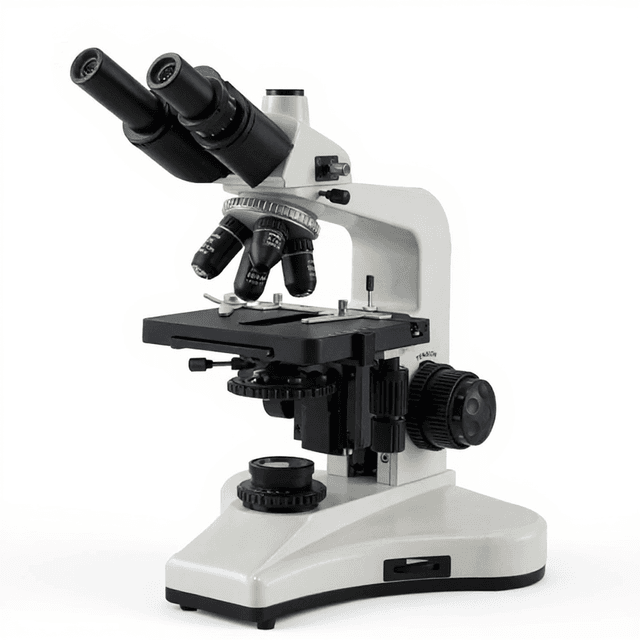
The 40X Portable Metallurgical Microscope with Penlight is a compact reflected-light optical instrument designed for field and laboratory examination of opaque specimens. The system combines a WF10X eyepiece with reticule (0.1mm graduations) and 4X/0.1 achromatic objective to provide 40X total magnification for surface analysis applications.
The instrument features LED spot illumination powered by dual No. 7 dry batteries, enabling operation in locations without AC power. With a 14.3mm working distance and 30mm focusing range, the microscope accommodates various specimen thicknesses while maintaining optical performance. The portable design (0.65kg weight, 143×63×210mm dimensions) supports field inspection and quality control workflows requiring immediate microscopic evaluation.
How It Works
Reflected-light microscopy utilizes incident illumination to examine opaque specimens that cannot transmit light. The LED spot light directs illumination through the objective lens onto the specimen surface, where it reflects back through the same optical path to form an image. This vertical illumination geometry enables examination of metals, ceramics, polymers, and other non-transparent materials.
The 4X/0.1 achromatic objective provides numerical aperture-limited resolution while maintaining sufficient working distance for specimen manipulation. The WF10X eyepiece incorporates a 0.1mm graduated reticule for dimensional measurements and feature quantification. The 160mm mechanical tube length ensures proper optical correction and image quality throughout the 30mm focusing range.
Battery-powered LED illumination eliminates heat generation that could affect temperature-sensitive specimens while providing consistent color temperature for accurate surface characterization. The portable configuration enables immediate field assessment without requiring laboratory infrastructure.
Features & Benefits
Automation Level
- manual
Product Type
- Microscope
Microscope Type
- Metallurgical
Application
- Materials Science
- Quality Control
Skill Level
- Intermediate
Brand
- ConductScience
Research Domain
- Analytical Chemistry
- Environmental Monitoring
- Food Science
- Industrial Hygiene
- Pharmaceutical QC
Weight
- 0.65 kg
Dimensions
- L: 4.9 mm
- W: 6.6 mm
- H: 6.6 mm
Comparison Guide
| Feature | This Product | Typical Alternative | Advantage |
|---|---|---|---|
| Total Magnification | 40X fixed magnification | Entry-level portable microscopes often offer 10-20X, while advanced models may provide 100-200X | Balanced magnification provides sufficient detail resolution while maintaining practical working distance for field applications. |
| Working Distance | 14.3mm working distance | Compact portables often have shorter working distances | Extended working distance allows examination of thicker specimens and provides space for manipulation tools. |
| Measurement Capability | Integrated 0.1mm reticule graduations | Many portable units lack measurement reticules | Built-in measurement capability eliminates need for separate measurement tools in field applications. |
| Power System | LED illumination with dual No. 7 dry batteries | Some models use rechargeable batteries or AC power only | Standard dry batteries provide reliable field operation with easy replacement availability worldwide. |
| Focusing Range | 30mm focusing range | Basic portable microscopes often have limited focus adjustment | Extended focusing range accommodates various specimen thicknesses without mechanical repositioning. |
| Weight and Portability | 0.65kg total weight | Portable microscopes range from 0.3-2.0kg depending on features | Lightweight design enables extended field use while maintaining stable optical performance. |
This microscope balances portability with practical optical performance, offering 40X magnification with measurement capability and extended working distance in a compact, battery-powered package suitable for field metallography and surface analysis applications.
Practical Tips
Verify reticule measurements using a certified stage micrometer before conducting quantitative analysis.
Why: Ensures measurement accuracy and accounts for any optical system variations or eyepiece positioning effects.
Clean optical surfaces with lens tissue and appropriate solvents, avoiding circular motions that can cause scratches.
Why: Maintains image quality and prevents permanent damage to expensive objective and eyepiece optics.
Use the minimum LED intensity that provides adequate contrast to extend battery life and reduce heat generation.
Why: Optimizes field operation time while preventing potential specimen thermal effects during extended examination.
If image appears dim or uneven, check LED battery condition and clean illumination optics for dust or contamination.
Why: Most illumination problems stem from power issues or optical contamination rather than LED failure.
Document illumination settings and specimen preparation methods for reproducible results across multiple examinations.
Why: Consistent documentation enables reliable comparison of results and supports quality control workflows.
Ensure specimens are securely positioned on the base stand to prevent dropping and potential optical damage.
Why: Portable use environments may lack the stability of laboratory benches, increasing risk of specimen or instrument damage.
Allow 5-10 minutes for thermal equilibrium when moving between temperature environments before conducting measurements.
Why: Temperature changes can affect focus stability and dimensional accuracy of reticule measurements.
Store the instrument in a protective case with desiccant when operating in humid field conditions.
Why: Prevents optical surface fogging and corrosion of mechanical components in challenging environmental conditions.
Setup Guide
What’s in the Box
- Main microscope body
- WF10X eyepiece with 0.1mm reticule
- 4X achromatic objective lens
- LED spot light with battery housing
- User manual and optical care instructions (typical)
- Protective carrying case (typical)
Compliance
References
Background reading relevant to this product:
Warranty & ConductCare
ConductScience provides a standard one-year manufacturer warranty covering optical and mechanical components, with technical support for setup and operational guidance.
What is the resolution limit at 40X magnification for surface feature analysis?
The theoretical resolution depends on the numerical aperture (0.1) and illumination wavelength. Consult product datasheet for specific resolution values, but expect feature discrimination in the 2-5 micrometer range for surface analysis applications.
How accurate are measurements made with the 0.1mm reticule graduations?
Reticule accuracy depends on proper calibration with a certified stage micrometer. At 40X magnification, each 0.1mm graduation represents the actual specimen dimension divided by total magnification.
What specimen preparation is required for metallographic examination?
Specimens should have flat, clean surfaces free of oils or debris. Polished metallographic specimens provide optimal results, though rough surfaces can be examined for general morphology assessment.
How long do the batteries typically last in field operation?
Battery life depends on LED usage intensity and environmental conditions. Consult product datasheet for specific operating hours, but typical LED systems provide several hours of continuous operation.
Can the microscope examine wet or immersed specimens?
The instrument is designed for dry specimen examination. While brief exposure to moisture may be tolerable, avoid submerged specimens that could damage optical components.
What is the maximum specimen thickness that can be accommodated?
The 14.3mm working distance and focusing range determine maximum specimen thickness. Consult specifications for exact clearance, but typical portable microscopes accommodate specimens up to 10-12mm thick.
How does this compare to bench-top metallurgical microscopes?
This portable unit offers convenience and field capability but with reduced magnification range and optical performance compared to full-size laboratory metallurgical microscopes with multiple objectives and professional illumination systems.
What type of specimens are not suitable for this microscope?
Transparent specimens requiring transmitted light, highly reflective surfaces causing glare, and specimens requiring magnifications above 40X or specialized illumination techniques like polarized light are not optimal for this instrument.
Have a question about this product?
Frequently Bought Together
Related Products