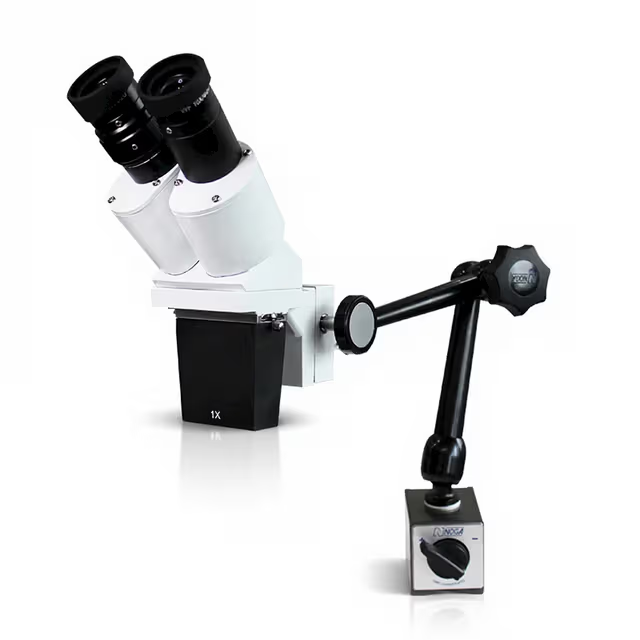
Binocular & Trinocular 40X~1000X Biological Microscope for School Students Laboratory
Compound biological microscope with 40X-1000X magnification range, binocular head, and mechanical stage for research and educational applications.

Louise Corscadden, PhD
Director of Science · ConductScience
Ask Louise about Binocular & Trinocular 40X~1000X Biological Microscope for School Students Laboratory fit, setup, configuration, or quote prep.
Already working with us? Sign in to connect this with My Scientist.
Key Specifications
Full details →- Model fit
- Configured during quote
- SKU family
- MCX-0014
- Shipping box
- 4.9 x 6.6 x 6.6 cm
- Ordering
- Online checkout and quote request available
- Category
- Microscopy
- Build notes
- Confirm accessories, station layout, and support needs before purchase
The ConductScience MCX-0014 is a compound biological microscope designed for research and educational applications requiring magnification from 40X to 1000X. The instrument features a binocular head with 360° articulation and 30° inclination for comfortable viewing, equipped with WF10X/20mm plan eyepieces and a complete set of achromatic objectives (4X, 10X, 40X, 100X oil immersion) mounted on a quadruple nosepiece.
The microscope incorporates an N.A. 1.25 Abbe condenser with iris diaphragm for optimal illumination control, coaxial coarse and fine focusing with 0.002mm minimum division, and a double-layer mechanical stage (140×155mm) with 74×54mm traveling range. Built-in LED illumination with adjustable intensity and iris diaphragm (φ2-φ30mm) provides consistent sample visualization across the magnification range.
How It Works
The microscope operates on the principle of compound magnification, where the objective lens forms a real, magnified image of the specimen, which is then further magnified by the eyepiece. Light from the built-in LED source passes through the adjustable iris diaphragm and Abbe condenser (N.A. 1.25), which focuses and controls the illumination cone angle to optimize resolution and contrast.
The four-objective system provides total magnifications of 40X (4X objective × 10X eyepiece), 100X, 400X, and 1000X. The 40X and 100X objectives are spring-loaded to prevent damage during focusing. The 100X oil immersion objective requires immersion oil to achieve its specified numerical aperture of 1.25, enabling resolution of fine cellular details. The coaxial focusing system uses rack and pinion mechanics with 0.002mm fine focus precision for accurate specimen positioning within the shallow depth of field at high magnifications.
Features & Benefits
Automation Level
- manual
Product Type
- Microscope
Microscope Type
- Biological / Compound
Viewing Head
- Trinocular
Application
- Clinical Research
- Life Science
Skill Level
- Intermediate
Brand
- ConductScience
Research Domain
- Cell Biology
- Histopathology
- Microbiology
Shipping weight
- 1.9 lb
Shipping box
- L: 4.9 cm
- W: 6.6 cm
- H: 6.6 cm
| Feature | This Product | Typical Alternative | Advantage |
|---|---|---|---|
| Magnification Range | 40X-1000X with four objectives (4X, 10X, 40X, 100X) | Entry-level models often provide 40X-400X with three objectives | Extended magnification range enables examination of fine cellular details and microorganisms at oil immersion magnification. |
| Condenser Specifications | N.A. 1.25 Abbe condenser with iris diaphragm | Basic models typically feature N.A. 0.65-1.0 condensers | Higher numerical aperture condenser improves resolution and contrast, particularly important for high-magnification work. |
| Stage Design | Double-layer mechanical stage (140×155mm) with 74×54mm travel and 0.1mm vernier | Single-layer stages with limited travel range are common in entry-level instruments | Larger stage accommodates multiple slides and precise positioning enables systematic sample scanning and reproducible measurements. |
| Focus System | Coaxial coarse/fine focusing with 0.002mm fine increment and 30mm range | Basic models often have separate focus knobs with lower precision | Integrated coaxial design and fine focus precision essential for critical focusing at high magnifications where depth of field is minimal. |
| Head Configuration | Binocular head with 360° articulation and 30° inclination | Fixed-angle heads or limited articulation in basic models | Full articulation accommodates different user heights and viewing preferences, reducing fatigue during extended observation sessions. |
The MCX-0014 offers research-grade optical and mechanical specifications including high N.A. condenser, extended magnification range to 1000X, and precision focusing systems typically found in more advanced instruments while maintaining educational accessibility.
Practical Tips
Verify parfocality by focusing on a specimen at 4X magnification, then rotating through higher objectives to ensure minimal refocusing is required.
Why: Proper parfocal adjustment saves time during multi-magnification examinations and indicates optical alignment quality.
Clean objective lenses with lens paper and appropriate solvents, removing immersion oil from the 100X objective immediately after use.
Why: Oil residue can harden and permanently damage objective coatings, while proper cleaning maintains optical performance.
Always start observations at 4X magnification to locate specimens before progressing to higher powers, and center objects before increasing magnification.
Why: Low magnification provides larger fields of view for efficient specimen location and prevents losing objects when switching to higher magnifications.
If image appears dim or low contrast, check condenser height and iris diaphragm opening - the condenser should be raised near the slide and iris opened appropriately for the objective N.A.
Why: Proper condenser alignment is critical for optimal resolution and contrast, particularly at high magnifications.
Use #1.5 thickness coverslips (0.17mm) for optimal performance with high-power objectives, as objective correction is designed for this standard thickness.
Why: Incorrect coverslip thickness introduces spherical aberrations that degrade image quality and resolution at high magnifications.
When using the 100X oil immersion objective, apply a small drop of immersion oil to the specimen area and slowly lower the objective to contact the oil.
Why: Proper oil immersion technique prevents air bubbles that scatter light and ensures the objective achieves its full numerical aperture.
Store the microscope with the 4X objective in position and stage lowered to prevent accidental contact between objectives and stage during transport.
Why: The 4X objective has the greatest working distance and is least susceptible to damage from accidental stage contact.
Setup Guide
What’s in the Box
- Binocular microscope with objectives installed (typical)
- WF10X/20mm plan eyepieces (pair) (typical)
- Mechanical stage with specimen clips (typical)
- LED power adapter (typical)
- Dust cover (typical)
- User manual and specification sheet (typical)
- Immersion oil for 100X objective (typical)
- Color filters (B, Y, G)
Warranty
ConductScience provides a standard one-year manufacturer warranty covering defects in materials and workmanship, with technical support for setup and operational guidance.
Compliance
References
Background reading relevant to this product:
What is the practical resolution limit with the 100X oil immersion objective?
With the 100X/1.25 N.A. oil immersion objective, theoretical resolution approaches 0.22 micrometers under optimal conditions with proper condenser alignment and immersion oil application.
Can this microscope accommodate different slide thicknesses and coverslip variations?
The 30mm focusing range and spring-loaded high-power objectives accommodate standard microscope slides (1mm) and various coverslip thicknesses, though optimal performance requires #1.5 coverslips for high-magnification work.
How does the mechanical stage precision affect quantitative measurements?
The 0.1mm vernier scale resolution on the mechanical stage enables reproducible positioning for morphometric analysis and systematic sampling, though digital measurement systems provide higher precision for quantitative work.
What maintenance is required for the LED illumination system?
LED systems typically require no routine bulb replacement and minimal maintenance compared to halogen systems, though periodic cleaning of the condenser and illumination path maintains optimal performance.
Is this microscope suitable for fluorescence applications?
This brightfield microscope lacks fluorescence excitation and emission filtering capabilities; fluorescence work requires specialized filter sets and mercury or LED excitation sources not included in this configuration.
How does image quality compare to plan achromatic objectives?
The achromatic objectives provide good color correction for routine work, though plan achromatic or plan apochromatic objectives offer superior field flatness and color correction for demanding applications.
Can the microscope be adapted for digital imaging?
The standard configuration accommodates C-mount camera adapters for digital imaging, though trinocular models provide dedicated camera ports without compromising binocular viewing.
Have a question about this product?
Have a question? Just ask.
Send it over and we'll email you a personalized answer — no call, no scheduling.
Prefer to talk it through?
Accessories
Enhance your setup with compatible accessories
Frequently Bought Together