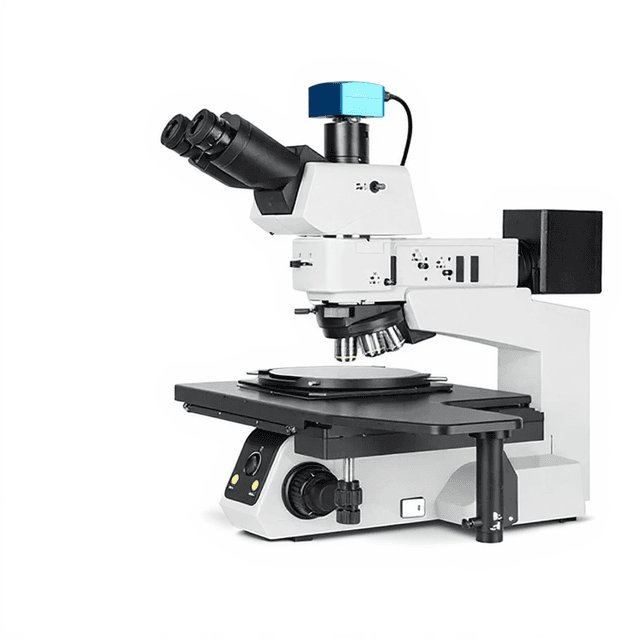
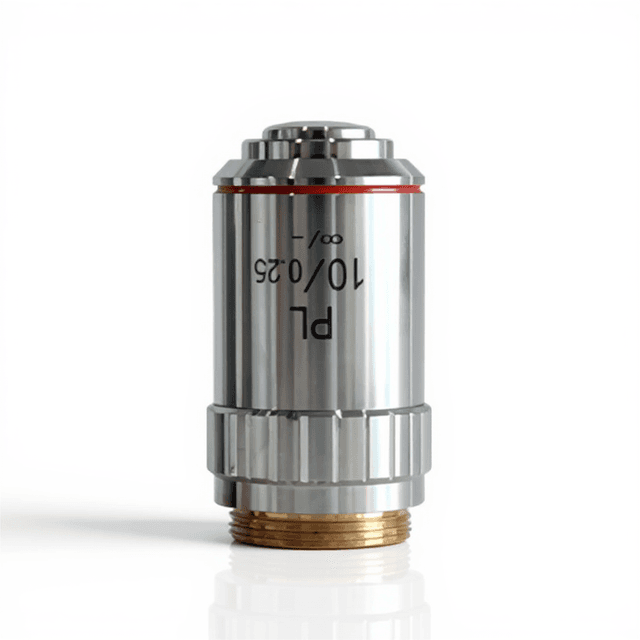
50X-1000X Coded Nosepiece Trinocular Inverted Metallurgical Microscope with Brightness Memory Function for Wafer Inspection
Inverted trinocular metallurgical microscope with coded nosepiece, 50X-500X magnification, LED illumination with brightness memory, and integrated camera adapter for materials analysis and wafer inspection.
| Automation Level | semi-automated |
| Product Type | Microscope |
| Microscope Type | Inverted |
| Viewing Head | Trinocular |
| Application | General Laboratory |
| Skill Level | Professional / Research |

The 50X-500X Coded Nosepiece Trinocular Inverted Metallurgical Microscope represents a specialized optical instrument designed for materials analysis and wafer inspection applications. This inverted configuration metallurgical microscope features a coded quintuple nosepiece that automatically adjusts calibration values in imaging software when switching between magnifications, streamlining analytical workflows. The trinocular head configuration enables simultaneous visual observation and digital documentation through the integrated camera adapter.
Key technical features include infinite metallurgical microscope objectives providing 50X to 500X magnification range, a low-hand coaxial coarse/fine focus system with 2μm minimum fine focusing division, and LED illumination with brightness control and memory function. The double-layer mechanical stage (215mm×165mm) offers 45mm×35mm movement range for systematic sample examination. The instrument incorporates high eyepoint wide field plan eyepieces and a 0.5X C-mount camera adapter with focusing capability for digital imaging applications.
How It Works
Metallurgical microscopy employs reflected light illumination to examine opaque specimens that cannot be observed using transmitted light. The inverted configuration positions the objectives below the specimen stage, allowing examination of samples that are too thick, heavy, or irregularly shaped for conventional upright microscopes. Light from the LED illumination source travels through the optical system, reflects off the specimen surface, and returns through the same objective lens to form the magnified image.
The coded quintuple nosepiece system automatically communicates magnification changes to connected imaging software, ensuring accurate calibration for measurement and analysis functions. The infinite optical system eliminates the need for tube length corrections when adding intermediate optical components. The coaxial focus mechanism provides precise specimen positioning with 2μm fine focus resolution, while the mechanical stage enables systematic scanning of large specimens across the 45mm×35mm movement range.
Features & Benefits
Automation Level
- semi-automated
Product Type
- Microscope
Microscope Type
- Inverted
Viewing Head
- Trinocular
Application
- General Laboratory
Skill Level
- Professional / Research
Brand
- ConductScience
Research Domain
- Analytical Chemistry
- Environmental Monitoring
- Industrial Hygiene
- Materials Science
- Pharmaceutical QC
Weight
- 8.5 kg
Dimensions
- L: 4.9 mm
- W: 6.6 mm
- H: 6.6 mm
Comparison Guide
| Feature | This Product | Typical Alternative | Advantage |
|---|---|---|---|
| Nosepiece Configuration | Coded quintuple nosepiece with automatic software calibration | Manual nosepieces require operator calibration for each magnification change | Eliminates calibration errors and speeds up multi-magnification analysis workflows. |
| Magnification Range | 50X to 500X with infinite optical system | Entry-level models often provide narrower magnification ranges | Covers typical metallographic examination requirements from overview to detailed analysis. |
| Focus Precision | 2μm minimum fine focus division | Basic models typically offer coarser focus adjustment | Enables precise examination of surface features and accurate depth measurements. |
| Illumination System | LED with brightness memory function | Halogen illumination without memory features | Provides stable, consistent illumination with heat-free operation and automatic brightness recall. |
| Stage Design | Double-layer mechanical stage (215mm×165mm) | Single-layer or smaller stage configurations | Accommodates larger specimens while maintaining precise positioning control for systematic examination. |
| Camera Integration | 0.5X C-mount adapter with independent focus | Basic camera ports without magnification optimization | Optimizes digital imaging field of view and provides precise focus control for documentation. |
This microscope combines automated coded nosepiece technology with precision optics and user-friendly features for efficient metallurgical analysis. The LED illumination system and trinocular design enhance both visual examination and digital documentation capabilities.
Practical Tips
Verify coded nosepiece calibration with a stage micrometer after software installation or updates.
Why: Ensures accurate measurements across all magnifications in imaging software.
Clean objective lenses weekly with lens paper and appropriate cleaning solution, working from center outward.
Why: Prevents accumulation of contaminants that reduce image quality and contrast.
Allow 10-15 minutes warm-up time for LED illumination to stabilize before critical measurements.
Why: Ensures consistent brightness and color temperature for reproducible imaging conditions.
If coded nosepiece signals are not recognized, check cable connections and verify software compatibility.
Why: Communication errors prevent automatic calibration and may cause measurement inaccuracies.
Use the brightness memory function to maintain consistent illumination settings between related samples.
Why: Standardized illumination improves image comparison and reduces variation in analysis results.
Secure heavy specimens properly on the mechanical stage before examination.
Why: Prevents specimen damage and protects objective lenses from impact in inverted configuration.
Recalibrate measurement software when changing between different objective manufacturers or types.
Why: Different objectives may have slight magnification variations affecting measurement accuracy.
Check and clean the mechanical stage tracks monthly to maintain smooth movement.
Why: Prevents binding and ensures precise specimen positioning during systematic examinations.
Setup Guide
What’s in the Box
- Trinocular inverted metallurgical microscope with coded quintuple nosepiece
- SWH10X high eyepoint wide field plan eyepieces (pair)
- 0.5X C-mount camera adapter with focusing mechanism
- LED illumination unit (5V/10W) with brightness control
- Power supply and cord
- Dust cover
- User manual and documentation
- Calibration certificate (typical)
Warranty
ConductScience provides a standard one-year manufacturer warranty covering defects in materials and workmanship, with technical support for setup and operation questions.
Compliance
References
Background reading relevant to this product:
What is the effective magnification range with the standard eyepieces?
With SWH10X eyepieces, total magnification ranges from 500X to 5000X (50X-500X objectives × 10X eyepieces). The coded nosepiece automatically adjusts software calibration for each magnification.
Can this microscope accommodate polarization accessories for grain structure analysis?
The infinite optical system design allows insertion of polarizing filters and other accessories in the optical path. Consult product datasheet for specific polarization accessory compatibility.
What camera systems are compatible with the C-mount adapter?
The 0.5X C-mount adapter accepts standard C-mount cameras. The 0.5X factor increases field of view while maintaining image quality. Independent focus adjustment accommodates various sensor sizes.
How does the brightness memory function work?
The LED illumination system stores brightness settings and recalls the last used intensity level when powered on, ensuring consistent illumination conditions between examination sessions.
What is the maximum specimen thickness that can be examined?
The inverted configuration with 9mm focus range and 6.5mm upward focal plane movement accommodates specimens several millimeters thick. Exact capacity depends on objective working distance.
Does the coded nosepiece require specific imaging software?
The coded nosepiece sends magnification signals to compatible imaging software for automatic calibration. Software compatibility should be verified before purchase for specific analysis requirements.
What maintenance is required for the LED illumination system?
LED illumination requires minimal maintenance due to long LED life and stable output. Periodic cleaning of optical surfaces and verification of brightness uniformity is recommended.
How precise is the mechanical stage movement for systematic examination?
The double-layer mechanical stage provides smooth movement across 45mm×35mm range with fine positioning control suitable for systematic grid examination and returning to specific locations.
Have a question about this product?
Frequently Bought Together
Related Products