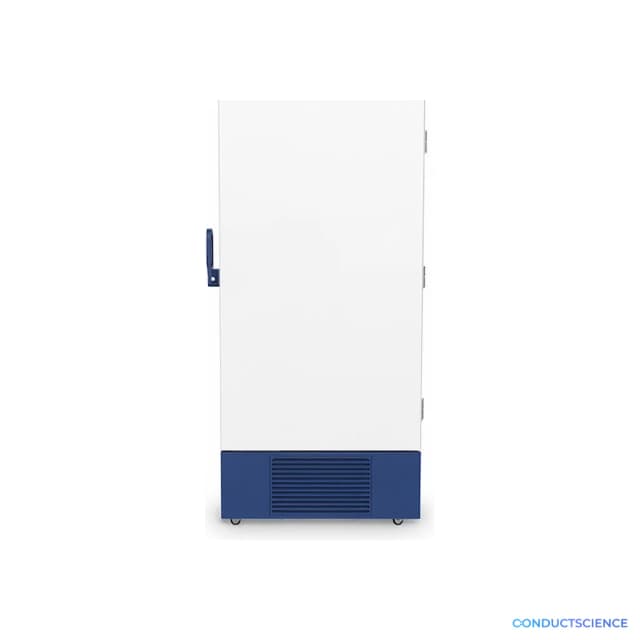
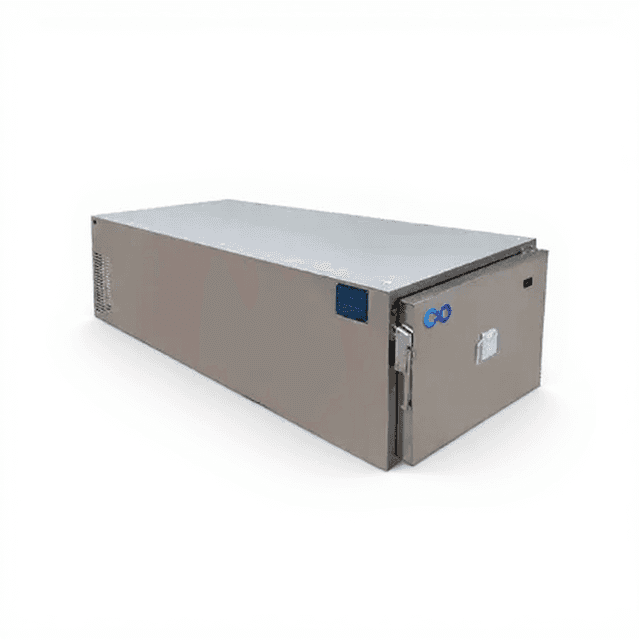
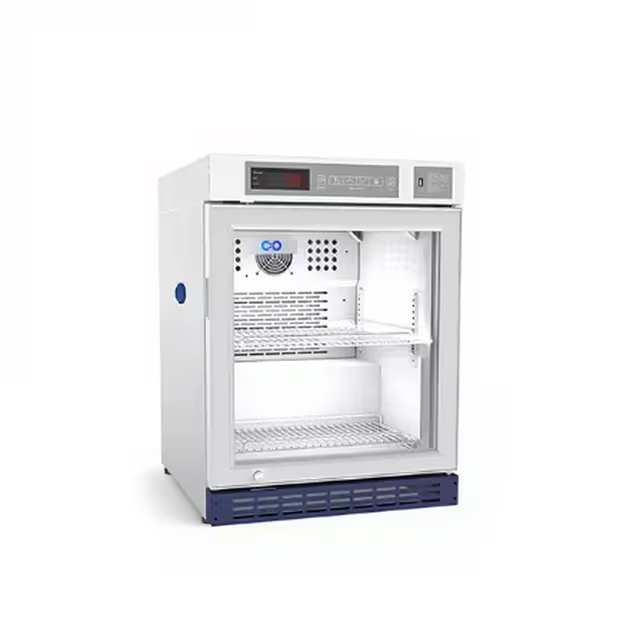
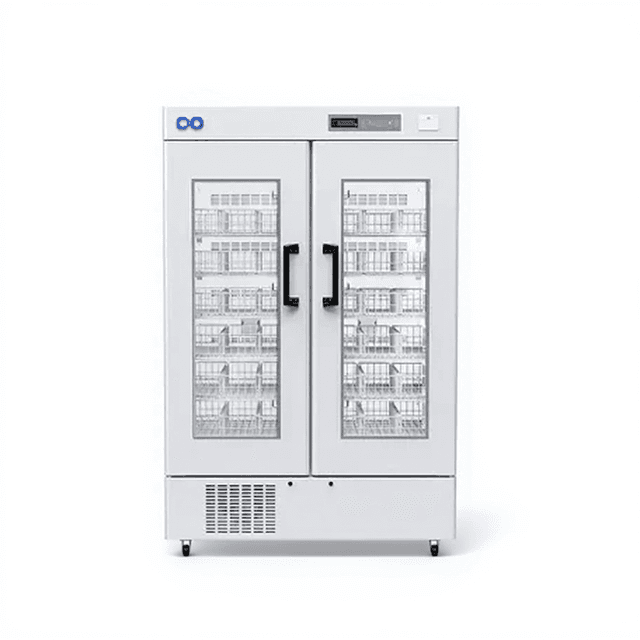
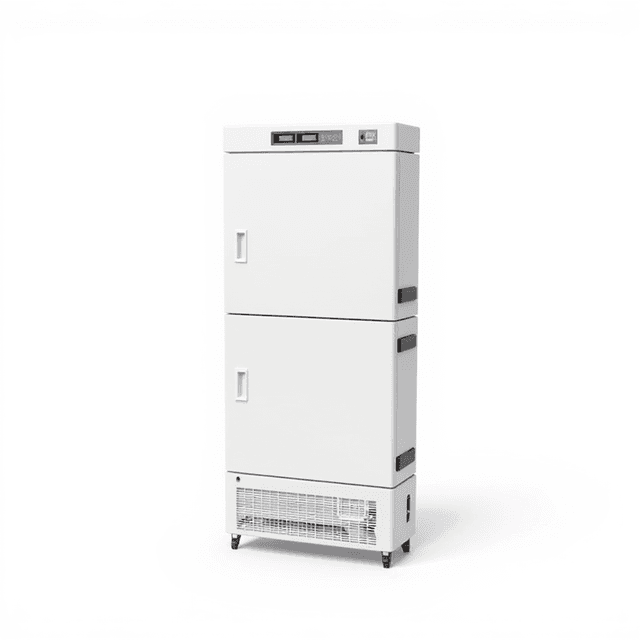
86℃ Freezer BDF-86V168 BDF-86V348 (Customized)
Ultra-low temperature freezer operating at -86°C for long-term cryopreservation of biological specimens and research materials in laboratory and biobank applications.

The 86℃ Freezer BDF-86V168 BDF-86V348 is a customized ultra-low temperature freezer designed for long-term storage of temperature-sensitive biological specimens and research materials. Operating at -86°C, this freezer provides stable cryopreservation conditions essential for maintaining sample integrity in biobanks, research laboratories, and clinical facilities.
The freezer features a compact design with dimensions of 820mm × 465mm × 455mm, making it suitable for laboratories with space constraints while maintaining adequate storage capacity. The unit is engineered to deliver consistent ultra-low temperatures required for preserving nucleic acids, proteins, cell lines, tissue samples, and other biological materials over extended storage periods.
How It Works
The ultra-low temperature freezer operates using a cascade refrigeration system that achieves and maintains temperatures of -86°C through sequential compression and expansion of specialized refrigerants. The primary cooling stage uses an initial refrigerant to reduce temperature from ambient to approximately -40°C, while a secondary stage utilizing a different refrigerant further reduces temperature to the target -86°C operating point.
Temperature uniformity is maintained through optimized airflow patterns and thermal insulation designed to minimize temperature fluctuations that could compromise sample integrity. The freezer incorporates temperature monitoring systems that continuously track internal conditions and provide alerts if temperature excursions occur. This multi-stage cooling approach ensures rapid pulldown times when samples are added and stable temperature recovery after door openings.
The storage chamber is designed to accommodate standard laboratory sample containers and storage boxes while maintaining consistent temperature distribution throughout the storage volume. Thermal mass and insulation properties work together to minimize the impact of brief door openings on overall storage temperature.
Features & Benefits
Research Domain
- Cancer Research
- Cell Biology
- Clinical Diagnostics
- Immunology
- Microbiology
- Pharmaceutical QC
Weight
- 168.0 kg
Dimensions
- L: 82.0 mm
- W: 46.5 mm
- H: 45.5 mm
Comparison Guide
| Feature | This Product | Typical Alternative | Advantage |
|---|---|---|---|
| Operating Temperature | -86°C stable operation | Entry-level models may offer -80°C with less stability | Lower temperature provides enhanced sample preservation for long-term storage applications. |
| Footprint | Compact 82cm × 46.5cm × 45.5cm design | Standard models often require larger floor space | Fits in space-constrained laboratories without compromising storage capability. |
| Customization Options | Customized configuration available | Standard models offer fixed specifications | Allows adaptation to specific laboratory storage requirements and workflow needs. |
| Construction Weight | 168 kg substantial thermal mass | Lighter models may have reduced thermal stability | Heavy construction provides better temperature stability and recovery performance. |
The BDF-86V168/348 offers ultra-low temperature performance in a compact, customizable design suitable for laboratories requiring -86°C storage capability without large equipment footprint. The substantial construction ensures temperature stability essential for biological sample preservation.
Practical Tips
Verify temperature accuracy using calibrated reference thermometers placed in multiple locations within the storage chamber.
Why: Temperature uniformity validation ensures consistent preservation conditions throughout the storage volume.
Inspect door seals monthly and clean exterior condenser coils quarterly to maintain optimal cooling efficiency.
Why: Regular maintenance prevents temperature excursions and extends equipment lifespan.
Pre-cool sample storage containers to -20°C before transferring to -86°C to minimize temperature impact on existing samples.
Why: Gradual temperature transition reduces thermal shock to both new and stored samples.
If temperature rises above -80°C, check door seal integrity and avoid frequent door openings until stability returns.
Why: Temperature excursions can compromise sample integrity and indicate potential equipment issues.
Maintain continuous temperature logs and establish clear protocols for temperature excursion documentation.
Why: Comprehensive temperature records support sample traceability and regulatory compliance requirements.
Use insulated gloves and safety equipment when handling samples stored at ultra-low temperatures.
Why: Direct contact with -86°C materials can cause severe frostbite and tissue damage.
Setup Guide
What’s in the Box
- Ultra-low temperature freezer unit
- Power cord and electrical connections (typical)
- Temperature monitoring probe (typical)
- User manual and operating instructions (typical)
- Installation hardware and documentation (typical)
Warranty
ConductScience provides a standard 1-year manufacturer warranty covering parts and components with technical support for installation and operational guidance.
Compliance
References
Background reading relevant to this product:
What is the temperature recovery time after door opening?
Recovery time depends on door opening duration and ambient conditions. Typical recovery to -86°C occurs within 15-30 minutes for brief openings, though extended access may require longer stabilization periods.
How should temperature monitoring be implemented for sample integrity documentation?
Install independent temperature monitoring with data logging capabilities. Record temperature readings at regular intervals and establish alarm thresholds to detect excursions that could compromise sample viability.
What storage containers are recommended for optimal sample preservation?
Use cryogenic storage boxes and vials designed for ultra-low temperatures. Avoid containers that may become brittle or fail at -86°C, and ensure proper labeling with cryogenic-compatible markers.
What maintenance schedule is recommended for optimal performance?
Perform monthly visual inspections of door seals and external components. Schedule annual preventive maintenance including refrigeration system checks and temperature calibration verification.
How does ambient temperature affect freezer performance?
Higher ambient temperatures increase compressor workload and may extend pulldown times. Maintain room temperature below 25°C when possible and ensure adequate ventilation around the unit.
What backup systems should be considered for sample protection?
Implement temperature monitoring alarms, backup power systems, and sample transfer protocols to secondary storage in case of equipment failure or extended power outages.
Have a question about this product?