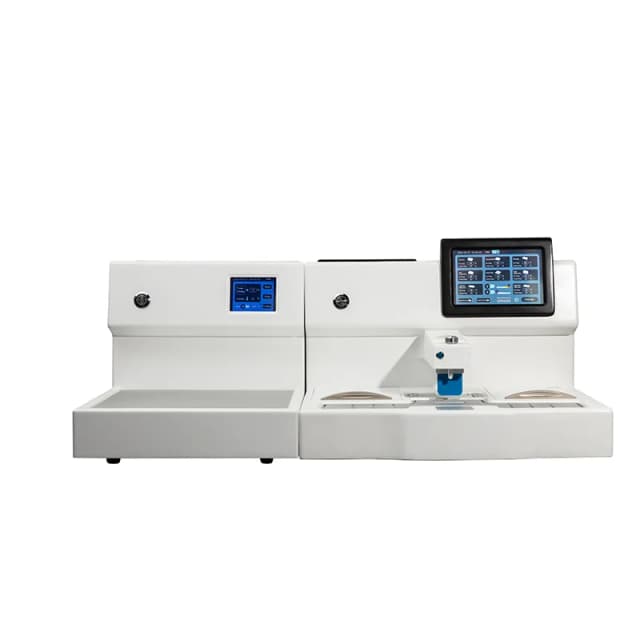
Fully Automated Rotary Microtome Series
Fully automated rotary microtome system with 0.25-100 μm section thickness control, OLED interface, and precision specimen handling for histopathology and electrophysiology applications. Available models: Standard – RD-355AT and Precision – RD-355...
| Handwheel | Precisely adjusted, lockable at any position |
| Retraction Setting Range | 0—50μm ( 0 is off ) 5-10-15—50 (optional) |
| Movement Range Of The Base Of Blade Holder Base | 0-60mm (front to back) |
| Feed Speed Adjust | 1500μm/s ~ 3500μm/s |
| Display Type | OLED |
| Sectioning Modes | Manual and automated smart sectioning |

The Fully Automated Rotary Microtome Series provides precision sectioning capabilities for histopathological specimen preparation and electrophysiological slice studies. Available in two configurations, the system offers section thickness control from 0.25-100 μm with automated cutting sequences and programmable specimen handling. The precision model (RF-RD-355ATK) achieves ±1% accuracy with 0.25 μm minimum increment capability, while the standard model (RF-RD-355AT) provides ±5% accuracy with 0.5 μm minimum increments.
Built around an advanced screw motion mechanism, the microtome features OLED display control, automated specimen retraction, and integrated safety systems including emergency braking and driver overload protection. The lateral movement blade holder accommodates three different blade segments with red protection bar, while the specimen orientation system allows XY adjustment within 8° and full 360° rotation for optimal sectioning angles.
How It Works
The rotary microtome operates on the principle of controlled linear advancement of the specimen past a stationary knife edge. The specimen, mounted in a precision chuck, advances incrementally through a screw-driven mechanism while the cutting arm moves in an arc to slice through the material. The international advanced screw motion mechanism ensures consistent feed rates and eliminates backlash during the cutting cycle.
Section thickness is controlled through precise micrometer adjustment with programmable increment settings. The automated system coordinates specimen advancement, blade engagement, and retraction sequences while monitoring cutting forces through driver overload protection. The OLED control interface manages cutting speeds from 0-300 mm/s (up to 500 mm/s with customization) and specimen feed rates of 1250-3500 μm/s depending on model configuration.
Safety systems include emergency braking that immediately halts cutting operations and automatic sleep protection to prevent accidental activation. The specimen retraction feature automatically withdraws the sample during blade changes or extended pauses, preventing compression artifacts and maintaining section quality throughout extended cutting sessions.
Features & Benefits
Model
- Standard - RD-355AT
- Precision - RD-355ATK
Handwheel
- Precisely adjusted, lockable at any position
Retraction Setting Range
- 0—50μm ( 0 is off ) 5-10-15—50 (optional)
Movement Range Of The Base Of Blade Holder Base
- 0-60mm (front to back)
Feed Speed Adjust
- 1500μm/s ~ 3500μm/s
Display Type
- OLED
Research Domain
- Cancer Research
- Developmental Biology
- Histopathology
- Materials Science
- Neuroscience
- Toxicology
Sectioning Modes
- Manual and automated smart sectioning
Blade Segments
- 3 different segments
Specimen Clamp Types
- Paraffin block and cassette clamps
Safety Features
- Emergency braking system, security alarm, driver overload protection, auto-sleep protection
Drive Functions
- Sectioning, trimming, fast forward, fast backward, quick mode conversion, automatic specimen retraction
Motion Mechanism
- International advanced screw motion mechanism
Blade Management
- Lateral movement blade holder with red protection bar
Waste Tray
- Large-volume, easy-to-remove with disposable blade storage
Control Features
- Remote control panel, adjustable automatic slicing speed
Section Thickness Setting Range
- 0.25—100μm 0.25—2.5μm increment 0.25μm 2.5—5μm increment 0.5μm 5.0—10μm increment 1μm 10—30μm increment 2μm 30—60μm increment 5μm 60—100μm increment 10μm
Weight
- 108.0 kg
Dimensions
- L: 69.0 mm
- W: 59.0 mm
- H: 50.0 mm
Comparison Guide
| Feature | This Product | Typical Alternative | Advantage |
|---|---|---|---|
| Section thickness accuracy | ±1% (precision model) / ±5% (standard model) | Entry-level automated models often provide ±10% accuracy | Improved consistency reduces section-to-section variation critical for quantitative analysis and diagnostic accuracy. |
| Minimum section thickness | 0.25 μm (precision model) / 0.5 μm (standard model) | Manual microtomes typically achieve 1-2 μm minimum thickness | Enables ultra-thin sectioning for electron microscopy specimen preparation and specialized staining protocols. |
| Automated specimen retraction | Programmable 0-50 μm retraction with automatic engagement | Manual models require operator-controlled retraction | Prevents compression artifacts and blade damage during extended cutting sessions without operator intervention. |
| Blade utilization system | Three-segment lateral movement with position control | Standard holders typically provide single-position blade mounting | Extends blade life and reduces consumable costs while maintaining cutting quality throughout extended use. |
| Specimen orientation flexibility | 360° rotation with XY adjustment within 8° | Basic models offer limited angular adjustment | Optimizes cutting angle for various tissue types and complex specimen geometries without time-consuming remounting. |
| User interface | OLED display with remote control panel | Manual controls with basic LCD displays or analog readouts | Provides intuitive parameter adjustment and real-time monitoring from optimal viewing distance during operation. |
This microtome series combines precision automation with flexible specimen handling capabilities, offering both cost-effective standard and high-precision configurations. The integrated safety systems and advanced motion control deliver consistent results while the modular blade system and automated retraction enhance operational efficiency for high-volume sectioning workflows.
Practical Tips
Verify section thickness accuracy monthly using certified thickness standards across the full working range.
Why: Environmental conditions and mechanical wear can gradually affect micrometer calibration accuracy.
Clean the advance mechanism weekly and apply manufacturer-specified lubricant to prevent backlash development.
Why: Accumulated debris and dry lubrication points can introduce inconsistencies in specimen feed rates.
Allow specimens to equilibrate to room temperature for 30 minutes before sectioning to minimize chatter and tearing.
Why: Temperature differences between specimen and ambient conditions can cause differential expansion and sectioning artifacts.
If sections appear compressed or torn, reduce cutting speed and verify blade sharpness before adjusting retraction settings.
Why: Cutting speed and blade condition are primary factors affecting section quality, and retraction adjustments may mask underlying issues.
Document blade changes and section counts to maintain consistency in studies requiring multiple cutting sessions.
Why: Blade wear can introduce gradual changes in section quality that may affect morphological and quantitative analyses.
Always engage the red protection bar on the blade holder when changing specimens or performing maintenance.
Why: The protection bar prevents accidental contact with the sharp blade edge during routine handling operations.
Use the three-segment blade positioning system systematically to maximize cutting edge utilization before blade replacement.
Why: Proper blade segment rotation extends consumable life while maintaining section quality throughout the blade's useful life.
Empty and clean the waste tray regularly to prevent specimen debris from interfering with automated functions.
Why: Accumulated waste can obstruct safety sensors and interfere with the specimen retraction mechanism.
Setup Guide
What’s in the Box
- Fully automated rotary microtome main unit
- OLED display and remote control panel
- Lateral movement blade holder assembly with protection bar
- Paraffin block and cassette specimen clamps
- Large-volume waste collection tray
- Power cable and user manual
- Calibration tools and adjustment keys (typical)
- Disposable blade storage compartment (typical)
Warranty
ConductScience provides a comprehensive one-year manufacturer warranty covering mechanical components and electronic systems, with technical support for calibration and operational guidance throughout the warranty period.
Compliance
References
Background reading relevant to this product:
What is the minimum achievable section thickness and how consistent is it across different specimen types?
The precision model achieves 0.25 μm minimum section thickness with ±1% accuracy. Consistency depends on specimen hardness and embedding medium quality, but the advanced screw mechanism maintains reproducible results across paraffin, OCT, and resin-embedded samples.
How does the automated retraction feature prevent compression artifacts?
The system automatically withdraws the specimen 0-50 μm (user-programmable) during blade changes and extended pauses, preventing continued contact pressure that can cause tissue compression and sectioning artifacts.
Can the microtome handle both routine histology and specialized applications like immunofluorescence?
Yes, the wide thickness range (0.25-100 μm) accommodates both standard 3-5 μm diagnostic sections and thicker 20-40 μm sections required for immunofluorescence and confocal microscopy applications.
What blade types are compatible and how often should they be changed?
The lateral movement holder accepts standard disposable microtome blades with three-segment utilization. Blade life depends on specimen type but typically 50-200 sections per segment for routine paraffin histology.
How does cutting speed affect section quality and what are the recommended settings?
Slower speeds (50-150 mm/s) typically produce better morphology for diagnostic work, while faster speeds up to 300 mm/s increase throughput for research applications. Optimal speed varies with specimen hardness and section thickness.
What maintenance procedures are required for consistent performance?
Daily cleaning of the cutting area and blade holder, weekly lubrication of the advance mechanism, and periodic calibration verification using thickness standards are essential for maintaining accuracy.
How does this compare to manual rotary microtomes in terms of section quality?
Automation eliminates operator variability in feed rate and cutting rhythm, often producing more consistent section thickness. However, experienced operators may achieve comparable results with high-end manual microtomes for specialized applications.
Have a question about this product?
Accessories
Enhance your setup with compatible accessories