Tissue Flotation Water Baths
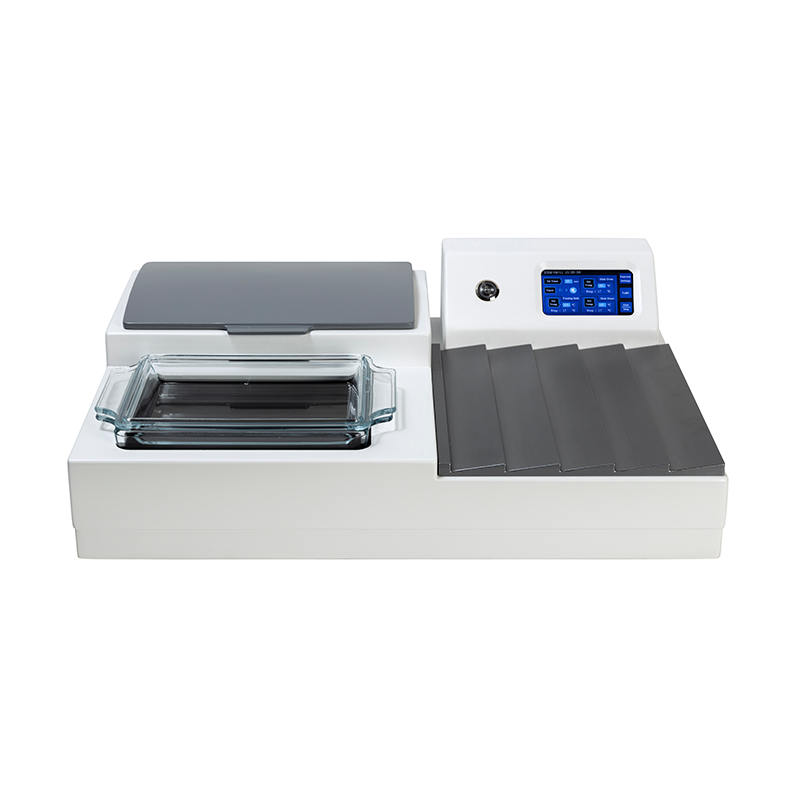
Integrated tissue flotation bath system with heated water surface, slide dryer, and oven for paraffin section mounting and processing workflows in histological laboratories.

Louise Corscadden, PhD
Director of Science · ConductScience
Ask Louise about Tissue Flotation Water Baths fit, setup, configuration, or quote prep.
Already working with us? Sign in to connect this with My Scientist.
Key Specifications
Full details →- Model fit
- Paraffin Sections
- SKU family
- RF-RD-80 / RF-RD-2018
- Shipping box
- 34.0 x 25.0 x 20.0 cm
- Ordering
- Online checkout and quote request available
- Category
- Pathology & Histology
- Build notes
- Confirm accessories, station layout, and support needs before purchase
The Tissue Flotation Water Bath system is an integrated histological processing workstation that consolidates paraffin section mounting into a unified instrument platform. The system combines a 2.0-liter heated flotation bath with integrated slide drying and oven components, providing controlled thermal environments for tissue section preparation and mounting workflows.
The flotation bath maintains precise temperature control across a 0°C to 75°C or 0°C to 99°C range with 1°C precision, enabling optimal paraffin ribbon spreading and section flattening. Digital illumination beneath the glass tray facilitates specimen observation during mounting procedures. The integrated dryer accommodates up to 60 tissue slices simultaneously using a multi-layer bevel design for efficient drainage, while the oven chamber holds 6 slide racks for processing 180 standard slides.
How It Works
The tissue flotation system operates on controlled thermal expansion principles to flatten paraffin-embedded tissue sections. The heated water bath creates a temperature-controlled surface that causes paraffin ribbons to expand uniformly, eliminating wrinkles and folds through differential thermal expansion of the paraffin matrix relative to the embedded tissue.
Digital illumination positioned beneath the glass tray provides transillumination for enhanced specimen visualization during the mounting process. The multi-layer bevel dryer design utilizes gravity-assisted drainage combined with controlled airflow to remove excess moisture from mounted slides. The integrated oven component provides consistent dry heat for final slide preparation and paraffin adhesion optimization.
Temperature regulation across all three modules ensures consistent thermal conditions throughout the mounting workflow, from initial ribbon flotation through final slide drying and curing processes.
Features & Benefits
Equipment Type
- Flotation Baths
Automation Level
- semi-automated
Application
- Histology
Temperature Range
- 0 to 75 C
Tissue Compatibility
- Paraffin Sections
Frequency
- 50Hz ±1Hz
Flotation Bath Tank Dimensions
- 210mm (L) x 170mm (W) x 55mm (H)
Oven Chamber Dimensions
- 240mm (L) x 152mm (W) x 110mm (H)
Dryer Throughput
- 60 tissue slices simultaneously
Oven Capacity
- 6 slide racks for 180 standard slides
Dryer Surface
- Color wear-resistant tabletop
Dryer Design
- Multi-layer bevel design
Product size :
- 327mm*340mm*166mm(L*W*H)
Temp range:
- 0℃~99℃,precise 1℃;
Dimensions of bath bowl:
- 210mm*168mm*55mm(L*W*H)
Function:
- Digital light under glass tray,easy to observe specimen
Voltage and frequency:
- AC220V±10%,50Hz±1Hz;
Power/Voltage
- 600 VA
- AC 220V ±10%
Temperature Range
- 0°C to 75°C or 0°C to 99°C
Capacity
- 2.0 Liters
Dimensions
- 570mm x 430mm x 180mm
Research Domain
- Cancer Research
- Clinical Diagnostics
- Developmental Biology
- Histopathology
- Neuroscience
- Toxicology
Shipping weight
- 6.61 lb
Shipping box
- L: 34.0 cm
- W: 25.0 cm
- H: 20.0 cm
| Feature | This Product | Typical Alternative | Advantage |
|---|---|---|---|
| Integration Level | Three-module integrated system (flotation, dryer, oven) | Standalone units requiring separate equipment | Reduces bench space requirements and eliminates sample transfer between instruments. |
| Flotation Capacity | 2.0-liter bath with 210mm × 170mm work area | Smaller capacity units often offer 1.0-1.5 liters | Enables simultaneous processing of multiple tissue sections for improved laboratory throughput. |
| Temperature Range | 0°C to 75°C or 0°C to 99°C with 1°C precision | Limited temperature ranges in basic models | Accommodates diverse paraffin formulations and specialized processing protocols. |
| Specimen Visualization | Digital light under glass tray | External lighting or no integrated illumination | Provides consistent transillumination for accurate section positioning and quality assessment. |
| Oven Capacity | 180 standard slides in 6 racks | Lower capacity systems with 60-120 slides | Supports high-volume laboratories with comprehensive batch processing capabilities. |
| Dryer Throughput | 60 tissue slices with multi-layer bevel design | Flat surface dryers with limited capacity | Optimizes drainage and drying efficiency for consistent slide preparation quality. |
This integrated system offers comprehensive thermal processing capabilities with enhanced visualization and high-capacity handling. The combination of precise temperature control, digital illumination, and multi-module integration provides advantages for high-throughput histological workflows requiring consistent processing conditions.
| Model | SKU | Listed price | Status | Shipping box |
|---|---|---|---|---|
| Bath & Slide Dryer | RF-RD-2018 | $899.00 | Available | 34.0 x 25.0 x 20.0 cm |
| Tissue Bath | RF-RD-80 | $599.00 | Available | 34.0 x 25.0 x 20.0 cm |
Practical Tips
Verify temperature accuracy monthly using a certified thermometer placed in the flotation bath during operation.
Why: Ensures consistent thermal conditions for reproducible tissue section quality.
Replace flotation bath water daily and clean the tank weekly with mild detergent to prevent contamination buildup.
Why: Maintains specimen quality and prevents artifacts from water impurities or residual debris.
Allow 15-20 minutes for thermal equilibration after temperature changes before processing critical specimens.
Why: Ensures stable thermal conditions throughout the water bath for consistent section flattening.
Position tissue ribbons at the center of the flotation bath where temperature is most uniform.
Why: Minimizes temperature gradients that could cause uneven section expansion or artifacts.
Clean the digital light system monthly to maintain optimal illumination for specimen observation.
Why: Prevents reduced visibility that could affect mounting accuracy and section quality assessment.
If sections wrinkle excessively, reduce flotation temperature by 2-3°C and verify water cleanliness.
Why: High temperatures or contaminated water can cause tissue distortion and mounting difficulties.
Ensure adequate ventilation around the unit during operation to prevent moisture buildup in the laboratory environment.
Why: Maintains safe working conditions and prevents condensation that could affect other laboratory equipment.
Setup Guide
What’s in the Box
- Main flotation bath unit with integrated dryer and oven
- Glass tray with digital illumination system
- 6 slide racks for oven chamber
- Power cord and connection hardware
- User manual and operation guide
- Temperature calibration certificate (typical)
- Drainage accessories for dryer section (typical)
Warranty
ConductScience provides a standard 1-year manufacturer warranty covering defects in materials and workmanship, with technical support for installation, operation, and maintenance procedures.
Compliance
What temperature accuracy is maintained across the flotation bath?
The system provides temperature control with 1°C precision across the specified range of 0°C to 75°C or 0°C to 99°C, suitable for various paraffin formulations and tissue types.
How many slides can be processed simultaneously in the complete workflow?
The dryer accommodates 60 tissue slices while the oven holds 6 slide racks for 180 standard slides, enabling high-throughput processing with staged workflow management.
What type of illumination is provided for specimen observation?
Digital lighting positioned beneath the glass tray provides transillumination for enhanced specimen visualization during mounting and positioning procedures.
What are the power requirements for installation?
The system requires AC 220V ±10% power supply at 50Hz ±1Hz frequency with 600 VA total power consumption across all three thermal modules.
How does the dryer design facilitate efficient slide processing?
The multi-layer bevel design promotes gravity-assisted drainage and optimized airflow patterns for uniform drying of mounted tissue sections.
What maintenance is required for the flotation bath?
Regular water changes with distilled water, periodic cleaning of the tank and glass tray, and temperature calibration verification are recommended for optimal performance.
Have a question about this product?
Have a question? Just ask.
Send it over and we'll email you a personalized answer — no call, no scheduling.
Prefer to talk it through?