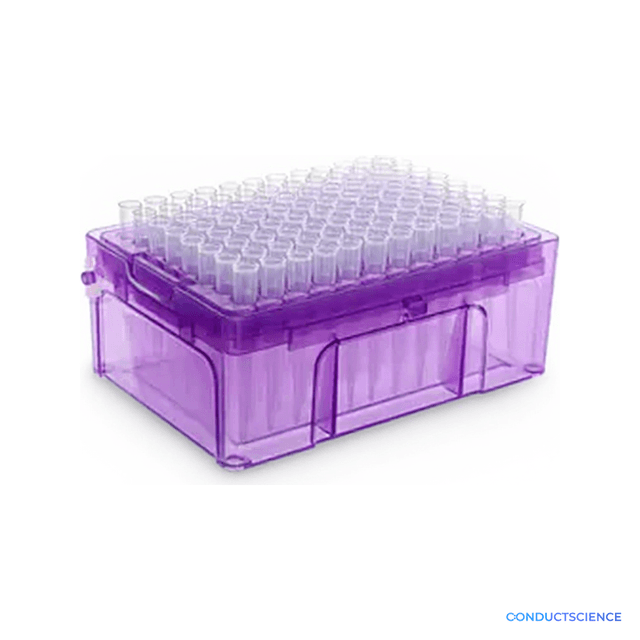
ConductScience Deep Well Plates, 96-Well, 2.2mL, Square Well (Case of 5)
$115.00 per unit | 5 units per pack Bulk pricing: Case of 5 at $575.00 ($115.00 per unit)

Louise Corscadden, PhD
Director of Science · ConductScience
Ask Louise about ConductScience Deep Well Plates, 96-Well, 2.2mL, Square Well (Case of 5) fit, setup, configuration, or quote prep.
Already working with us? Sign in to connect this with My Scientist.
Key Specifications
Full details →- Model fit
- Configured during quote
- SKU family
- CS-DWP-96-25
- Shipping box
- 113.5 x 94.6 x 75.6 cm
- Ordering
- Online checkout and quote request available
- Category
- General Labware
- Build notes
- Confirm accessories, station layout, and support needs before purchase
ConductScience Deep Well Plates provide high-capacity sample storage and processing for laboratory workflows requiring volumes up to 2.2mL per well. These 96-well plates feature square well geometry in polypropylene construction, offering chemical resistance and autoclave compatibility for sterilization protocols. The square well design maximizes working volume while maintaining standard SBS footprint dimensions for compatibility with automated liquid handling systems.
Manufactured from DNase and RNase-free materials, these plates support molecular biology applications where nucleic acid integrity is critical. The deep well format accommodates larger reaction volumes, cell culture applications, and sample storage protocols that exceed the capacity of standard microplates.
How It Works
Deep well plates function as high-capacity sample containers that maintain the standard 96-well array format while providing significantly increased working volume. The square well geometry optimizes space utilization within the SBS-standard footprint, allowing maximum volume capacity while ensuring compatibility with automated liquid handling systems and plate readers.
The polypropylene construction provides chemical resistance across a broad pH range and temperature tolerance suitable for most laboratory applications. Autoclave compatibility enables steam sterilization protocols, while the DNase/RNase-free manufacturing process ensures molecular biology applications maintain sample integrity throughout processing and storage.
Features & Benefits
Research Domain
- Analytical Chemistry
- Cell Biology
- Environmental Monitoring
- Materials Science
- Microbiology
- Pharmaceutical QC
Shipping weight
- 559.16 lb
Shipping box
- L: 113.5 cm
- W: 94.6 cm
- H: 75.6 cm
| Feature | This Product | Typical Alternative | Advantage |
|---|---|---|---|
| Well Volume | 2.2mL capacity per well | Entry-level models often offer 1.0-1.5mL capacity | Higher volume capacity supports larger sample sizes and extended culture applications without splitting across multiple plates |
| Well Geometry | Square well design | Many alternatives use round well geometry | Square geometry maximizes working volume within standard footprint and improves mixing uniformity |
| Material Purity | DNase/RNase-free manufacturing | Standard plates may not specify nuclease-free production | Ensures molecular biology application compatibility without additional cleaning or treatment steps |
| Sterilization Compatibility | Autoclavable polypropylene construction | Some alternatives require gamma irradiation or are single-use only | Enables in-house sterilization protocols and reduces per-use costs for sterile applications |
These deep well plates combine high-volume capacity with molecular biology compatibility in standard automation-friendly format. The square well design and autoclavable construction support diverse laboratory workflows requiring larger sample volumes than standard microplates.
Practical Tips
Pre-wet pipette tips when working with viscous samples to ensure accurate volume delivery across all wells.
Why: Viscous solutions can cause inconsistent dispensing that affects downstream analysis reproducibility.
Clean plates immediately after use with appropriate detergents before residues can dry and become difficult to remove.
Why: Dried samples can create permanent staining and affect subsequent use for sensitive applications.
Always use proper sealing when working with volatile or hazardous compounds to prevent vapor escape.
Why: Deep wells hold larger volumes that can generate significant vapor concentrations in laboratory environments.
Maintain consistent fill volumes across wells when using automated detection systems to ensure uniform optical path lengths.
Why: Volume variations affect spectrophotometric readings and can introduce systematic errors in plate-based assays.
Allow plates to equilibrate to room temperature before use if stored in cold conditions to prevent condensation.
Why: Condensation can interfere with liquid handling accuracy and contaminate samples during processing.
If experiencing liquid handling errors, verify plate orientation and check for warped or damaged wells that affect seal integrity.
Why: Damaged wells can cause aspiration problems and cross-contamination between samples.
Setup Guide
What’s in the Box
- Deep well plates (quantity per package - consult product datasheet)
- Product certificate of analysis (typical)
- Storage and handling instructions (typical)
Warranty
ConductScience provides standard warranty coverage against manufacturing defects. Technical support available for application guidance and compatibility questions.
Compliance
What is the maximum temperature these plates can withstand during autoclaving?
Polypropylene construction supports standard autoclave temperatures. Consult product datasheet for specific temperature and pressure limits to ensure material integrity.
Are these plates compatible with organic solvents commonly used in extraction protocols?
Polypropylene provides broad chemical compatibility including resistance to many organic solvents. Test compatibility with specific solvents in your application or consult chemical resistance data.
Can these plates be used with automated liquid handling systems?
Yes, the SBS-standard footprint ensures compatibility with most automated liquid handlers. Verify specific dimensional requirements with your system manufacturer.
What sealing options are recommended for long-term sample storage?
Heat-sealable films or individual caps are recommended depending on storage conditions and access requirements. Consider evaporation rates for volatile samples.
How do these compare to round-well deep plates for mixing applications?
Square wells provide more uniform mixing patterns and reduced dead volume compared to round wells, improving sample recovery and processing consistency.
Are these plates suitable for PCR applications?
The DNase/RNase-free manufacturing supports PCR sample preparation, though thermal cycling compatibility depends on your specific PCR system requirements.
What is the recommended centrifugation speed limit for these plates?
Centrifugation limits depend on plate design and rotor compatibility. Consult product specifications and centrifuge manufacturer guidelines for safe operating parameters.
Have a question about this product?
Have a question? Just ask.
Send it over and we'll email you a personalized answer — no call, no scheduling.
Prefer to talk it through?
Upgrade Options
Related Products