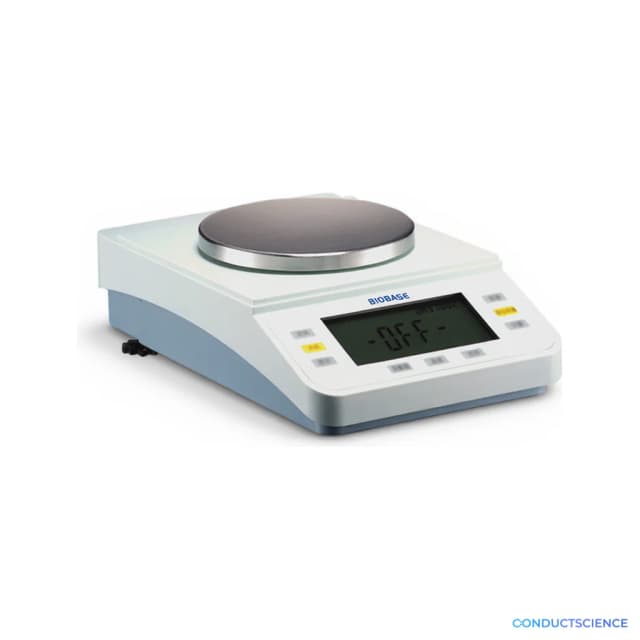
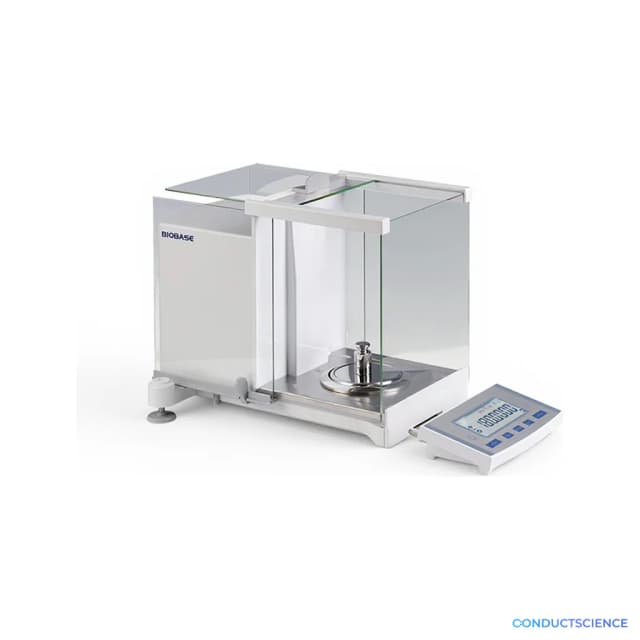
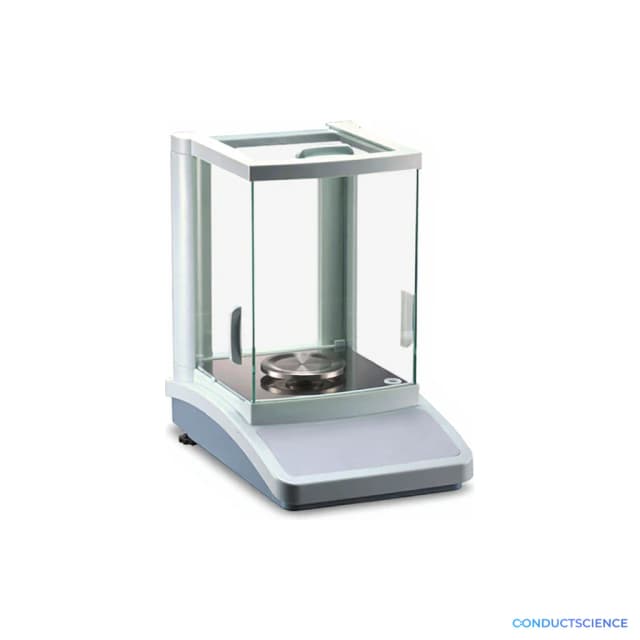
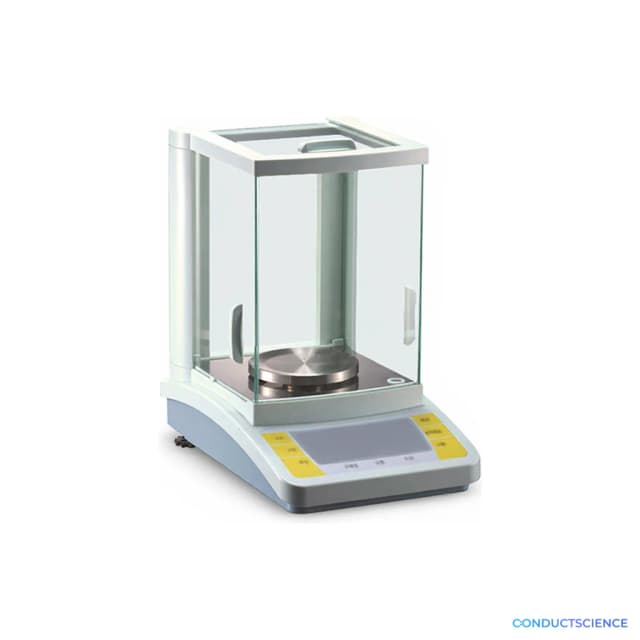
Electronic Density(Specific Gravity) Balance
Precision analytical balance for density and specific gravity determination with 100g capacity and complete accessory kit for hydrostatic weighing measurements.
| Automation Level | semi-automated |
| Max Capacity | 100g |
| Repeatability | 10mg |
| Linear Error | 20mg |
| Min Capacity | 10mg |
| Fixed Support | H=203mm |

The Electronic Density (Specific Gravity) Balance BIO-0344 is a precision analytical instrument designed for accurate density and specific gravity measurements of solid and liquid samples. This specialized balance combines traditional weighing capabilities with density determination protocols, enabling researchers to characterize material properties through hydrostatic weighing principles.
The instrument features a 100g maximum capacity with 10mg repeatability and includes a complete accessory kit for density measurements including measuring platform, measuring cup, fixed support apparatus, thermometer, and specialized weights. With RS-232C output capability and standard AC power operation, the balance integrates readily into laboratory workflows requiring precise density characterization of research materials.
How It Works
The Electronic Density Balance operates on hydrostatic weighing principles, utilizing Archimedes' principle that states an object immersed in fluid experiences a buoyant force equal to the weight of displaced fluid. The instrument measures sample weight in air and then in a reference liquid (typically distilled water) to calculate density through the relationship: density = (weight in air / (weight in air - weight in liquid)) × density of reference liquid.
The balance incorporates a specialized weighing chamber with a fixed support apparatus positioned 203mm above the weighing platform. Samples are suspended using platinum wire and double-hook weights, allowing precise measurement of samples both above and below the liquid surface. Temperature measurement via the included thermometer enables correction for liquid density variations, ensuring accurate results across different environmental conditions.
Digital electronics process the weighing data and calculate density values automatically, with results transmitted through RS-232C interface for data logging and analysis. The 10mg repeatability specification ensures consistent measurements suitable for research applications requiring precise density characterization.
Features & Benefits
Automation Level
- semi-automated
Max Capacity
- 100g
Repeatability
- 10mg
Linear Error
- 20mg
Min Capacity
- 10mg
Fixed Support
- H=203mm
Scale Size
- φ110mm
Output
- RS-232C
Package Size
- 377*281*278mm
Accessories
- Measuring platform, measuring cup, fixed support, thermometer, doublehook weights, platinum wire, pl
Brand
- ConductScience
Research Domain
- Analytical Chemistry
- Environmental Monitoring
- Food Science
- Materials Science
- Microbiology
- Pharmaceutical QC
Power/Voltage
- AC110/220V±10%, 50/60Hz; Power cord, no battery
Weight
- 3.5kg
Weight
- 3.5 kg
Dimensions
- L: 27.8 mm
- W: 37.7 mm
- H: 28.1 mm
Comparison Guide
| Feature | This Product | Typical Alternative | Advantage |
|---|---|---|---|
| Measurement Capacity Range | 10mg to 100g weighing range | Entry-level models often limited to 50g maximum capacity | Broader capacity range accommodates diverse sample sizes from small research quantities to larger material specimens. |
| Repeatability Specification | 10mg repeatability | Basic density balances may offer 50mg or higher repeatability | Higher precision enables more reliable density measurements for research applications requiring statistical analysis. |
| Complete Accessory Kit | Includes measuring platform, cup, support, thermometer, weights, and platinum wire | Many models require separate accessory purchases | Complete kit eliminates additional procurement needs and ensures measurement protocol standardization. |
| Data Communication | RS-232C digital output interface | Basic models often provide display-only readouts | Digital communication enables automated data collection and integration with laboratory information systems. |
| Power Supply Flexibility | Dual voltage AC 110/220V ±10% compatibility | Single voltage operation requiring power conversion | International laboratory compatibility without additional power conversion equipment. |
| Temperature Measurement Integration | Included thermometer for reference liquid temperature correction | Separate temperature measurement often required | Integrated temperature monitoring improves measurement accuracy and protocol efficiency. |
The BIO-0344 combines precision weighing with comprehensive density measurement capabilities through hydrostatic principles. The complete accessory package and digital output interface provide researchers with a standardized measurement platform suitable for diverse materials characterization applications.
Practical Tips
Verify calibration using certified density reference materials rather than just mass standards to ensure the complete measurement system accuracy.
Why: Mass calibration alone does not validate the hydrostatic measurement components and calculation algorithms.
Clean platinum wire suspension system with dilute acid solution periodically to remove any surface contamination that could affect buoyancy measurements.
Why: Surface films on the suspension wire can introduce systematic errors in density calculations.
Allow samples and reference liquid to equilibrate to the same temperature before measurement to minimize thermal effects.
Why: Temperature gradients can create convection currents and density variations that affect measurement precision.
Perform multiple measurements and statistical analysis rather than relying on single readings for research data.
Why: The 10mg repeatability specification requires statistical treatment to achieve the precision needed for research conclusions.
Check for air bubbles on the sample surface when measuring in liquid, as they can significantly affect buoyancy calculations.
Why: Even small air bubbles alter the effective sample volume and introduce errors in density determination.
Ensure proper electrical grounding and use appropriate personal protective equipment when working with unknown samples.
Why: Electrical safety and sample handling protocols protect both operator and equipment during routine measurements.
Document environmental conditions including temperature, humidity, and barometric pressure for quality assurance records.
Why: Environmental factors can influence measurement accuracy and documentation supports data integrity requirements.
Verify the accuracy of the reference liquid density using certified density standards before critical measurements.
Why: Reference liquid density is fundamental to all calculations, and water density varies with temperature and purity.
Setup Guide
What’s in the Box
- Electronic density balance main unit
- Measuring platform
- Measuring cup
- Fixed support apparatus (H=203mm)
- Thermometer
- Double-hook weights
- Platinum wire suspension system
- Power cord
- User manual (typical)
- Calibration certificate (typical)
Warranty
ConductScience provides a standard one-year manufacturer warranty covering defects in materials and workmanship, with technical support available for calibration guidance and troubleshooting assistance.
Compliance
What is the minimum sample size required for accurate density measurements?
The balance has a 10mg minimum capacity, but for reliable density measurements, samples should be at least 100mg to minimize relative error from the 10mg repeatability specification during the dual weighing process.
Can this balance measure density of both solids and liquids?
Yes, the included accessory kit supports both solid sample density measurement via hydrostatic weighing and liquid specific gravity determination using the measuring cup and appropriate protocols.
How does temperature affect measurement accuracy?
Temperature variations affect the reference liquid density, which is why the system includes a thermometer for temperature correction calculations to maintain accuracy across different laboratory conditions.
What data output formats are available from the RS-232C interface?
Consult product datasheet for specific data formats and communication protocols supported by the RS-232C output interface for integration with laboratory data systems.
How frequently does the balance require calibration?
Calibration frequency depends on usage and accuracy requirements, but monthly calibration verification with certified reference weights is recommended for research applications requiring documented accuracy.
Can volatile samples be measured accurately with this system?
Volatile samples may present challenges due to evaporation during measurement; consider using sealed measurement cells or alternative techniques for highly volatile materials.
What reference liquids can be used besides water?
While distilled water is standard, other reference liquids of known density can be used provided they are chemically compatible with the sample and platinum wire suspension system.
How does this compare to displacement methods for density measurement?
Hydrostatic weighing typically offers better precision than volumetric displacement methods and requires smaller sample sizes, making it more suitable for research applications with limited sample availability.
Have a question about this product?