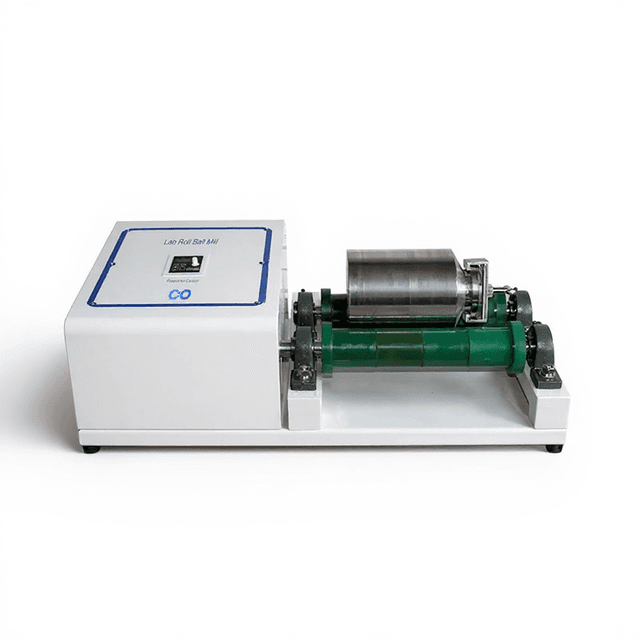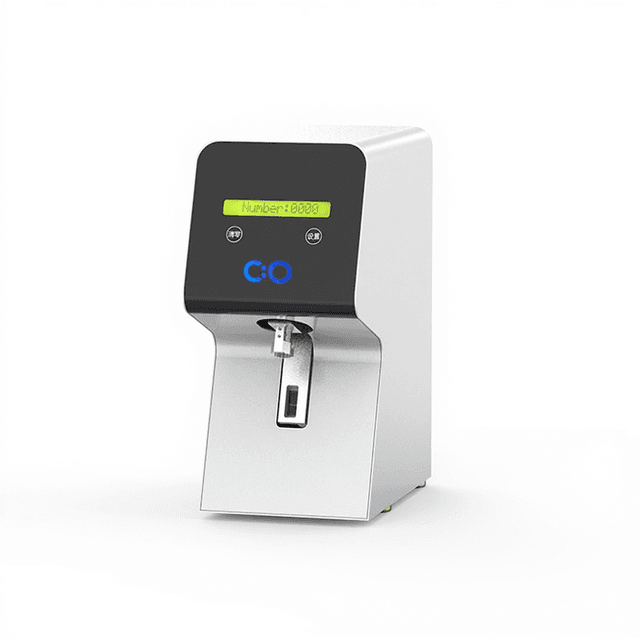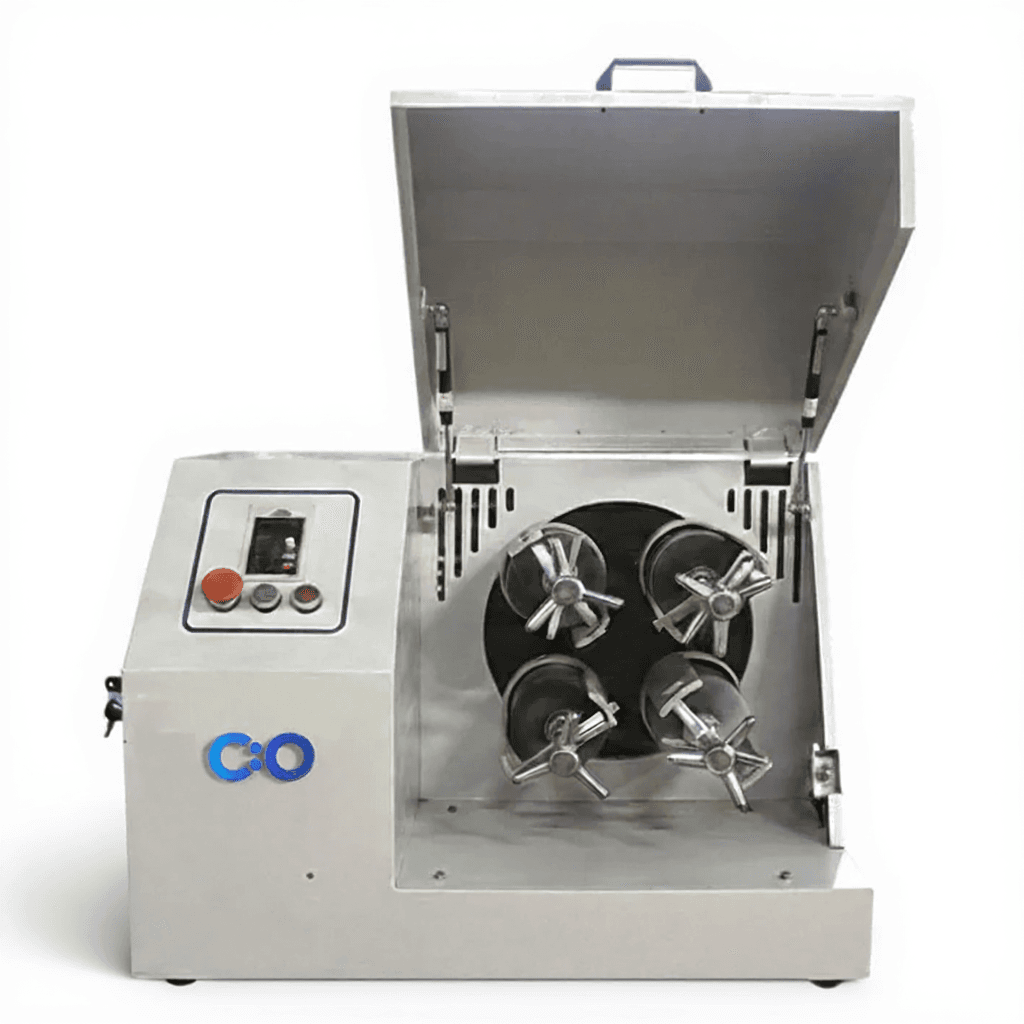
Light Horizontal Planetary Ball Mill
Precision horizontal planetary ball mill with 2L capacity for size reduction and mechanochemical processing, featuring stepless speed control and accommodating up to four grinding pots (50-500ml) for particle sizes down to 0.1 micrometers.
| structure | Horizontal grinding pots |
| gear_type | Special gear with low noise |
| Automation Level | semi-automated |
The Light Horizontal Planetary Ball Mill (BIO-BKBM-H2L) is a precision mechanical grinding instrument designed for size reduction, homogenization, and mechanochemical processing of solid materials in research laboratories. This 2L capacity system employs a horizontal grinding pot configuration with simultaneous revolution and rotation movements to achieve controlled, high-energy ball milling. The gear-driven transmission system with special low-noise gearing provides stepless speed control with revolution speeds of 35-335 rpm and rotation speeds of 70-670 rpm.
The mill accommodates up to four grinding pots (50-500ml each) with flexible operation allowing 2 or 4 pots per run. With its ability to process materials from 10mm feed size down to particles of 0.1 micrometers, this instrument serves laboratories requiring consistent mechanical processing for sample preparation, particle size analysis, and mechanochemical synthesis applications across materials science, analytical chemistry, and pharmaceutical research.
How It Works
The planetary ball mill operates through a dual-motion grinding mechanism where grinding pots rotate around their own axes while simultaneously revolving around the main drive axis. This planetary motion creates alternating centrifugal forces that cause grinding balls to impact sample material from multiple directions. The horizontal pot configuration ensures consistent sample-ball interaction while the special gear transmission system maintains precise speed ratios between revolution and rotation movements.
During operation, the centrifugal forces generated by the planetary motion cause grinding balls to press against the pot wall with forces up to several times gravitational acceleration. The alternating direction of these forces creates intense friction and impact energy that breaks down particle structures through mechanical stress. The stepless speed control allows optimization of grinding conditions for different material hardnesses and target particle sizes.
The gear-driven transmission with low-noise design ensures reliable power transfer while minimizing operational disturbance. The ability to operate 2 or 4 pots simultaneously provides flexibility for processing multiple samples or increasing throughput while maintaining consistent grinding conditions across all pots.
Features & Benefits
structure
- Horizontal grinding pots
gear_type
- Special gear with low noise
Automation Level
- semi-automated
Research Domain
- Analytical Chemistry
- Environmental Monitoring
- Food Science
- Industrial Hygiene
- Materials Science
- Pharmaceutical QC
Weight
- 176.37 lbs
Dimensions
- L: 42.0 in
- W: 43.6 in
- H: 38.0 in
Comparison Guide
| Feature | This Product | Typical Alternative | Advantage |
|---|---|---|---|
| Grinding Pot Configuration | Horizontal orientation with up to 4 pots (50-500ml each) | Vertical configurations or fewer pot options in entry-level models | Horizontal design prevents material segregation and enables more uniform grinding results |
| Speed Control Range | Stepless control: 35-335 rpm revolution, 70-670 rpm rotation | Fixed speed ratios or limited speed steps in basic models | Precise speed optimization allows fine-tuning of grinding energy for different materials |
| Total Processing Capacity | 2L total capacity across multiple pots | Single pot systems or lower total capacity options | Higher throughput capability while maintaining sample flexibility for research applications |
| Noise Reduction | Special gear transmission with low-noise design | Standard drive systems without noise optimization | Enables extended operation in shared laboratory environments without excessive noise |
| Particle Size Achievement | Down to 0.1 micrometers from 10mm feed | Limited fine grinding capability in basic mills | Achieves submicron sizes necessary for advanced analytical and materials applications |
This horizontal planetary ball mill combines flexible pot configuration with precise speed control and low-noise operation. The 2L total capacity and submicron particle size capability position it for demanding research applications requiring both throughput and precision.
Practical Tips
Verify speed settings using a tachometer before critical experiments and document actual vs. set speeds.
Why: Speed calibration affects grinding energy and reproducibility of particle size results.
Inspect grinding balls regularly for wear and replace when diameter decreases by more than 10%.
Why: Worn balls reduce grinding efficiency and can introduce contamination from ball material.
Pre-condition new grinding balls by running empty cycles to remove surface debris and achieve consistent surface texture.
Why: Fresh balls may have manufacturing residues or surface irregularities that affect initial grinding performance.
Balance pot loading when using fewer than 4 pots by positioning them symmetrically around the drive axis.
Why: Unbalanced loading creates vibration and uneven wear on drive components.
If excessive noise develops, stop operation and check for loose pots, worn bearings, or damaged grinding media.
Why: Unusual noise often indicates mechanical issues that can worsen and damage the mill if not addressed.
Document grinding parameters including ball type, ball-to-sample ratio, speeds, and time for each sample type.
Why: Systematic documentation enables reproducible results and optimization of grinding protocols.
Always ensure pots are securely locked before starting operation and never open the mill while running.
Why: Loose pots can cause severe damage and injury due to high centrifugal forces during operation.
Setup Guide
What’s in the Box
- Light Horizontal Planetary Ball Mill main unit
- Grinding pot set (typical)
- Grinding ball media (typical)
- Power cord and connection hardware
- User manual and operation guide
- Safety documentation (typical)
- Calibration certificate (typical)
Warranty
ConductScience provides a standard one-year manufacturer warranty covering defects in materials and workmanship, with technical support for operation and maintenance guidance.
Compliance
References
Background reading relevant to this product:
What ball-to-sample ratios are recommended for different materials?
Typical ratios range from 10:1 to 20:1 by weight, with harder materials requiring higher ratios. Start with 10:1 for soft materials and 15-20:1 for ceramics and metals. Optimize based on grinding efficiency and contamination concerns.
How do I prevent cross-contamination between samples?
Use dedicated grinding pots and balls for each sample type, or implement thorough cleaning protocols with appropriate solvents. Consider using grinding pot linings for highly sensitive applications.
What factors determine optimal grinding speed settings?
Material hardness, desired final particle size, and heat sensitivity govern speed selection. Start with lower speeds (35-150 rpm revolution) for initial trials and increase gradually while monitoring temperature and grinding efficiency.
How do I achieve reproducible particle size distributions?
Maintain consistent ball-to-sample ratios, grinding times, and speed settings. Document all parameters and pre-condition grinding balls before use. Monitor wear on grinding media and replace when necessary.
What maintenance is required for reliable operation?
Regular cleaning of grinding pots and balls, periodic inspection of gear mechanisms, and verification of speed calibration. Replace worn grinding media and lubricate drive components according to the maintenance schedule.
Can the mill process temperature-sensitive materials?
Yes, but requires careful speed optimization and potentially intermittent grinding cycles to minimize heat generation. Monitor sample temperature and consider cryogenic grinding for highly heat-sensitive materials.
How does this compare to other grinding methods?
Planetary ball milling provides higher energy density than conventional ball mills and better particle size control than jaw crushers. Offers superior homogenization compared to mortar and pestle methods while maintaining reproducibility.
Have a question about this product?
Accessories
Enhance your setup with compatible accessories
Frequently Bought Together