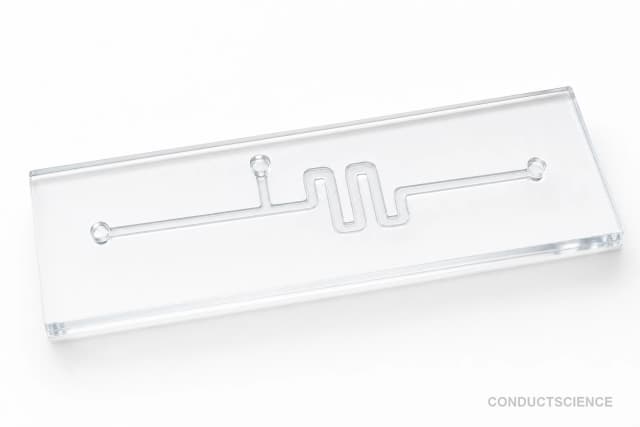
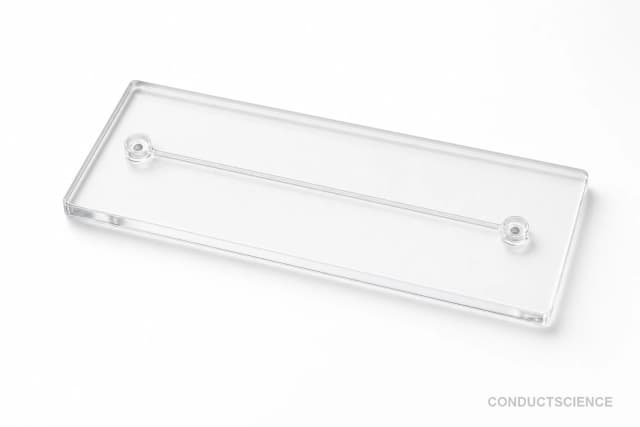
PDMS 3-Layer Porous Membrane Chip
Three-layer PDMS microfluidic chip with integrated porous membrane for tissue barrier modeling, co-culture studies, and transport assays.
Reusable chip — designed for multiple experimental runs. Compatible with standard microfluidic tubing: steel pins (0.7 mm ID / 1.0 mm OD) and silicone tubing (0.8 mm ID / 1.9 mm OD). Available in bulk packs (5‑, 10‑, and 25‑unit) for lab-scale and consumable workflows.

Louise Corscadden, PhD
Director of Science · ConductScience
Ask Louise about PDMS 3-Layer Porous Membrane Chip fit, setup, configuration, or quote prep.
Already working with us? Sign in to connect this with My Scientist.
Key Specifications
Full details →- Model fit
- 3 selectable configurations
- SKU family
- WHM-0128
- Shipping box
- 181.8 x 136.3 x 90.9 cm
- Ordering
- Online checkout and quote request available
- Category
- Microfluidic Chips
- Build notes
- Confirm accessories, station layout, and support needs before purchase
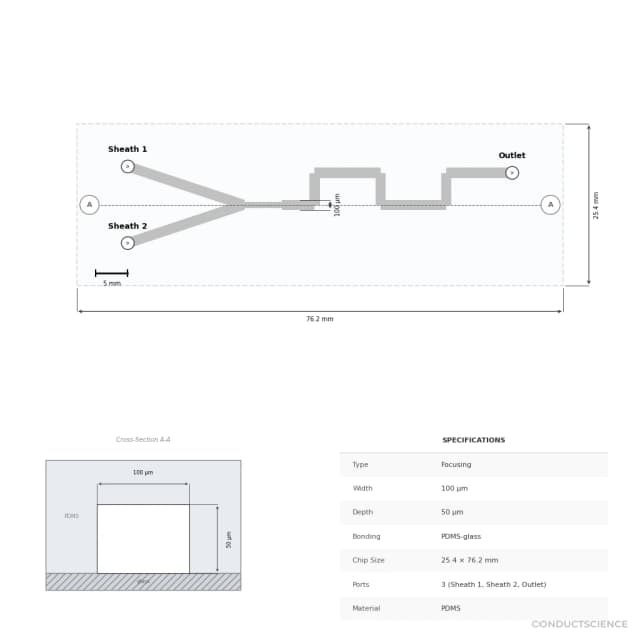
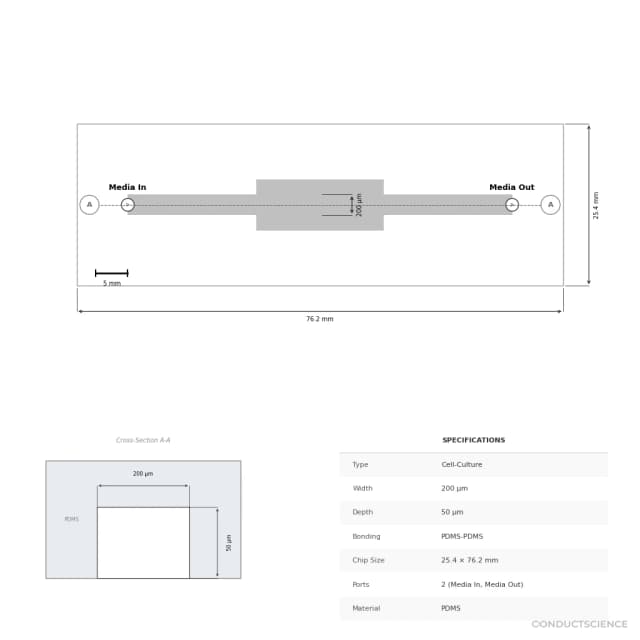
The PDMS 3-Layer Porous Membrane Chip is a microfluidic platform designed for modeling tissue barriers and conducting transport studies across biological membranes. This device features three distinct layers: a top channel, a central porous membrane, and a bottom channel, enabling researchers to create physiologically relevant barrier models and co-culture systems.
The polydimethylsiloxane (PDMS) construction with an integrated porous membrane provides a versatile platform for studying cellular transport phenomena, barrier function, and drug permeability. The design allows for precise control of fluid flow while maintaining cellular separation across the membrane interface, making it suitable for organ-on-chip applications and barrier permeability studies in controlled microenvironments.
How It Works
The chip operates on the principle of compartmentalized fluid flow across a porous membrane interface. The three-layer architecture creates distinct microenvironments: cells or test solutions are introduced into the top channel, while the bottom channel allows for independent perfusion and sample collection. The central porous membrane serves as the interface for molecular transport, cellular migration, or barrier function studies.
Fluid dynamics within each channel can be controlled independently, allowing researchers to establish physiological shear stresses and concentration gradients. The PDMS material provides optical transparency for real-time microscopy while maintaining biocompatibility for cell culture applications. Transport across the membrane occurs through diffusion, active transport by cultured cells, or pressure-driven flow, depending on the experimental design.
The porous membrane architecture enables size-selective transport studies, cellular co-culture with paracrine signaling, and barrier permeability measurements. Researchers can monitor transport kinetics, barrier integrity, and cellular responses using standard analytical techniques including fluorescence microscopy, spectrophotometry, and chromatographic analysis of collected samples.
Features & Benefits
Shipping weight
- 3.3 lb
Shipping box
- L: 181.8 cm
- W: 136.3 cm
- H: 90.9 cm
| Feature | This Product | Typical Alternative | Advantage |
|---|---|---|---|
| Channel Architecture | Three-layer design with integrated porous membrane | Two-chamber systems or separate membrane inserts requiring assembly | Provides integrated barrier function with independent perfusion control in each compartment. |
| Material Construction | PDMS with integrated porous membrane | Separate plastic chambers with removable membrane inserts | Eliminates assembly steps and ensures consistent membrane positioning for reproducible results. |
| Flow Control | Independent perfusion in top and bottom channels | Static culture conditions or single-sided perfusion | Enables establishment of physiological gradients and controlled transport conditions. |
| Optical Access | Transparent PDMS construction throughout device | Limited optical access through specific viewing windows | Allows comprehensive microscopic observation of cellular behavior across the entire culture area. |
| Application Versatility | Tissue barriers, co-culture, and transport studies | Single application focus or limited experimental flexibility | Supports diverse experimental designs from barrier function to cell migration studies in one platform. |
This chip integrates barrier modeling capabilities with microfluidic control in a single device. The three-layer architecture and PDMS construction provide experimental flexibility and optical access not commonly available in traditional barrier study platforms.
| Model | SKU | Listed price | Status | Shipping box |
|---|---|---|---|---|
| 25-Pack | WHM-0128-25PK | Quote | Available | 181.8 x 136.3 x 90.9 cm |
| 10-Pack | WHM-0128-10PK | $1,490.00 | Available | 181.8 x 136.3 x 90.9 cm |
| 5-Pack | WHM-0128-5PK | Quote | Available | 181.8 x 136.3 x 90.9 cm |
Practical Tips
Prime all channels slowly to avoid membrane damage and ensure complete bubble removal before cell seeding.
Why: Air bubbles can disrupt cellular attachment and create flow artifacts that compromise experimental results.
Verify membrane integrity using fluorescent dextrans of known molecular weights before each experiment.
Why: Membrane defects can lead to non-physiological transport rates and compromise barrier function studies.
Clean channels immediately after use with appropriate detergents followed by extensive rinsing to prevent protein buildup.
Why: Residual biological material can alter surface properties and affect subsequent experimental reproducibility.
Monitor barrier integrity throughout experiments using transepithelial electrical resistance or permeability markers.
Why: Barrier function can change over time, and continuous monitoring ensures data represents intended experimental conditions.
If cells fail to attach, treat PDMS surfaces with plasma oxidation or protein coating to improve cell adhesion.
Why: Native PDMS surfaces can be hydrophobic and may not support optimal cellular attachment without surface modification.
Handle chips with sterile technique and avoid excessive pressure that could damage the porous membrane structure.
Why: Membrane damage compromises the barrier properties essential for accurate transport and permeability measurements.
Use physiological pH and osmolarity in all perfusion media to maintain cellular health and barrier function.
Why: Non-physiological conditions can compromise cellular tight junctions and alter transport characteristics.
Include appropriate controls with known transport properties to validate experimental conditions and membrane performance.
Why: Controls help distinguish between experimental variables and potential technical issues affecting transport measurements.
Setup Guide
What’s in the Box
- PDMS 3-Layer Porous Membrane Chip
- Product documentation and specifications (typical)
- Sterile packaging (typical)
Warranty
ConductScience provides a standard one-year manufacturer warranty covering material defects and fabrication issues. Technical support is available for setup guidance and troubleshooting applications.
Compliance
References
Background reading relevant to this product:
What membrane pore sizes are available for different transport studies?
Consult the product datasheet for specific membrane pore size options, as this parameter is critical for determining molecular cutoff and cellular migration capabilities.
Can the chip support co-culture of multiple cell types simultaneously?
Yes, the three-layer design allows different cell types to be cultured in the top and bottom channels while maintaining separation through the porous membrane for paracrine signaling studies.
What flow rates are recommended for physiological barrier studies?
Flow rates depend on the specific tissue model being created; typical ranges are 1-100 μL/min to achieve physiological shear stresses without disrupting cellular monolayers.
How should the chip be sterilized before cell culture use?
UV sterilization for 30-60 minutes or ethylene oxide treatment are recommended, followed by sterile medium priming to ensure biocompatibility.
Is the chip compatible with standard microscopy systems?
Yes, the PDMS construction provides optical transparency suitable for brightfield, fluorescence, and confocal microscopy applications with standard objectives.
What is the expected lifetime for repeated experimental use?
PDMS chips can typically be used for multiple experiments if properly cleaned and sterilized, though membrane integrity should be verified before each use.
Can the chip be used for drug permeability screening applications?
Yes, the barrier design is well-suited for ADME studies where drug transport across cellular barriers needs to be quantified under controlled conditions.
What sample volumes are required for transport measurements?
Sample volumes depend on channel dimensions and experimental duration; consult product specifications for dead volumes and recommended working volumes.
Have a question about this product?
Have a question? Just ask.
Send it over and we'll email you a personalized answer — no call, no scheduling.
Prefer to talk it through?