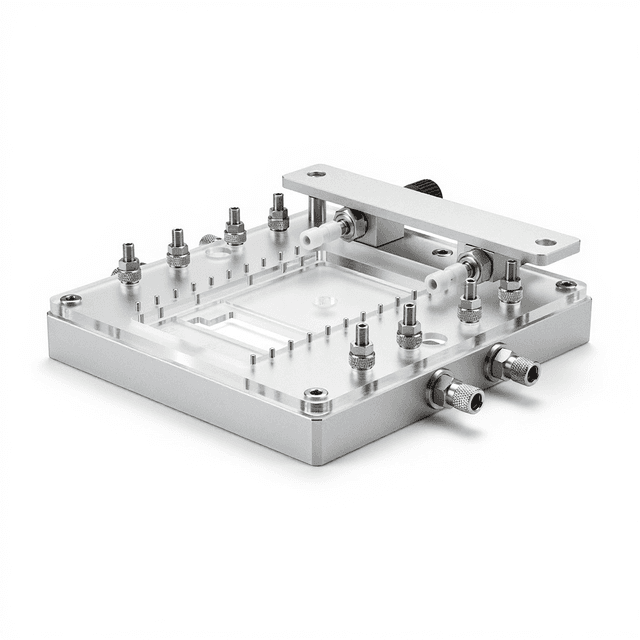
Concentration Gradient Generator Microfluidic Chip
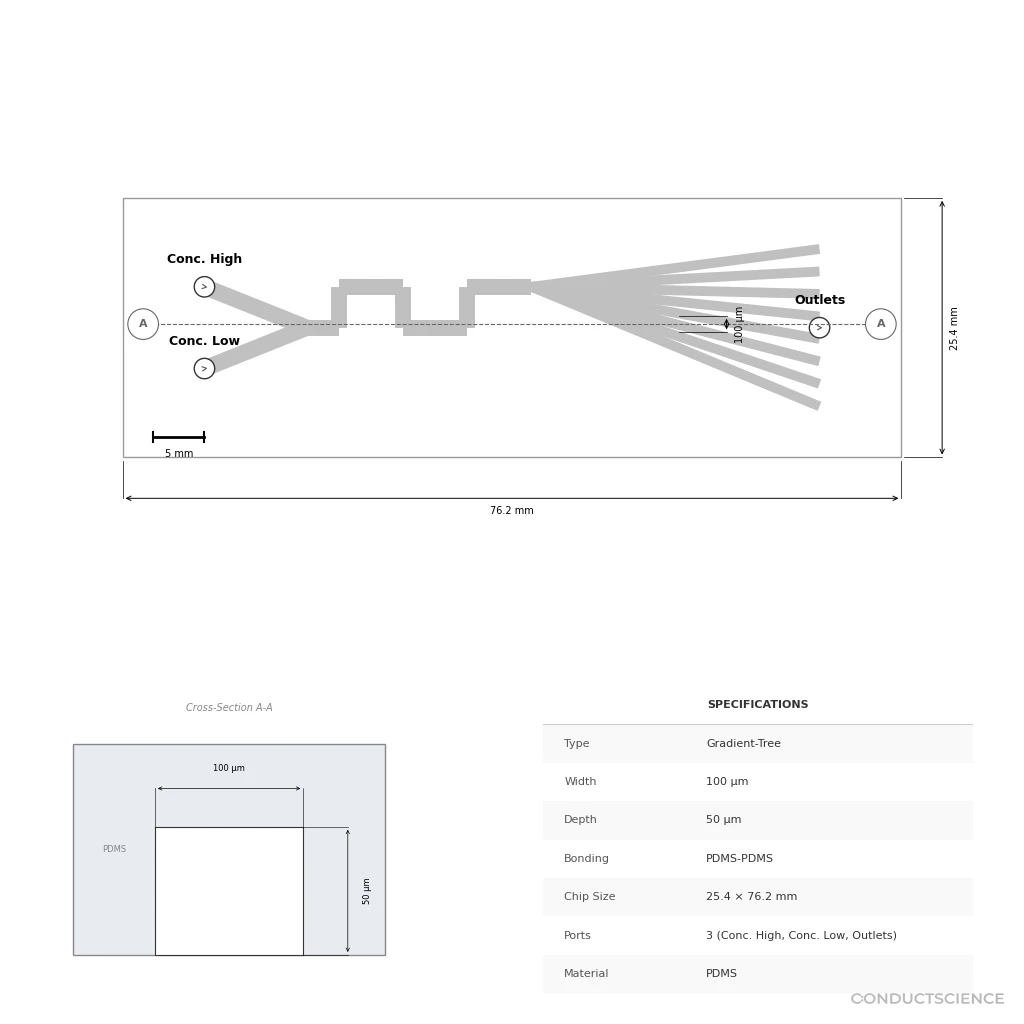
Microfluidic chip with Christmas-tree gradient network for generating stable concentration gradients in drug screening and chemotaxis studies.
Reusable chip — designed for multiple experimental runs. Compatible with standard microfluidic tubing: steel pins (0.7 mm ID / 1.0 mm OD) and silicone tubing (0.8 mm ID / 1.9 mm OD). Available in bulk packs (5‑, 10‑, and 25‑unit) for lab-scale and consumable workflows.

Louise Corscadden, PhD
Director of Science · ConductScience
Ask Louise about Concentration Gradient Generator Microfluidic Chip fit, setup, configuration, or quote prep.
Already working with us? Sign in to connect this with My Scientist.
Key Specifications
Full details →- Model fit
- 3 selectable configurations
- SKU family
- WHM-0018
- Shipping box
- 25.0 x 15.0 x 3.0 cm
- Ordering
- Online checkout and quote request available
- Category
- Lab Equipment
- Build notes
- Confirm accessories, station layout, and support needs before purchase
The Concentration Gradient Generator Microfluidic Chip (WHM-0018) is a precision microfluidic device designed for creating stable concentration gradients in aqueous solutions. The chip features a Christmas-tree gradient network architecture that enables systematic dilution of test compounds across multiple output channels. This design allows researchers to expose cells or test systems to a range of concentrations simultaneously, facilitating dose-response studies and chemotaxis experiments.
The chip measures 25 mm × 15 mm × 3 mm, providing a compact platform for gradient generation in standard laboratory settings. The microfluidic channels are fabricated to ensure laminar flow conditions, enabling predictable mixing and gradient formation. The device is particularly valuable for applications requiring precise concentration control, including drug screening assays, cell migration studies, and chemical gradient characterization experiments.
How It Works
The Christmas-tree gradient network operates on the principle of sequential binary mixing through a series of branched microchannels. Two input solutions—one containing the test compound and one serving as diluent—enter the chip at controlled flow rates. The network design features multiple branching points where streams split and recombine, creating a series of mixing nodes that produce increasingly diluted concentrations.
At each mixing node, the two incoming streams undergo laminar mixing due to the low Reynolds number flow conditions typical in microfluidic systems. The Christmas-tree architecture ensures that each output channel receives a different but predictable concentration, with the gradient typically ranging from the original stock concentration down to pure diluent. The channel dimensions and geometry are optimized to achieve complete mixing while maintaining stable flow conditions.
The resulting concentration profile across the output channels follows a logarithmic or linear distribution depending on the mixing ratio at each node. This allows researchers to expose their test system to multiple concentrations simultaneously, significantly reducing experimental time compared to traditional serial dilution methods while improving reproducibility through parallel processing.
Features & Benefits
Shipping weight
- 0.03 lb
Shipping box
- L: 25.0 cm
- W: 15.0 cm
- H: 3.0 cm
| Feature | This Product | Typical Alternative | Advantage |
|---|---|---|---|
| Gradient Network Architecture | Christmas-tree gradient network design | Simple linear mixing channels or T-junction designs | Provides more systematic and predictable concentration distribution through cascaded binary mixing |
| Device Dimensions | 25 mm × 15 mm footprint with 3 mm thickness | Varies by model, often larger form factors | Compact size reduces reagent consumption while maintaining compatibility with standard microscope stages |
| Weight Profile | 0.03 kg lightweight construction | Heavier devices with integrated pumping systems | Easy handling and positioning without requiring additional support structures |
| Application Focus | Optimized for concentration gradients, chemotaxis, and drug screening | General-purpose mixing devices with broader but less specialized capabilities | Purpose-built design ensures optimal performance for gradient-dependent biological assays |
The WHM-0018 offers a specialized Christmas-tree gradient network in a compact, lightweight format specifically designed for concentration gradient applications. The device combines systematic mixing architecture with practical form factor considerations for standard laboratory workflows.
| Model | SKU | Listed price | Status | Shipping box |
|---|---|---|---|---|
| 25-Pack | WHM-0018-25PK | Quote | Available | 25.0 x 15.0 x 3.0 cm |
| 10-Pack | WHM-0018-10PK | $1,490.00 | Available | 25.0 x 15.0 x 3.0 cm |
| 5-Pack | WHM-0018-5PK | Quote | Available | 25.0 x 15.0 x 3.0 cm |
Practical Tips
Use fluorescent tracers to visualize gradient formation before introducing biological samples to verify proper concentration distribution.
Why: Confirms the gradient profile matches experimental requirements and identifies any mixing irregularities early in the protocol.
Establish flow rate ratios using precision pumps or pressure regulators to ensure consistent gradient reproduction between experiments.
Why: Maintains reproducible concentration profiles that are essential for quantitative dose-response analysis.
Flush thoroughly with deionized water between different compounds to prevent cross-contamination and preserve gradient accuracy.
Why: Eliminates carryover effects that could interfere with subsequent experiments and compromise data quality.
If gradient formation appears uneven, check for air bubbles in inlet lines and verify equal back-pressure at all output channels.
Why: Air bubbles disrupt laminar flow conditions essential for predictable mixing, while pressure imbalances cause flow maldistribution.
Allow the system to reach steady-state conditions before starting data collection, typically requiring several channel volume exchanges.
Why: Ensures transient startup effects have dissipated and the measured concentrations represent true equilibrium conditions.
Use appropriate containment when working with hazardous compounds, as the open channel design may allow aerosol formation at high flow rates.
Why: Protects laboratory personnel from exposure to potentially harmful test compounds while maintaining experimental integrity.
Setup Guide
What’s in the Box
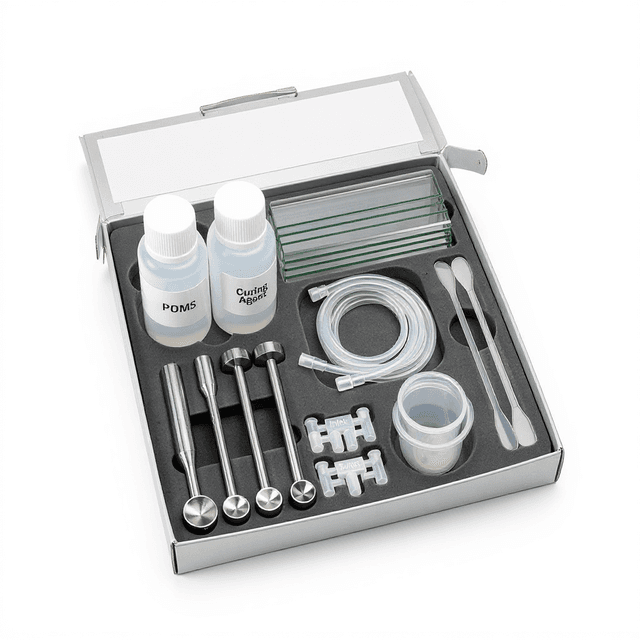
- Concentration Gradient Generator Microfluidic Chip
- User manual (typical)
- Quality control certificate (typical)
Warranty
ConductScience provides a 1-year manufacturer warranty covering defects in materials and workmanship. Technical support is available to assist with setup optimization and troubleshooting of gradient formation protocols.
Compliance
References
Background reading relevant to this product:
What concentration range can be achieved with the gradient network?
The concentration range depends on the input concentration ratio and mixing design. Consult product datasheet for specific dilution factors achievable with the Christmas-tree network configuration.
What flow rates are recommended for optimal gradient formation?
Flow rates should be optimized based on the viscosity of test solutions and desired mixing time. Start with equal flow rates at both inlets and adjust based on gradient visualization using traceable markers.
How many output concentrations does the chip generate?
The number of discrete output concentrations depends on the specific Christmas-tree network design. Consult the channel layout documentation for the exact number of gradient steps produced.
Is the chip reusable or single-use?
Reusability depends on the materials and experimental requirements. Thorough cleaning between uses is essential to prevent cross-contamination, particularly for biological applications.
What microscopy techniques are compatible with this chip thickness?
The 3 mm thickness accommodates standard brightfield, fluorescence, and phase contrast microscopy with appropriate working distance objectives. High-magnification oil immersion may require specialized objectives.
Can the chip handle viscous solutions or only aqueous buffers?
The chip is designed primarily for aqueous solutions. Highly viscous solutions may require pressure-driven flow systems and extended equilibration times to achieve stable gradients.
How do I validate that the gradient is linear or logarithmic?
Use fluorescent dyes or UV-absorbing compounds as tracers to characterize the actual concentration profile. Measure intensities across output channels to verify gradient linearity.
Have a question about this product?
Have a question? Just ask.
Send it over and we'll email you a personalized answer — no call, no scheduling.
Prefer to talk it through?
Upgrade Options