Polypropylene Rat Breeding Cage
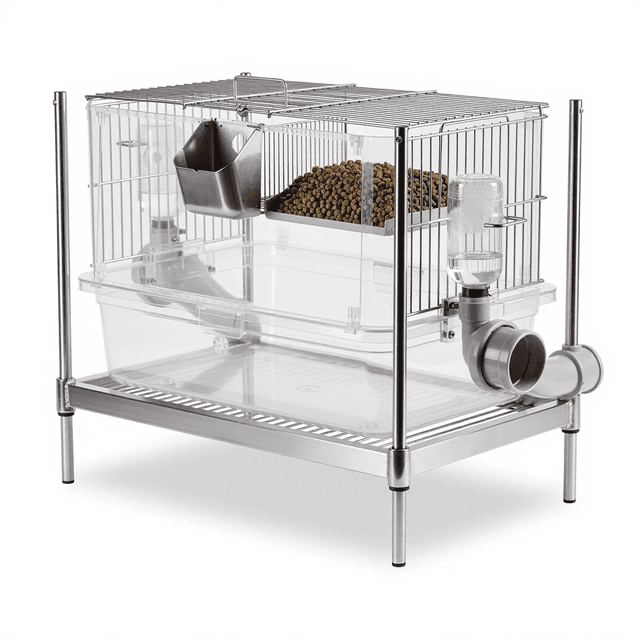
Autoclavable polypropylene breeding cage with dual water bottles for laboratory rat colonies, featuring chemical-resistant construction and stainless steel wire lid.
| Cage Dimensions | 545 x 395 x 200 mm |
| Lid Material | Stainless Steel wire |
| Water Bottles | 2x 500 mL included |
| Autoclavable | Yes |
| Automation Level | manual |
| Brand | ConductScience |

The Polypropylene Rat Breeding Cage provides standardized housing for laboratory rat breeding colonies with 545 x 395 x 200 mm internal dimensions. Constructed from autoclavable polypropylene with stainless steel wire lid, this cage system accommodates breeding pairs or small groups while supporting natural maternal behaviors and nesting activities.
The polypropylene construction offers chemical resistance and thermal stability for repeated autoclave sterilization cycles at standard laboratory temperatures. Dual 500 mL water bottle capacity ensures adequate hydration for breeding pairs and litters. The stainless steel wire lid provides proper ventilation while maintaining secure containment for controlled breeding programs.
How It Works
The breeding cage system provides a controlled microenvironment that supports natural rat reproductive behaviors while maintaining laboratory standards for hygiene and monitoring. The 545 x 395 x 200 mm internal dimensions allow adequate space for nest construction, maternal care behaviors, and pup development during the critical pre-weaning period.
The dual water bottle system ensures continuous hydration access for breeding pairs and growing litters, preventing competition for water resources. The stainless steel wire lid maintains proper air circulation while providing secure containment. The polypropylene construction withstands repeated autoclave cycles at 121°C, enabling thorough sterilization between breeding cycles to prevent pathogen transmission.
The cage dimensions support the establishment of distinct functional areas within the enclosure - nesting zones, feeding areas, and activity spaces - allowing expression of species-typical behaviors essential for successful reproduction and offspring development.
Features & Benefits
Cage Dimensions
- 545 x 395 x 200 mm
Lid Material
- Stainless Steel wire
Water Bottles
- 2x 500 mL included
Autoclavable
- Yes
Automation Level
- manual
Brand
- ConductScience
Material
- Polypropylene (PP)
Species
- Rat
Research Domain
- Aging Research
- Behavioral Pharmacology
- Developmental Biology
- Metabolic Research
- Neuroscience
- Toxicology
Weight
- 1.5 kg
Dimensions
- L: 45.5 mm
- W: 22.4 mm
- H: 57.4 mm
Comparison Guide
| Feature | This Product | Typical Alternative | Advantage |
|---|---|---|---|
| Internal Dimensions | 545 x 395 x 200 mm (43.3L volume) | Standard breeding cages often provide 400-500 x 300-350 x 180-200 mm | Larger floor area supports natural nesting behaviors and territorial establishment for breeding pairs |
| Water Bottle Capacity | Dual 500 mL bottles (1L total) | Many breeding cages include single 500-750 mL bottles | Dual bottle system prevents water shortage during high-consumption lactation periods |
| Construction Material | Autoclavable polypropylene with stainless steel lid | Standard models may use polycarbonate or mixed plastic materials | Polypropylene offers superior chemical resistance and thermal stability for repeated sterilization |
| Lid Design | Stainless steel wire construction | Plastic or coated wire lids are common in entry-level systems | Stainless steel provides better durability and resistance to corrosion from cleaning agents |
This breeding cage provides expanded internal dimensions and dual water access specifically designed for laboratory rat reproduction. The polypropylene construction and stainless steel lid offer enhanced durability and sterilization capability for long-term breeding programs.
Practical Tips
Introduce breeding pairs during the evening hours when rats are naturally more active to reduce stress-related breeding delays.
Why: Timing introduction with natural circadian rhythms promotes faster acceptance and breeding initiation.
Inspect water bottle sipper tubes weekly and replace if showing wear or blockage signs.
Why: Consistent water access is critical during pregnancy and lactation when consumption increases 2-3 fold.
Position nesting material in cage corners to encourage natural den-building behaviors.
Why: Proper nesting site establishment reduces maternal stress and improves pup survival rates.
If breeding success is poor, verify cage placement away from high-traffic areas and loud equipment.
Why: Environmental stressors can disrupt estrous cycles and maternal behaviors in breeding females.
Rotate between two identical cages to allow thorough drying after autoclave sterilization.
Why: Completely dry cages prevent moisture-related problems and maintain optimal hygiene standards.
Use appropriate PPE when handling breeding cages, as pregnant and lactating females may exhibit increased defensive behaviors.
Why: Hormonal changes during reproduction can increase aggression and bite risk during routine husbandry.
Setup Guide
What’s in the Box
- Polypropylene cage bottom (545 x 395 x 200 mm internal)
- Stainless steel wire lid
- Two 500 mL water bottles
- Water bottle mounting hardware
- User manual (typical)
Warranty
ConductScience provides a standard one-year manufacturer warranty covering material defects and construction quality, with technical support for proper cage maintenance and sterilization protocols.
Compliance
What is the recommended bedding depth for optimal breeding outcomes?
Maintain bedding depth of 2-3 cm to support natural nesting behaviors while allowing easy monitoring of breeding activity and pup development.
How frequently should the cage be autoclaved during breeding cycles?
Autoclave between breeding cycles and when transitioning animals, typically every 2-3 weeks during active breeding or as required by facility protocols.
Can this cage accommodate multiple breeding pairs simultaneously?
The cage is designed for single breeding pairs or small groups. Housing multiple breeding pairs requires careful monitoring for territorial behavior and resource competition.
What is the maximum litter size this cage can accommodate until weaning?
The cage dimensions can accommodate typical rat litters of 8-12 pups until weaning age, with dual water bottles supporting increased consumption during lactation.
Is the polypropylene material compatible with standard laboratory disinfectants?
Yes, the polypropylene construction resists common laboratory disinfectants including quaternary ammonium compounds and chlorine-based solutions.
How does the wire lid design affect environmental control?
The stainless steel wire lid provides adequate ventilation while maintaining temperature and humidity control when used in properly regulated vivarium environments.
Have a question about this product?
Accessories
Enhance your setup with compatible accessories
Frequently Bought Together