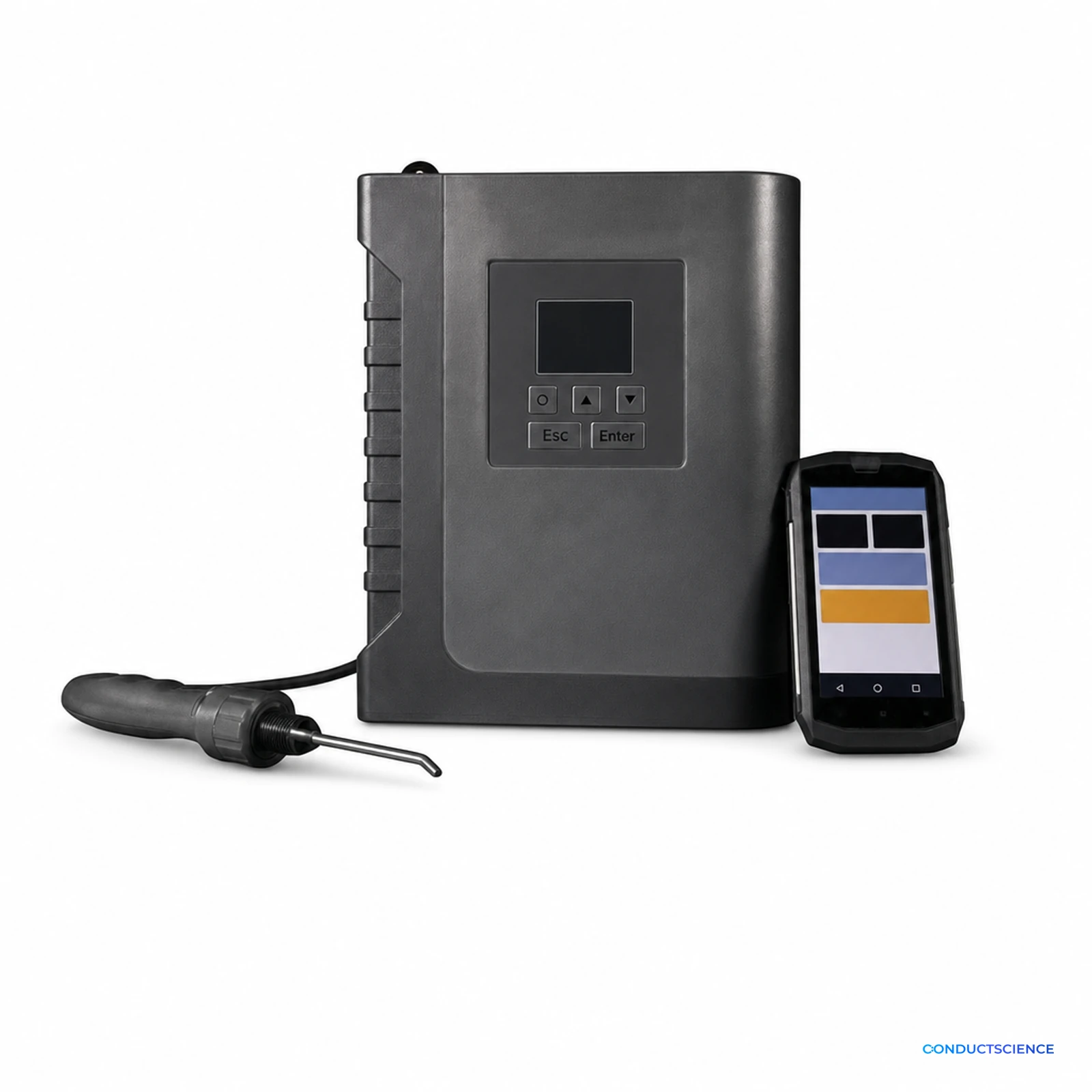
Portable VOC Analyzer with FID and PID Detection
Dual FID/PID portable analyzer for volatile organic compound leak survey and fenceline work.

Louise Corscadden, PhD
Director of Science · ConductScience
Ask Louise about Portable VOC Analyzer with FID and PID Detection fit, setup, configuration, or quote prep.
Already working with us? Sign in to connect this with My Scientist.
Key Specifications
Full details →- Model fit
- Configured during quote
- SKU family
- CS-AIR-00019
- Sizing
- Model-specific dimensions confirmed from the selected configuration
- Ordering
- Quote-reviewed before fulfillment
- Category
- Air Quality
- Build notes
- Confirm accessories, station layout, and support needs before purchase
A portable volatile organic compound analyzer carrying both flame-ionisation and photo-ionisation detection. The two detectors answer different questions, total hydrocarbon burden and photo-ionisable species, from one instrument on one walk.
Key features
- Flameproof and intrinsically safe design.
- Strong On-site Detection Ability with optional FID and PID dual detector and measurement of hundreds of VOCs in 3.5 seconds.
- Suitable for network applications, wireless connection, upload all data to the cloud platform efficiently.
- Safe and fast hydrogen charging/discharging working mode
Applications
Built for leak detection and repair, fenceline and industrial hygiene programmes.
- Widely used for detection of VOCs, which from on-site emergency detection of pollution sources, unorganized on-site emergency detection and leak detection of pipeline emissions in chemical enterprises.
- VOC leakage detection (on-site)
Choosing the right configuration
Specify the target species, measurement range, zero and span equipment, sample conditioning, shelter or rack arrangement, communications, and reporting method as one monitoring system. ConductScience reviews the site and calibration plan before quoting.
Features & Benefits
Detectors
- FID, PID (optional)
Range
- FID: 1.0~50000ppm Methane; PID: 0.5~2000ppm Isobutylene;
Detection Limit
- FID: 0.5ppm Methane; PID: 0.5ppm Isobutylene;
Repeatability
- <2% for FID 500ppm methane; <1% for PID 100ppm isobutene
Dimensions
- 302×245×88mm
Weight
- 3.7kg
Explosion-proof form
- Ex d ia IIC T4Gb
Detector
- FID and PID are optional
Working temperature
- -10~45℃
Detection limit
- FID: 0.5ppm methane; PID: 0.5ppm isobutene
Continuous operating time
- Hydrogen: 15.3MPa (2200psi) for 10 seconds at 25℃, 10+ hours continuous operation when fully charged; Battery: Rechargeable battery,>10h continuous operation when fully charged.
Response time of probe sampling
- The FID is fed with 10,000ppm methane and takes less than 3.5s to reach 90% of the final value; the PID is fed with 500ppm isobutene and takes less than 3.5s to reach 90% of the final value.
Measurement range
- FID 1.0 ~ 50,000ppm methane; PID 0.5 ~ 2,000ppm isobutene
Sampling speed
- At the inlet of the sampling probe, typically 1L/min
What does this instrument measure, and who is it for?
It measures total hydrocarbon burden and photo-ionisable species, from one instrument on one walk. It is built for leak detection and repair, fenceline and industrial hygiene programmes. It is designed for continuous, unattended operation in a monitoring shelter or cabinet, with periodic zero and span calibration.
What measurement principle does it use?
Flame ionisation and photo-ionisation detection in one instrument. The two detectors answer different questions, total hydrocarbon burden, and photo-ionisable species, from the same walk.
Which specifications are confirmed?
The specification table lists fourteen confirmed ordering parameters for this instrument. Use them to compare the operating range, utilities, and analytical performance required by the method. They include Dimensions at 302×245×88mm, Weight at 3.7kg and Explosion-proof form at Ex d ia IIC T4Gb.
What should be confirmed before ordering?
Confirm siting and inlet configuration, zero and span gas supply, the calibration interval your reporting regime requires, and the data acquisition and reporting path. These are configured and quoted per installation, so raise anything unusual about the site during quote review rather than after delivery.
What else is needed to run it?
A zero air generator and a multi-point dilution calibrator. Every concentration this analyser reports is measured against its zero. A zero that is not actually zero is a systematic error in every number downstream of it, so the calibration gear is not an accessory, it is what makes the readings defensible.
How is it supplied?
This instrument is configured and quoted per installation rather than sold at a list price. Request a quote and we will confirm the configuration, the site requirements and the lead time before anything is ordered.
Have a question about this product?
Have a question? Just ask.
Send it over and we'll email you a personalized answer — no call, no scheduling.
Prefer to talk it through?